
Two-dimensional (2D) shapes and concepts
Overview of two-dimensional geometry: definitions, properties, history, common examples and practical uses in mathematics, computing, graphics and everyday representation.
Overview
A two-dimensional or 2D object is a figure that lies in a plane and has only two independent measures. In everyday terms a 2D shape has width and length but lacks depth or thickness. Common classroom examples include squares, circles, triangles and other polygons. The idea of two dimensions is a fundamental building block in geometry and in any context where flat representations are used.
Image gallery
1 Image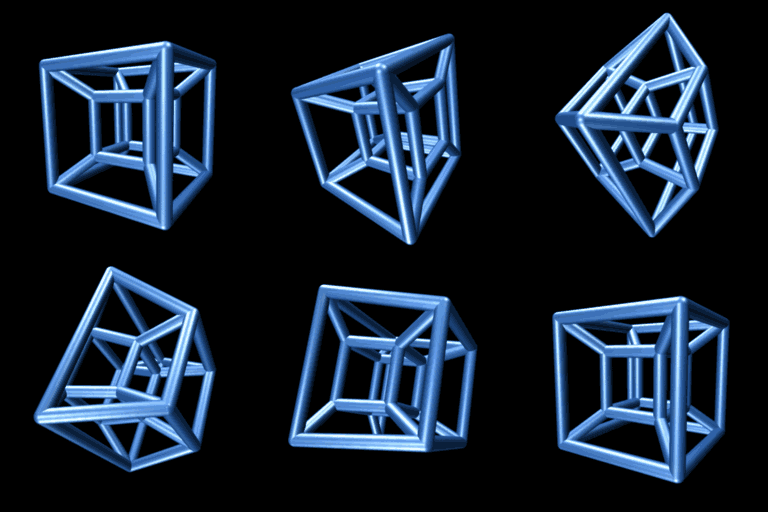
Characteristics and measures
Two-dimensional figures are described by features such as side lengths, angles, perimeter and area. Basic properties are expressed with simple formulas: for instance, the area of a rectangle is the product of its two sides, while the area of a triangle is one half the product of base and height. Points on a plane are located with two coordinates; see measurements and the concepts of width and length. The term two-dimensional emphasizes absence of depth, so a cube is not 2D (cube).
Historical and mathematical context
The study of plane figures dates back to ancient geometry. Euclidean plane geometry formalized many properties of flat figures, while the later development of coordinate methods allowed analytic descriptions using two variables. Two-dimensional concepts remain central in branches of mathematics, from elementary school exercises to advanced planar analysis.
Applications and examples
2D representations are everywhere: printed media, maps, diagrams and user interfaces rely on flat depictions. In technology, video games often use 2D sprites, and many problems in computer science—such as image processing and computational geometry—work primarily in two dimensions. Designers and engineers use 2D drawings for plans and schematics.
Notable distinctions and uses
- Dimensional comparison: 1D (lines), 2D (planes), 3D (solids).
- Topological vs. metric properties: some flat shapes can be deformed without changing connectivity.
- Branching relevance: plane geometry connects to many other categories such as trigonometry, graph theory and computational models.
Understanding two-dimensional figures provides an accessible entry point into spatial reasoning and practical tasks that depend on flat, measurable representations.
Related articles
Author
AlegsaOnline.com Two-dimensional (2D) shapes and concepts Leandro Alegsa
URL: https://en.alegsaonline.com/art/112775