
Zanskar Range
Mountain range in the western Himalaya separating Ladakh from Kashmir and containing high peaks, strategic passes, glaciated valleys and rivers that feed the Indus system.
Overview
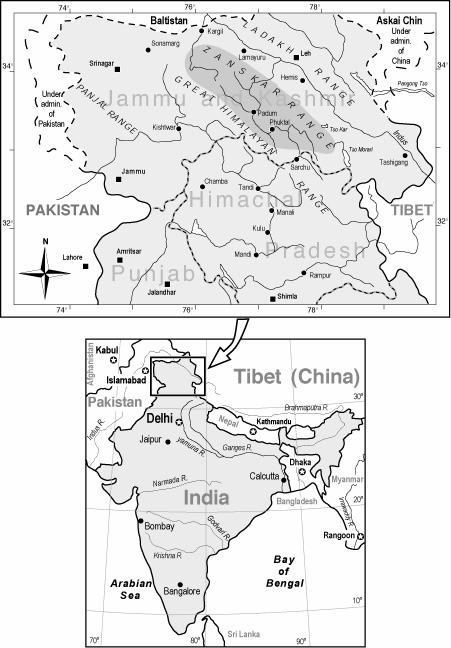
The Zanskar Range is a high, rugged chain of mountains in the western Himalaya that forms a natural barrier between the high plateau of Ladakh and the lower valleys to the south and west. It stretches from the southeastern limits of the region commonly called Kashmir toward the northeastern edge of Baltistan, and is usually treated as a branch of the greater Himalayan system. The range contains snow-capped peaks, glaciers, narrow valleys and important mountain passes that have shaped human movement and ecology in the area.
Image gallery
7 Images


Geography and major features
The Zanskar Range forms a watershed between the high-altitude deserts and plateaus of Ladakh and the greener valleys drained by tributaries of the Chenab River and other south-flowing systems. Administratively it separates the cold desert of Ladakh from the rest of the former state areas such as the Jammu region and the Vale of Kashmir. The mountains rise in complex ridges rather than a single continuous crest, producing many isolated basins and sharp, glaciated peaks.
Peaks, passes and routes
The range includes prominent summits such as the Nun–Kun massif (often cited as one of the highest groups in the region, with elevations around seven thousand metres) and many lesser peaks that dominate adjacent valleys. A number of historic and seasonal passes cross the Zanskar Range and have been used for trade, pilgrimage and military movement. Notable crossings include the Zojila area at the northwestern end (a high, often snowbound pass of more than three thousand five hundred metres), Marbal Pass and a network of smaller mule tracks and winter routes that connect mountain villages.
Hydrology and rivers
Numerous streams and rivers originate in the glaciated flanks of the Zanskar Range and generally flow north or west to join the great Indus River system. Among the better-known rivers born in or fed by Zanskar glaciers are the Zanskar River, the Suru River and the Shingo River, together with smaller torrents such as the Hanle and Khurna. These waterways carve deep gorges, sustain valley agriculture where irrigation is possible, and have long influenced settlement patterns.
Role in neighbouring regions
In the west and southwest the Zanskar Range also serves as a dividing spine within the western Himalayan province: it marks a climatic and cultural boundary with adjacent plateaus and valleys. For example, in the Indian state of Himachal Pradesh the Zanskar-related high ridges separate districts and help delineate the arid highlands from alpine zones, and the range is often cited in accounts that contrast Spiti with neighbouring regions such as Kinnaur.
Human use, ecology and significance
The valleys and passes of the Zanskar Range support small agricultural communities, pastoralism and seasonal trade routes. The region is known for striking high-altitude landscapes, unique mountain cultures and distinctive ecological zones ranging from steppe-like slopes to alpine meadows and permanent snowfields. In winter some river valleys freeze; one famous winter route on the frozen surface of the Zanskar River has become known in recent decades as a demanding trekking route. The combination of strategic location, difficult terrain and water resources has also given the range contemporary importance for transport planning, conservation and local livelihoods.
Notable distinctions
- Boundary function: acts as a natural divide between Ladakh and the Kashmir/Chenab valleys.
- Water source: feeds multiple tributaries of the Indus River, including the Zanskar River and Suru River.
- High passes: contains several snowbound passes such as the Zojila region and Marbal that have historically linked communities.
- Regional links: touches or influences areas described as Kashmir, Ladakh, Baltistan, and parts of Himachal Pradesh including Spiti.
Related articles
Author
AlegsaOnline.com Zanskar Range Leandro Alegsa
URL: https://en.alegsaonline.com/art/110380