
Yellow hypergiant
Very luminous, massive evolved stars with spectral types A–K; extremely rare, highly unstable, and prone to heavy mass loss as they cross late stages of stellar evolution.
Overview
A yellow hypergiant is an extremely luminous, evolved star with a spectral type roughly between A and K. These objects occupy a short-lived and unstable phase of the most massive stars' lives: they are far brighter than typical supergiants, have enormous radii and low surface gravity, and show signatures of strong atmospheric instability and mass loss. For a general definition of the stellar class see hypergiant and for context on stars in this mass regime see star.
Image gallery
3 Images

Physical characteristics
Yellow hypergiants begin life as very massive stars. Typical initial masses cited for stars that pass through a yellow hypergiant phase are on the order of tens of solar masses; many references give ranges such as about 20–60 solar masses at birth. In the yellow hypergiant stage the outer layers are cool enough to give A-to-K spectral types, while the bolometric luminosity remains among the highest for single stars (visual absolute magnitudes near or brighter than −8 to −9 are common descriptors). These stars have extended, often partially ionized atmospheres, slow expanding winds, and low surface gravity that permit large-scale pulsations and episodic ejections.
Evolutionary context
Yellow hypergiants represent a transitional evolutionary phase. They have evolved off the main sequence and possess cores that have largely exhausted central hydrogen; some show evidence of helium burning or more advanced burning stages. Depending on initial mass and prior mass loss they can appear while evolving from blue to red supergiant regions or during a blueward return after a red supergiant phase. Their short lifetimes in this state make them valuable tracers of late-stage stellar evolution and of pathways leading to more exotic phases such as luminous blue variables or direct supernova progenitors (post–main-sequence evolution).
Instability and mass loss
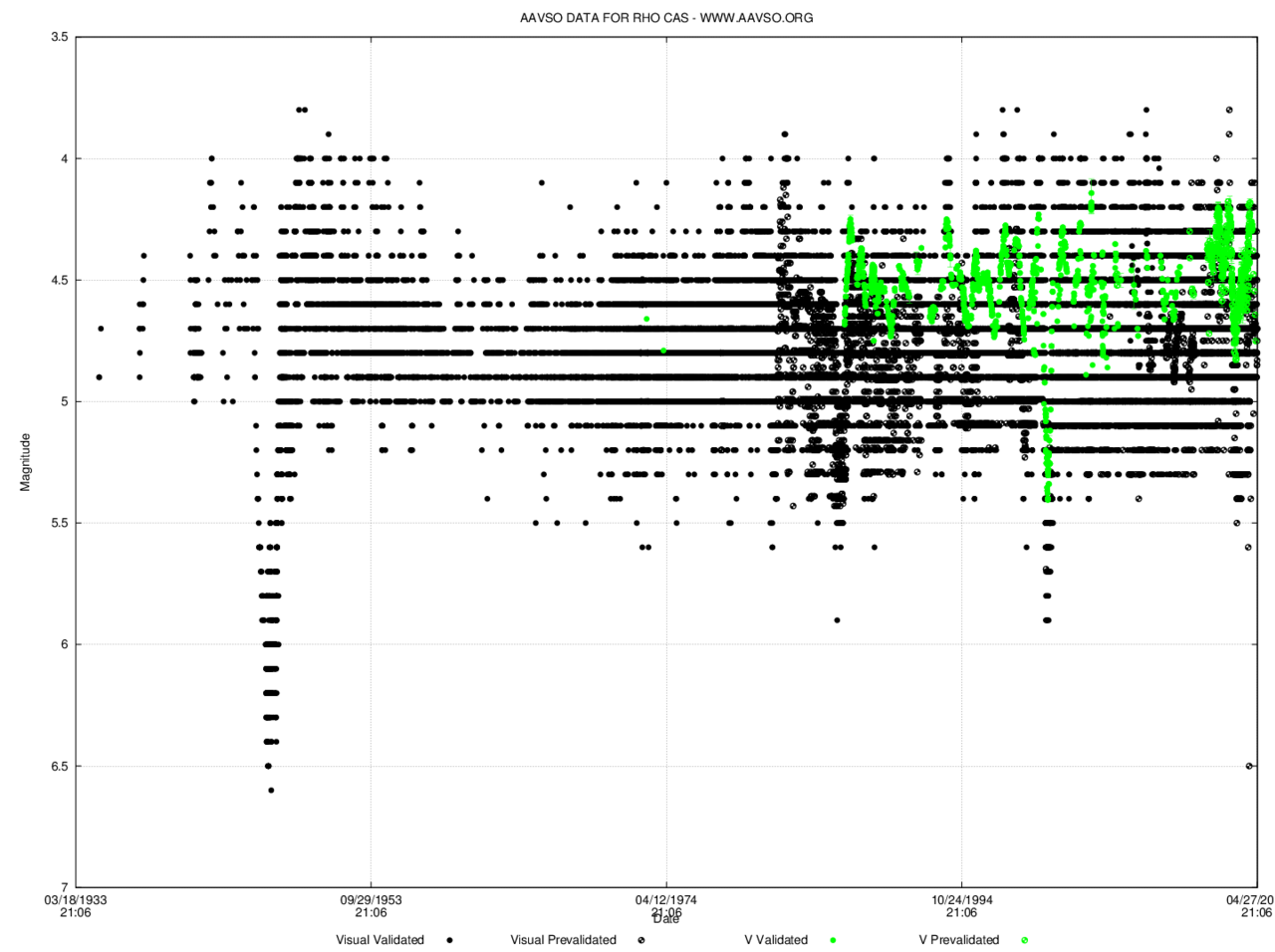
Instability is a defining feature: yellow hypergiants are subject to large radial pulsations, atmospheric shocks and repeated episodes of enhanced mass loss that create dusty or gaseous circumstellar shells. Observationally they may show variable spectra, irregular photometric changes, and emission features from expanding envelopes. Because of their cooler temperatures relative to O and B hypergiants, they are sometimes called "cool hypergiants," whereas compared with red supergiants they may be termed "warm hypergiants"—different labels that emphasize their position among evolved massive stars (temperature comparisons).
Rarity and notable examples
Yellow hypergiants are very rare in the Galaxy. Surveys and catalogues note only a small handful of well-studied objects in the Milky Way; some published counts mention on the order of a dozen to a few dozen confirmed or candidate members (Galactic counts). A striking concentration has been reported in particular massive clusters where several luminous evolved stars coexist, with one cluster hosting multiple yellow hypergiant candidates (cluster example). Well-known individual examples serve as laboratories for mass-loss physics and atmospheric dynamics.
Why astronomers study them
Researchers study yellow hypergiants to learn how the most massive stars shed mass, how instabilities affect late-stage evolution, and which kinds of massive stars explode as particular types of supernovae. Observations across the spectrum, long-term photometric monitoring and high-resolution spectroscopy are used to track their changing atmospheres and circumstellar material, improving models of stellar structure and the chemical enrichment of galaxies (observational programs, stellar evolution theory).
Related articles
Author
AlegsaOnline.com Yellow hypergiant Leandro Alegsa
URL: https://en.alegsaonline.com/art/109762