
10 Hygiea — Large C‑type asteroid in the outer main belt
10 Hygiea is the fourth largest asteroid, a dark carbonaceous body in the outer main belt. It is large but faint, with an irregular to near‑spherical shape and a mass of roughly a few percent of the belt.
Overview
10 Hygiea is one of the largest members of the main asteroid belt and is generally ranked as the fourth largest asteroid after Ceres, Vesta and Pallas. Discovered in the mid‑19th century, it is the biggest representative of the dark, carbon‑rich C‑type class of asteroids and occupies a place in the outer portion of the belt where these primitive bodies are common. For context on its location see the main belt.
Image gallery
10 Images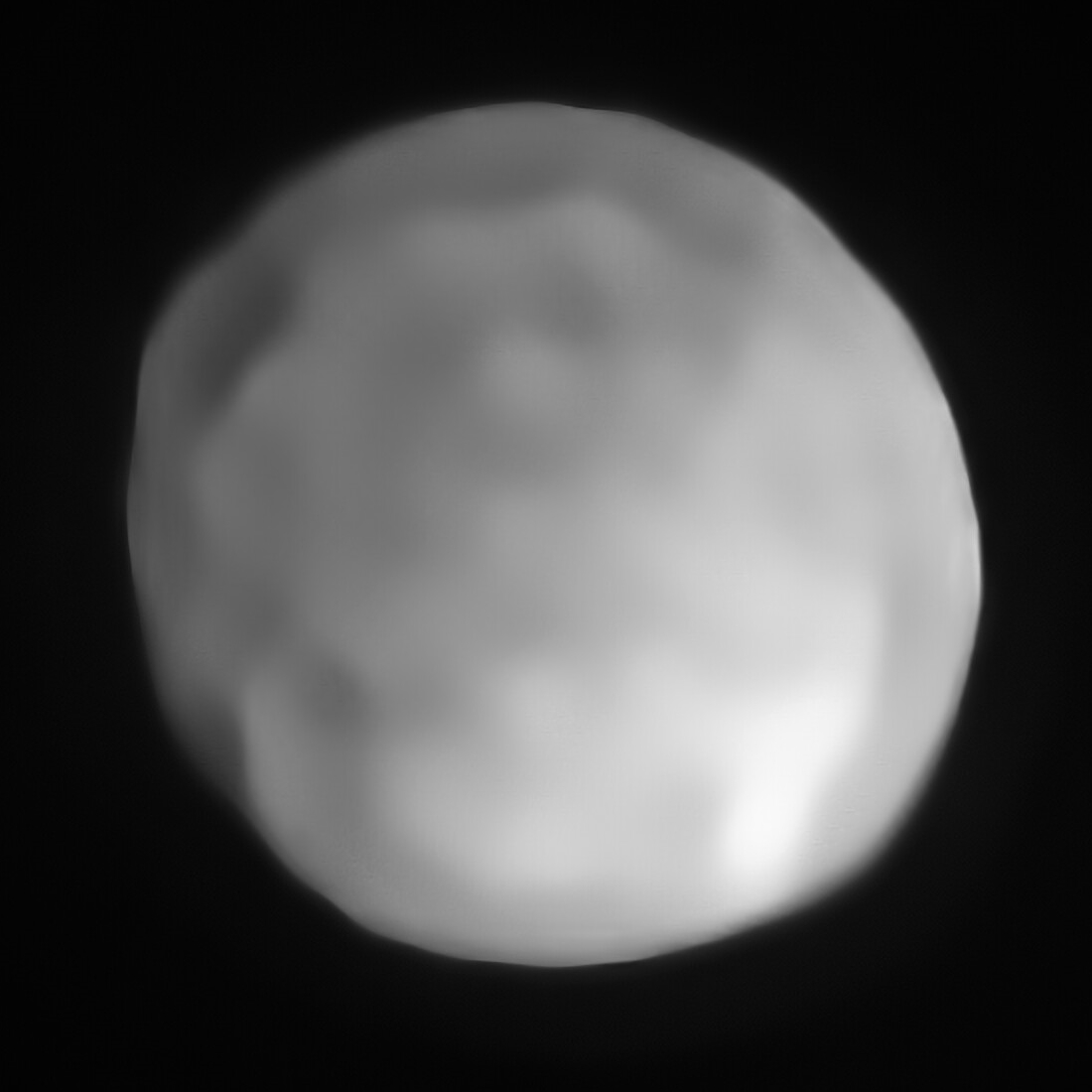
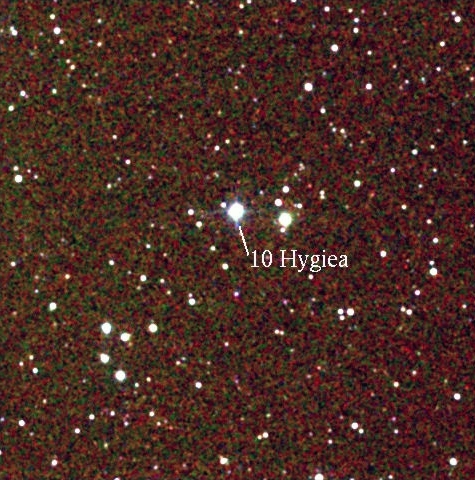




Physical characteristics
Hygiea is a dark, carbonaceous object whose surface reflects only a small fraction of incident sunlight, so it appears fainter than many smaller but brighter asteroids. Estimates of its maximum dimensions fall in the range of a few hundred kilometres across; published diameter ranges often indicate roughly 350–500 km. In mass, Hygiea contributes a non‑negligible share of the belt’s total—commonly quoted estimates put it at on the order of a few percent of the belt’s mass. Its overall shape has long been described as somewhat non‑spherical, though some modern high‑resolution observations suggest it is closer to spherical than previously thought. For more on its shape and imaging studies see shape observations and diameter estimates.
Orbit and location
Hygiea orbits the Sun in the outer main belt, beyond a major orbital gap known as the Kirkwood gap near 2.82 astronomical units. That region of the belt is dominated by dark C‑type asteroids and Hygiea is the largest known object in that zone. Its orbital position and physical type are discussed in studies of the outer belt’s composition and dynamics; see the description of the main belt and the Kirkwood gap for context.
Observation and brightness
Because Hygiea has a low albedo and orbits relatively far from the Sun, it is much dimmer in the sky than its size might suggest. At most oppositions it typically reaches visual magnitudes near +10.2, and during favourable perihelic oppositions it can approach about +9.1. These magnitudes mean Hygiea is generally beyond naked‑eye visibility and requires binoculars or a small telescope: observers commonly note it needs at least a 4‑inch telescope under ordinary circumstances and may become just detectable in 10×50 binoculars at the very best apparitions. For practical observing advice see references on telescopic observation of asteroids telescope guidance and binocular limits. By comparison, brighter asteroids such as Vesta can be several magnitudes more conspicuous.
History, naming and notable facts
Hygiea was discovered in the nineteenth century and named after Hygieia (or Hygiea), the Greek goddess associated with health and cleanliness. It is notable among the first few dozen asteroids discovered for how faint it appears: among the first twenty‑three asteroids discovered, Hygiea is one of the dimmest at opposition. In addition to its role as the largest dark C‑type, it has attracted interest because of high‑resolution imaging and shape studies that probe whether such large, primitive bodies reach near‑hydrostatic shapes. Any formal change in classification would follow international criteria and further study; for more about its classification and composition see C‑type asteroid resources.
Quick reference
- Rank: generally considered the fourth largest asteroid in the main belt.
- Type: dark, carbonaceous C‑type (C‑type).
- Diameter: commonly quoted in the range ~350–500 km (size estimates).
- Mass contribution: roughly a few percent of the total asteroid belt mass.
- Visibility: around +10.2 magnitude at typical opposition; up to ~+9.1 at favorable opposition (telescopes, binoculars).
- Region: largest object in the outer main belt beyond the Kirkwood gap (main belt context).
- Comparative notes: fainter than many smaller but higher‑albedo asteroids and dimmer than the nearby large dark asteroids such as 704 Interamnia and 511 Davida in terms of everyday visibility considerations.
For further reading and observation details consult specialist asteroid catalogues and observing guides linked above and in professional literature.
Questions and answers
Q: What is the size of 10 Hygiea?
A: 10 Hygiea has diameters of 350 – 500 km.
Q: What is the estimated mass of 10 Hygiea?
A: The estimated mass of 10 Hygiea is 3% of the total mass of the asteroid belt.
Q: What type of asteroid is 10 Hygiea?
A: 10 Hygiea is a dark C-type asteroid with a carbonaceous surface.
Q: What is the dominant type of asteroid in the region where 10 Hygiea is located?
A: The dominant type of asteroid in the region where 10 Hygiea is located is dark C-type asteroids with a carbonaceous surface.
Q: Why is 10 Hygiea is very dim when seen from Earth?
A: 10 Hygiea is very dim when seen from Earth due to its dark surface and bigger than average distance from the Sun.
Q: What is the opposition magnitude of 10 Hygiea at most oppositions?
A: At most oppositions, 10 Hygiea has a magnitude of around +10.2, which is as much as four orders fainter than Vesta.
Q: What is the smallest telescope needed to resolve 10 Hygiea at most oppositions?
A: At least a 4-inch telescope is needed to resolve 10 Hygiea at most oppositions.
Related articles
Author
AlegsaOnline.com 10 Hygiea — Large C‑type asteroid in the outer main belt Leandro Alegsa
URL: https://en.alegsaonline.com/art/111013
Sources
- psi.edu : "Supplemental IRAS Minor Planet Survey"
- rni.helsinki.fi : Models of Twenty Asteroids from Photometric Data
- adsabs.harvard.edu : The Mass of Asteroid 10 Hygiea
- edpsciences.org : Determination of asteroid masses
- ipa.nw.ru : Masses and densities of minor planets · webcitation.org · web.archive.org
- jas.org.jo : The Brightest Asteroids
- books.google.com : The solar system: a descriptive treatise upon the sun, moon, and planets, including an account of all the recent discoveries