
Ymir — a small irregular moon of Saturn
Ymir (Saturn XIX) is a small, retrograde irregular satellite discovered in 2000. Named for a figure in Norse myth, it orbits Saturn at ~23.2 million km with a high inclination and eccentricity.
Overview
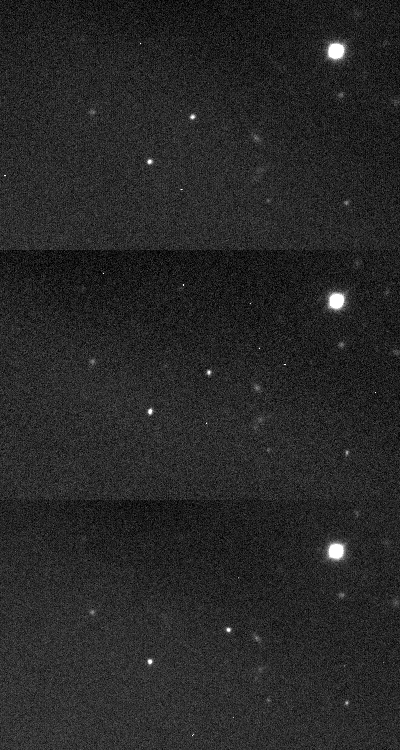
Ymir, formally designated Saturn XIX and originally catalogued as S/2000 S 1, is one of Saturn's irregular moons. Discovered in 2000 by an observing team led by Brett J. Gladman, it is a small, distant satellite that follows a retrograde orbit around the planet. The moon takes roughly 1,317 days to complete one orbit and is grouped with other distant, inclined satellites commonly referred to as the Norse group.
Image gallery
5 Images


Physical characteristics
Ymir is a minor body with an estimated diameter on the order of tens of kilometres (commonly quoted around 16 km). Like many irregular satellites of this size, it is too small and faint for detailed surface mapping with ground-based telescopes. Its surface composition and albedo are not well constrained from Earth; typical expectations for such objects include a dark, primitive surface rich in rock and possibly ices, but precise spectral data remain limited.
Orbit and classification
Ymir's orbit is notable for its distance, tilt and eccentricity. Key orbital parameters include:
- Average distance from Saturn: about 23,175,000 km
- Orbital period: approximately 1,317.137 days
- Inclination: about 172° to the ecliptic (about 146° relative to Saturn's equator)
- Eccentricity: roughly 0.358
These values identify Ymir as a retrograde irregular satellite: its orbit is both highly inclined and eccentric, and it revolves in the direction opposite to Saturn's rotation. Such orbits contrast with the nearly circular, low-inclination orbits of the regular moons closer to the planet.
Discovery and name
The moon was discovered in 2000 by a team including Brett J. Gladman and colleagues and was provisionally designated S/2000 S 1. In August 2003 it received the name Ymir, taken from Norse mythology. In the mythic tradition Ymir is an archetypal ancestor of the frost giants; the choice of name follows the convention of naming Saturn's retrograde, distant moons after figures from Norse legends. Further cultural context for the name can be found in sources on the figure Ymir.
Origin and scientific importance
Like other irregular satellites, Ymir is believed to be a captured object rather than one formed in situ with Saturn. Capture scenarios commonly invoked by researchers include gravitational interactions during the early Solar System or collisions and fragmentation of a larger progenitor, producing small bodies with similar orbital characteristics. Studying moons such as Ymir provides clues about the population of small outer-system bodies and the history of dynamical interactions around the giant planets. For technical summaries of its orbital elements and dynamical behaviour see listings of Saturnian satellites and orbital databases (orbital data, eccentricity details).
Observations and future study
Because Ymir is small and faint, most information comes from astrometric tracking and occasional photometry with large telescopes. No dedicated spacecraft mission has visited Ymir specifically; observations rely on Earth-based facilities and surveys that discover and monitor irregular satellites. Continued monitoring refines its orbit and can reveal signs of collisional families or changes in brightness that hint at surface properties. Such work contributes to a broader understanding of how the outer satellites of Saturn were acquired and evolved.
Related articles
Author
AlegsaOnline.com Ymir — a small irregular moon of Saturn Leandro Alegsa
URL: https://en.alegsaonline.com/art/109870
Sources
- cbat.eps.harvard.edu : "IAUC 7512"
- ssd.jpl.nasa.gov : "Planetary Satellite Mean Orbital Parameters"
- dtm.ciw.edu : "Saturn's Known Satellites"
- cbat.eps.harvard.edu : "IAUC 8177: Sats OF (22); Sats OF JUPITER, SATURN, URANUS"
- cfa-www.harvard.edu : IAUC 7512: S/2000 S 1 and S/2000 S 2
- cfa-www.harvard.edu : MPEC 2000-Y15: S/2000 S 1, S/2000 S 2, S/2000 S 7, S/2000 S 8, S/2000 S 9
- cfa-www.harvard.edu : IAUC 8177: Satellites of Jupiter, Saturn, Uranus