
Whirligig beetle (Gyrinidae): surface-swimming water beetles
Whirligig beetles (family Gyrinidae) are small, surface-dwelling aquatic beetles notable for divided eyes, rapid circular schooling behaviour, an air reserve under the elytra, and about 700 species worldwide.
Overview
Whirligig beetles belong to the family Gyrinidae in the order Coleoptera. They are a distinctive group of small aquatic insects most often seen on the surface of ponds, lakes and slow-moving streams. Commonly forming loose schools, these beetles are readily recognised by their rapid, often circular swimming when disturbed — the behaviour that gives them the common name "whirligig." Most species live in fresh water and exploit the air–water interface rather than a permanently submerged lifestyle. They are part of the broader assemblage of water beetles encountered by naturalists and anglers.
Image gallery
9 Images



Appearance and anatomy
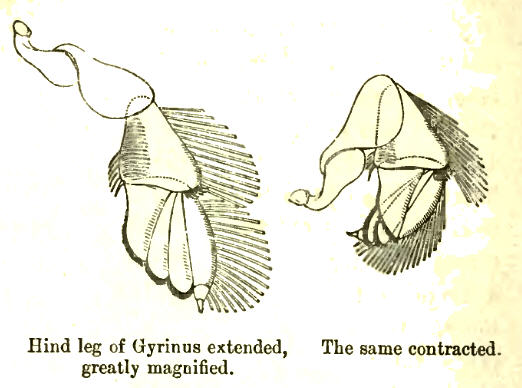
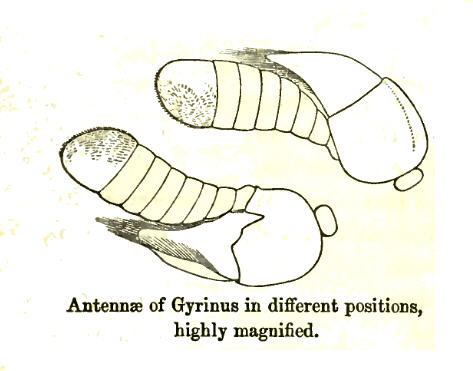
Adult whirligig beetles are compact, rounded and usually somewhat flattened in profile. Sizes range from only a few millimetres up to around 18 mm in most species. The body approximates an ellipsoid, helping to reduce drag as the beetle swims on or under the surface. Limbs and antennae fold into grooves to present a smooth outline. A conspicuous and diagnostic feature is the divided compound eye: each eye is functionally split into an upper and a lower portion, an adaptation that allows individuals to monitor both the air above and the water below simultaneously.
Behaviour and ecology
Whirligig beetles typically patrol the water surface either singly or in groups. When alarmed they accelerate into rapid, tight circuits. They are capable of diving and can remain submerged for extended periods by trapping an air film beneath their hardened wing covers (the elytra), which acts as an external gill and oxygen store. Both adults and larvae are active predators, capturing small invertebrates from the surface film or just beneath it. As mid-level consumers they both help control populations of other small aquatic animals and serve as prey for fish and waterbirds.
Life cycle
Like other beetles, whirligigs undergo complete metamorphosis with egg, larva, pupa and adult stages. Eggs are laid in or beside water, and the aquatic larvae have elongated, predatory forms adapted for hunting among submerged vegetation and detritus. Pupation for many surface-dwelling aquatic beetles takes place out of water in moist substrate near the shoreline; similar patterns are reported or expected in several whirligig species, though details vary across taxa and habitats.
Diversity, distribution and fossil record
The family includes roughly 700 living species placed in about 15 genera, and it has a fossil record represented by several described specimens from different geologic deposits. Whirligigs are distributed worldwide in suitable freshwater habitats, from temperate ponds to tropical streams, and many species occupy well-defined ecological niches within that range.
Taxonomy and identification
Gyrinidae is a clearly defined family within Coleoptera. Identification in the field relies on behaviour (surface schooling and circling), body shape and the divided eyes; species-level determination typically requires examination of body proportions, elytral patterns and genital characters by a specialist. For general reference and additional identification guidance consult a regional field guide or an authoritative online resource, for example a general reference on aquatic insects.
Scientific interest and applications
Whirligig beetles are of interest to researchers studying sensory biology (because of their divided eyes), collective movement and the physics of moving at the air–water interface. Their streamlined form and behaviour have also informed simple studies in fluid dynamics and robotics that seek inspiration from biological swimmers operating at a boundary between media.
Conservation and human interactions
Because many whirligig species depend on clean, well-oxygenated water and accessible shoreline habitat, their presence or absence can informally reflect local aquatic health. They are not generally targeted by people, but habitat loss, pollution and changes to the shore environment may reduce local populations. Observers are encouraged to record sightings and habitat notes to support monitoring and conservation efforts.
Field tips
- When to look: calm, sunny conditions on ponds and slow streams are favourable for observing surface groups.
- How to recognise: small, rounded beetles that swim rapidly in groups and show a split upper/lower eye when examined closely.
- Handling: avoid removing individuals from the water for long periods; use a net and photographic records for study.
Overall, whirligig beetles (Gyrinidae) are a readily observed and ecologically important family of surface specialists whose adaptations illustrate how insects exploit the unique physical and sensory challenges of life at the boundary between air and water.
Questions and answers
Q: What are whirligig beetles?
A: Whirligig beetles are a family (Gyrinidae) of water beetles that swim on the surface of fresh water.
Q: Where do whirligig beetles usually swim?
A: Whirligig beetles usually swim on the surface of the water if undisturbed.
Q: What do whirligig beetles do when they are threatened?
A: When threatened, whirligig beetles go underwater.
Q: How do whirligig beetles see?
A: Whirligig beetles have divided eyes which may allow them to see above and below water at the same time.
Q: How many species of whirligig beetles are there worldwide?
A: There are some 700 living species of whirligig beetles worldwide.
Q: What is the approximate size range of whirligig beetles?
A: Whirligig beetles vary in size from 3 mm to 18 mm in length.
Q: What do both larvae and adults of whirligig beetles eat?
A: Both larvae and adults of whirligig beetles are active predators.
Related articles
Author
AlegsaOnline.com Whirligig beetle (Gyrinidae): surface-swimming water beetles Leandro Alegsa
URL: https://en.alegsaonline.com/art/107767