
Vulpecula — the Little Fox (northern constellation)
Vulpecula is a faint northern constellation, best known for the Dumbbell Nebula (M27) and the Coathanger asterism. It lies within the Summer Triangle and has no stars brighter than fourth magnitude.
Overview
Vulpecula is a small, faint constellation in the northern celestial hemisphere whose name means "little fox" in Latin. It does not contain any very bright stars and is more often noticed by observers for its interesting deep-sky targets than for bold stellar patterns. Because it sits amid richer constellations, Vulpecula is easy to overlook under light-polluted skies.
Image gallery
7 Images
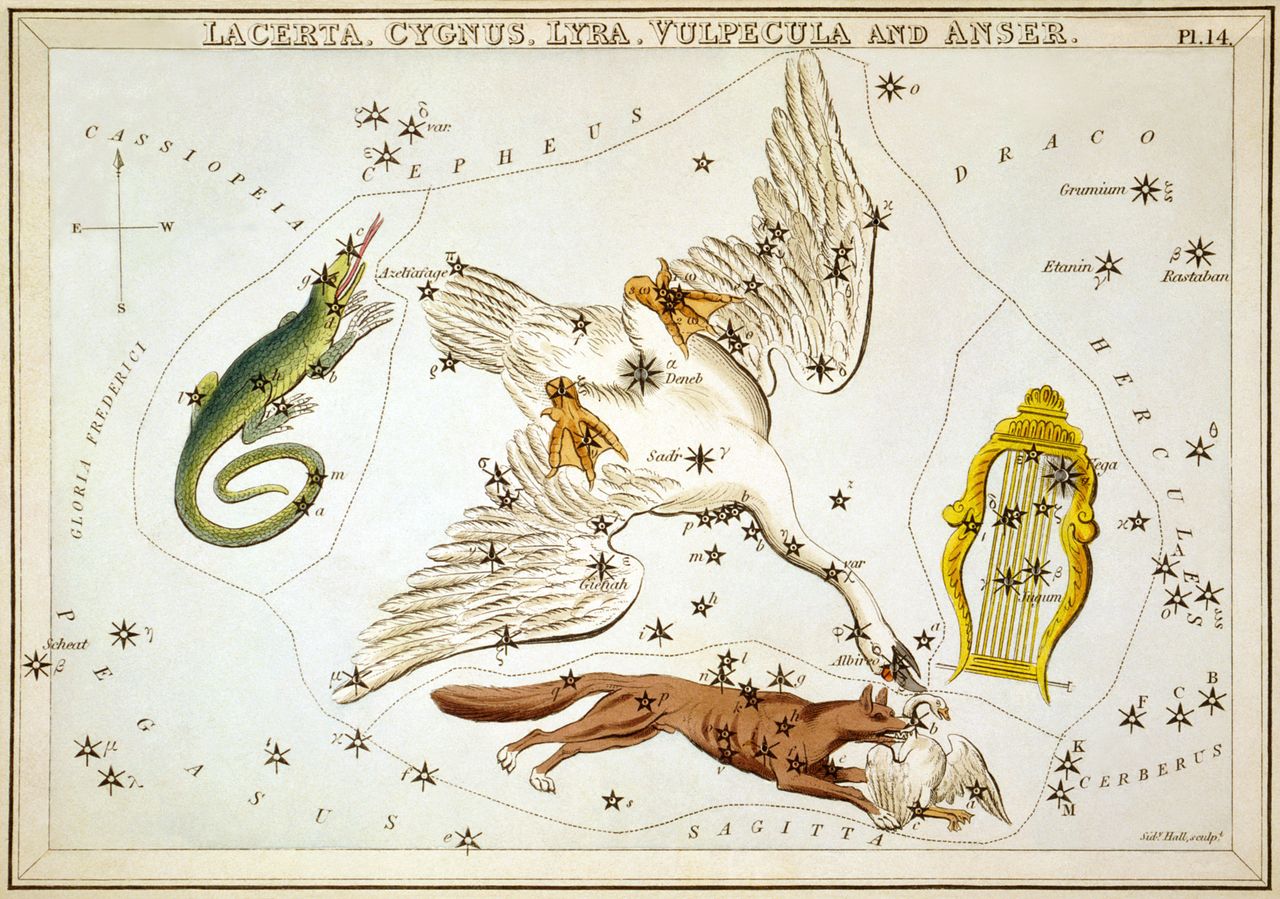





Location and visibility
Situated roughly at the center of the well-known Summer Triangle, Vulpecula lies between the bright stars Vega (in Lyra), Deneb (in Cygnus) and Altair (in Aquila). Its compact area makes it convenient to find once the triangle is identified. The constellation is best viewed from mid-northern latitudes during the late summer months when the Summer Triangle stands high at night.
Stars and asterisms
Vulpecula lacks prominent beacon stars: none of its members shine brighter than fourth magnitude, so the pattern is subtle to the unaided eye. It contains a modest group of stars used in small-field star charts and several cataloged stars visible with binoculars or a small telescope.
Notable deep-sky objects
- M27 (Dumbbell Nebula) — A bright planetary nebula often seen in small telescopes; it was one of the first such objects discovered and remains a favorite for amateur observers.
- Brocchi's Cluster (the Coathanger) — An easily recognized asterism that resembles an upside-down coathanger and is a popular target for binoculars.
History and naming
The constellation was introduced in the 17th century and originally called Vulpecula cum Anser, the "little fox with the goose." Over time the goose figure (often referred to as Anser) fell out of common depiction and the constellation became known simply as Vulpecula, the fox. Its modern boundaries were standardized in the 20th century, making it one of the recognized constellations used in astronomy today.
Observing tips and significance
- Use the Summer Triangle as a guide: once Vega, Deneb and Altair are located, sweep the interior area to find Vulpecula's faint stars and its deep-sky objects.
- Binoculars will reveal Brocchi's Cluster easily; a small telescope or long-exposure photography brings out the Dumbbell Nebula's shape and color.
- Because it contains few bright stars, Vulpecula is best appreciated from dark sites where contrast for nebulae and asterisms is higher.
Questions and answers
Q: What is Vulpecula?
A: Vulpecula is a northern constellation.
Q: What is the shape people say Vulpecula looks like?
A: People say Vulpecula looks like a fox.
Q: Is Vulpecula a bright constellation?
A: No, Vulpecula is not very bright.
Q: What is the highest magnitude of stars in Vulpecula?
A: None of the stars in Vulpecula are brighter than the 4th magnitude.
Q: What other stars are near Vulpecula?
A: Vulpecula is in the middle of the Summer Triangle, three stars that make the shape of a triangle in the sky.
Q: Is Vulpecula visible all year long?
A: Vulpecula is visible in the northern hemisphere during the summer months.
Q: What is the significance of the Summer Triangle in relation to Vulpecula?
A: Vulpecula is in the middle of the Summer Triangle, which is a group of three stars that make the shape of a triangle in the sky.
Related articles
Author
AlegsaOnline.com Vulpecula — the Little Fox (northern constellation) Leandro Alegsa
URL: https://en.alegsaonline.com/art/106027