
Voyager program: NASA's long-range interstellar probe missions
Two robotic probes launched in 1977 that explored the outer planets and are now traveling through interstellar space, carrying scientific instruments and the Golden Record.
Overview
The Voyager program is a pair of robotic probes developed and operated by the NASA Jet Propulsion Laboratory for the United States. Designed in the 1970s, the twin spacecraft — Voyager 1 and Voyager 2 — were launched in 1977 to exploit a rare alignment of the outer planets that enabled gravity-assist trajectories. Their original mission emphasized close study of the outer planetary system, and both craft continued well beyond those goals to make pioneering measurements of the outer heliosphere and interstellar space.
Image gallery
10 Images


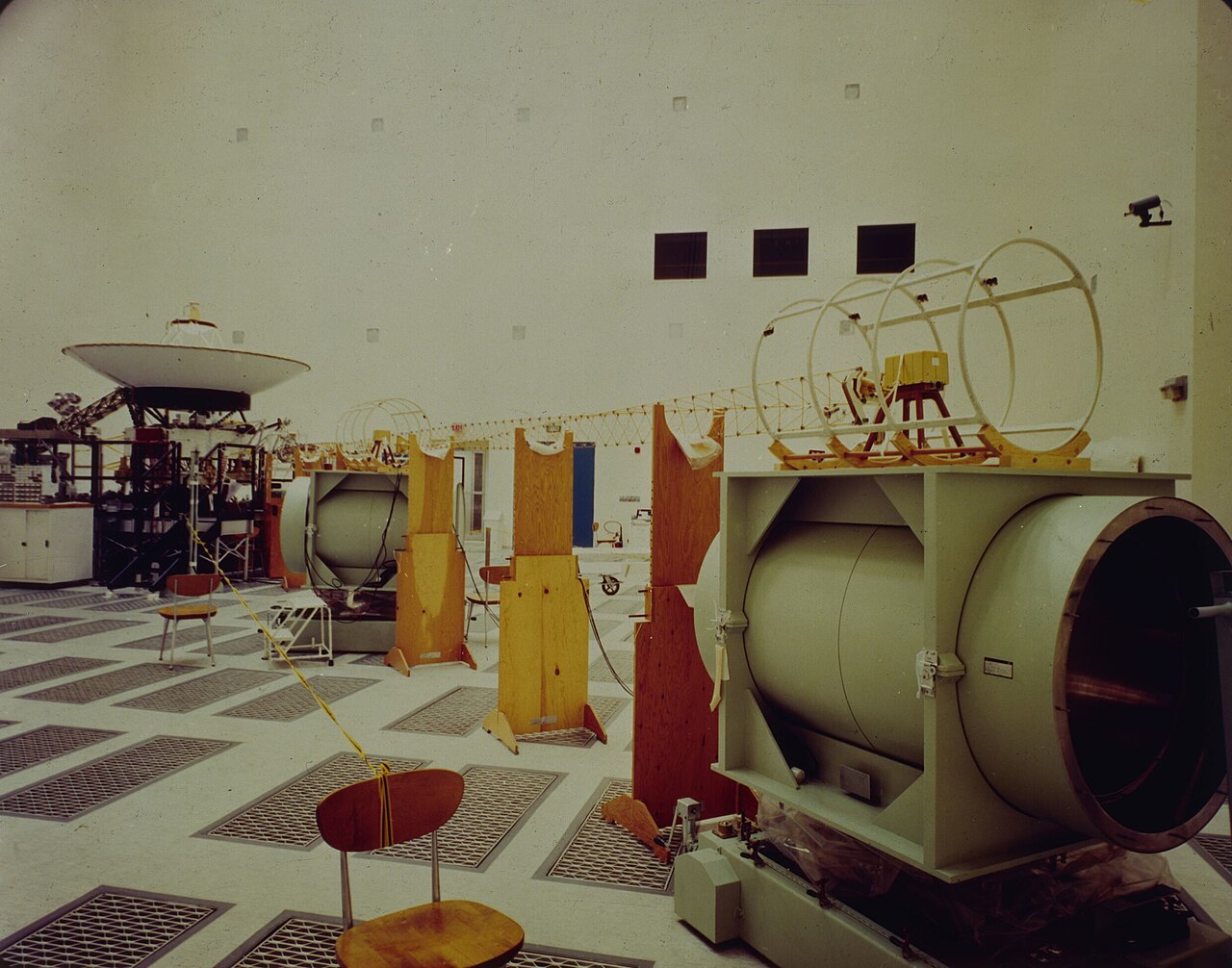





Design and instruments
Each spacecraft carries a suite of instruments for imaging and in-situ measurements: cameras, spectrometers (infrared and ultraviolet), magnetometers, plasma detectors, charged-particle sensors, and radio science experiments. Electrical power is supplied by radioisotope thermoelectric generators; their output has declined over decades but has sustained long-term operations. Onboard data handling, fault protection and a high-gain antenna for communications with the Deep Space Network allowed low-rate telemetry across ever-increasing distances. Both Voyagers also carry a gold-plated phonograph disc — the Golden Record — created as a snapshot of Earth and intended as a message for any future finders.
Trajectory, encounters and mission history
The program used gravity assists at successive targets to increase spacecraft speed and change direction without large fuel burns. Both probes provided detailed, close-up studies of the Solar System's giant planets and many of their moons. The Voyagers returned transformative images and measurements at Jupiter and Saturn, and Voyager 2 continued to perform flybys of Uranus and Neptune, giving humanity its first close observations of those ice giants. Data from the flybys expanded knowledge of atmospheres, ring systems and satellite geology, and revealed unexpected activity such as volcanism on Io.
Scientific contributions and discoveries
- Detailed imaging of cloud belts, storms and aurorae at Jupiter and Saturn.
- Discovery of active volcanism on Io and evidence for subsurface oceans on icy moons.
- Revealing complex structure in Saturn's rings and new small moons and ring features.
- Providing the only close-up observations of Uranus and Neptune, including new moons, rings and atmospheric dynamics.
- Measuring the heliospheric environment: solar wind, magnetic fields and cosmic rays out to the heliopause, constraining models of the heliosphere.
Transition to interstellar space and current status
As the probes moved beyond the giant-planet region they shifted to a long-duration mission to study the outer reaches of the Sun's influence. NASA announced that Voyager 1 crossed the heliopause and began sampling interstellar plasma in 2012, and that Voyager 2 traversed that boundary in 2018. These events represent the first in-situ measurements of the local interstellar medium by human-made instruments. Both spacecraft continue to return data while their instruments and power allow, though telemetry rates are low due to distance and diminishing power.
Operations, data and longevity
Mission operations are coordinated through the Jet Propulsion Laboratory, using the Deep Space Network to receive telemetry and send commands. Scientific data and archived mission documents are preserved in institutional repositories and published literature; outreach pages maintained by NASA and the JPL provide up-to-date summaries. Over decades the mission team has adjusted instrument duty cycles and command strategies to extend science returns as available power declines. The Voyagers remain the farthest human-made objects and continue to inform models of space beyond the planets.
Context, legacy and cultural impact
The Voyager program greatly expanded understanding of the gas giants, their rings and satellite systems, and it pioneered long-duration deep-space operations that influenced subsequent missions. The Golden Record embedded on each vehicle symbolizes the program's cultural as well as scientific aspirations. Observations and trajectories from the mission have been used in broader Solar System studies, including searches and limits for hypothesized distant objects, and the Voyagers are often compared with earlier achievements such as Pioneer 10. The program grew from priorities set by the scientific community and national space policy, and it remains a touchstone in public and scientific histories of space exploration.
Further reading
Primary launch and encounter dates, technical summaries and instrument lists are preserved in mission archives; outreach and technical material can be found through agency pages and scientific publications. Historical narratives discuss the program's planning, funding and long-term operations within the context of United States space initiatives and international scientific collaboration. The Voyager story exemplifies how robust engineering and flexible mission management enable discoveries far beyond original objectives.
Questions and answers
Q: What is the Voyager program?
A: The Voyager program is a space exploration program of the United States' NASA agency. It consists of a pair of unmanned scientific probes, Voyager 1 and Voyager 2.
Q: When were the probes launched?
A: The probes were launched in 1977 to take advantage of a favorable planetary alignment of the late 1970s.
Q: What was their mission?
A: Although they were officially used to study just Jupiter and Saturn, the two probes were able to continue their mission into the outer solar system. They have since continued out and exited the solar system.
Q: Who built them and funded them?
A: The spacecrafts were built at JPL and funded by NASA.
Q: What data did they collect about gas giants?
A: Both missions have gathered large amounts of data about the gas giants of the solar system, which was previously unknown before their launch.
Q: How has it been used to place limits on Planet X's existence?
A: The paths taken by both spacecrafts have been used to place limits on the existence of Planet X, a planet believed by some people to be farther from the Sun than Pluto.
Q: When did each probe leave our Solar System?
A: In 2013, NASA announced that Voyager 1 had left our Solar System (Heliosphere) on 25 August 2012 while in 2018, NASA announced that Voyager 2 had reached its heliopause on 5 November that year.
Related articles
Author
AlegsaOnline.com Voyager program: NASA's long-range interstellar probe missions Leandro Alegsa
URL: https://en.alegsaonline.com/art/105969