
Vladikavkaz — capital of North Ossetia–Alania
Vladikavkaz is a city in the North Caucasus, capital of the Republic of North Ossetia–Alania. A regional industrial and transport hub at the foothills of the Caucasus Mountains on the Terek River.

Overview. Vladikavkaz is the administrative centre and largest city of the Republic of North Ossetia–Alania. The city's Russian name appears as Владикавказ, a word often rendered into English as meaning "ruler of the Caucasus". It sits on the Terek River at the northern foothills of the Caucasus Mountains and functions as the capital of the republic (North Ossetia–Alania) within the state of Russia. The city had a population of roughly 311,693 at the 2010 census and is one of the larger urban centres in the North Caucasus.
Image gallery
10 Images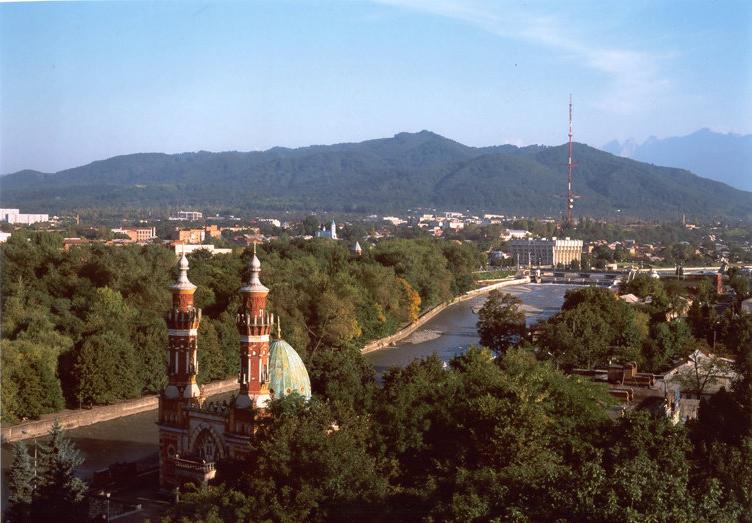



Geography and urban character
Located where lowland steppe meets rugged mountain approaches, Vladikavkaz historically served as a gateway between plains and highland passes. The Terek River corridor gives the city a linear layout along transportation routes, while nearby elevations influence climate and local recreation. Its urban fabric mixes industrial districts, residential neighborhoods and older historic areas near the riverfront.
History and names
The settlement began as a military and trading post in the late 18th century and developed as imperial and later Soviet administrations expanded control in the Caucasus. During the Soviet period the city was renamed Ordzhonikidze and for a time was also known by its Ossetian name Dzaudzhikau. After the Soviet era it resumed the historic Vladikavkaz name, reflecting both local identity and its role in regional administration (capital city status).
Economy and transport
Vladikavkaz is an important industrial and transportation centre. Major sectors include metallurgy, machine building and light industry; the city has factories producing processed zinc and lead, along with chemical goods, clothing and food products. It serves as a regional rail and road junction that links lowland Russia with mountain routes, making it a logistics hub as well as an industrial base (industrial, transportation).
Culture, demographics and significance
The city's population is ethnically and culturally mixed; metropolitan life reflects Ossetian traditions alongside Russian and other North Caucasian influences. As a regional capital it hosts administrative institutions, cultural venues and educational establishments that serve the republic and neighboring areas. Vladikavkaz's position at the edge of the mountains also makes it a practical center for tourism, mountaineering access and trade with highland communities.
Notable facts and distinctions
- The name Vladikavkaz highlights its historic strategic role as a "ruler" or controlling point of access to the Caucasus.
- It has been known by different names in different periods, including Ordzhonikidze and Dzaudzhikau, reflecting political and linguistic changes.
- Today it combines administrative functions, industry and transport links that make it one of the most important cities in the North Caucasus region.
For readers who want to explore further, regional histories and economic profiles outline how Vladikavkaz evolved from a fortress town into the present-day capital of North Ossetia–Alania within Russia, and how its industries and transport connections remain central to its role in the Caucasus. Additional context on the Russian name and linguistic forms is available through resources that document the local languages and geographic names (Владикавказ, name meaning).
Related articles
Author
AlegsaOnline.com Vladikavkaz — capital of North Ossetia–Alania Leandro Alegsa
URL: https://en.alegsaonline.com/art/105713
Sources
- vladikavkaz-osetia.ru : "Archived copy" · web.archive.org
- region15.ru : "15-й РЕГИОН: Владикавказ" · web.archive.org
- docs.cntd.ru : "КОНСТИТУЦИЯ РЕСПУБЛИКИ СЕВЕРНАЯ ОСЕТИЯ - АЛАНИЯ (с изменениями на: 10.05.2017), Конституция Республики Северная Осетия - Алания от 12 ноября 1994 года" · web.archive.org