
Víðarr (Vidar) — Norse god of vengeance and survival
Víðarr, son of Odin and the giantess Gríðr, is a Norse god associated with vengeance and endurance; famed for killing Fenrir at Ragnarök and for surviving to help renew the world.
Overview
Víðarr (anglicized Vidar) is a figure in Norse myth chiefly associated with silent strength, vengeance, and survival. His name appears in Old Norse sources and is sometimes interpreted as denoting breadth or ruling power. He is numbered among the Æsir and is described as a son of Odin and the giantess Gríðr, a parentage that links him to both the divine and the jötnar.
Image gallery
5 Images


Name and character
Víðarr is portrayed as a taciturn, powerful deity whose mythic role is concentrated and decisive. He is commonly described as a god of vengeance: restrained in speech but resolute in action. Traditional accounts emphasize his physical strength and a special, thickly constructed shoe or footwear that helps him withstand and defeat monstrous foes.
Family and associations
As an Æsir, Víðarr belongs to the principal pantheon of gods. His close kinship ties place him beside other important figures: he is a son of Odin, brother to gods like Váli, and in the post-cataclysmic narratives he is reunited with figures such as Höðr and Baldr. Later traditions also pair him in the new age with the sons of Thor, Magni and Móði, as part of a renewed divine order.
Ragnarök and the slaying of Fenrir
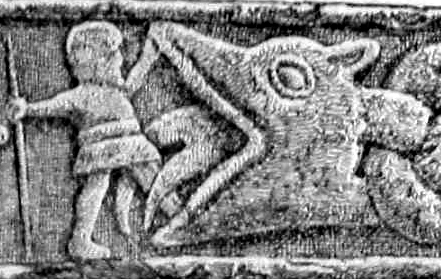
Víðarr's most famous deed occurs at Ragnarök, the foretold cataclysm. When the wolf Fenrir devours Odin, Víðarr avenges his father by confronting the wolf, placing his foot in Fenrir's jaw and tearing the beast apart, according to the surviving narratives. This grim, physical vengeance secures his reputation as the god who balances loss with retributive power.
Survival and the renewed world
Unlike many deities who perish in the final battle, Víðarr is said to survive. He appears after the doom on the plain of Iðavöllr, the site associated with where Asgard once stood, and helps inaugurate the renewed world. There he meets other survivors and restituted figures, and he is sometimes represented as taking part in leadership or the restoration of order alongside his kin.
Sources and textual evidence
Accounts of Víðarr are preserved in medieval Icelandic compilations, most notably the corpus of poems and the prose collections that form the backbone of what is known about Norse myth. The surviving references are relatively sparse and concentrated: instead of lengthy narratives, Víðarr is known through decisive episodes and characteristic details cited by later redactors and poets.
Interpretations and cultural legacy
Scholars treat Víðarr as an example of how Norse tradition often entrusts specific cosmic tasks to figures who are otherwise lightly sketched. His combination of silence, a distinct ritual or material attribute (the shoe), and a single decisive act has made him a potent symbol in modern receptions of Norse myth, appearing in literature, art, and popular retellings that emphasize themes of duty, endurance, and righteous vengeance.
Further reading
Readers seeking primary and secondary materials can consult editions and translations of the medieval poems and prose texts, as well as modern scholarly studies of the mythic cycle and of individual deities. For introductions to the broader material, see general surveys of Norse mythology and thematic studies of Ragnarök and divine survivals. For genealogical and comparative details follow references to Odin, Gríðr, and related figures such as Váli and Magni and Móði.
Related articles
Author
AlegsaOnline.com Víðarr (Vidar) — Norse god of vengeance and survival Leandro Alegsa
URL: https://en.alegsaonline.com/art/105021