
United Kingdom Census 2001
The 2001 United Kingdom census, held on 29 April 2001, was the 19th decennial census and noted for new questions and coordinated delivery by the devolved statistical agencies.
The United Kingdom Census 2001 took place on Sunday 29 April 2001. It was the nineteenth census covering the UK and was planned and carried out by the four official statistical bodies: the Office for National Statistics in England (ONS), the Welsh census team (Wales), the General Register Office for Scotland (Scotland) and the Northern Ireland Statistics and Research Agency (NISRA). The census collected information about households and individuals to produce statistics for government, public services and research.
Image gallery
1 Image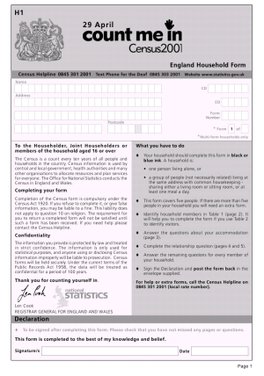
Scope and key features
The 2001 census used short and long household forms to capture population and housing characteristics. Questions covered age, sex, marital status, occupation, employment, education, ethnicity and housing conditions. For the first time in a UK census, people in England, Scotland and Wales were asked a direct question about their religion (religion question), while Northern Ireland continued its established separate practice on religious affiliation.
Purpose and uses
Census data provide the most complete snapshot of the population at a point in time. Outputs are used to plan health and education services, allocate central government funding, design transport and housing policy, and support academic and commercial research. Small-area statistics enabled local authorities and community groups to understand demographic change.
Procedure, confidentiality and releases
Households were required by law to complete a form for every person usually resident. Returned information was processed by the national agencies and published in tabulated form and thematic reports. Individual census forms are protected by confidentiality rules and held apart from name and address information; detailed personal returns are released only under long-standing archival arrangements (the "100-year rule").
Impact and notable aspects
- It reinforced the practice of separate national statistical authorities coordinating a UK-wide enumeration.
- The inclusion of a religion question in Great Britain prompted debate about identity and social trends and produced new baseline data for religious affiliation.
- Data from 2001 served as a baseline for analyses of demographic change into the first decades of the 21st century.
Readers seeking official tables, methodological notes or historical comparisons can consult the relevant national agency publications and guidance pages: ONS, Wales, Scotland, Northern Ireland and specific documentation on the religion question here.
Related articles
Author
AlegsaOnline.com United Kingdom Census 2001 Leandro Alegsa
URL: https://en.alegsaonline.com/art/102959
Sources
- news.bbc.co.uk : Census paints portrait of ageing UK