
United States invasion of Panama (Operation Just Cause)
Operation Just Cause was the December 1989–January 1990 U.S. military operation to remove Manuel Noriega, restore an elected government and protect U.S. interests in Panama; its legality and consequences remain debated.
Overview
The United States invasion of Panama, known as Operation Just Cause, was a large-scale military operation conducted in December 1989 and January 1990. The action aimed to depose Panama's de facto leader, General Manuel Noriega, to protect U.S. personnel and interests in Panama, and to restore the government that the United States and many Panamanians considered the legitimate authority. The intervention followed years of escalating tensions between Washington and Panama amid concerns over drug trafficking, political repression and control of strategic facilities.
Image gallery
10 Images



Background and stated objectives
Tensions had been building since the 1977 Torrijos–Carter Treaties, under which the Panama Canal was scheduled to transfer from U.S. control to Panama at the end of 1999. By the late 1980s the U.S. government under President George H. W. Bush said that Noriega's regime threatened American lives, undermined democracy, and aided drug trafficking. The administration characterized the operation as necessary to:
- Protect U.S. citizens and personnel in Panama;
- Safeguard the operation and neutrality of the canal and related facilities;
- Remove Noriega from power and facilitate the restoration of civilian rule;
- Disrupt drug trafficking networks linked to Noriega.
Course of the operation
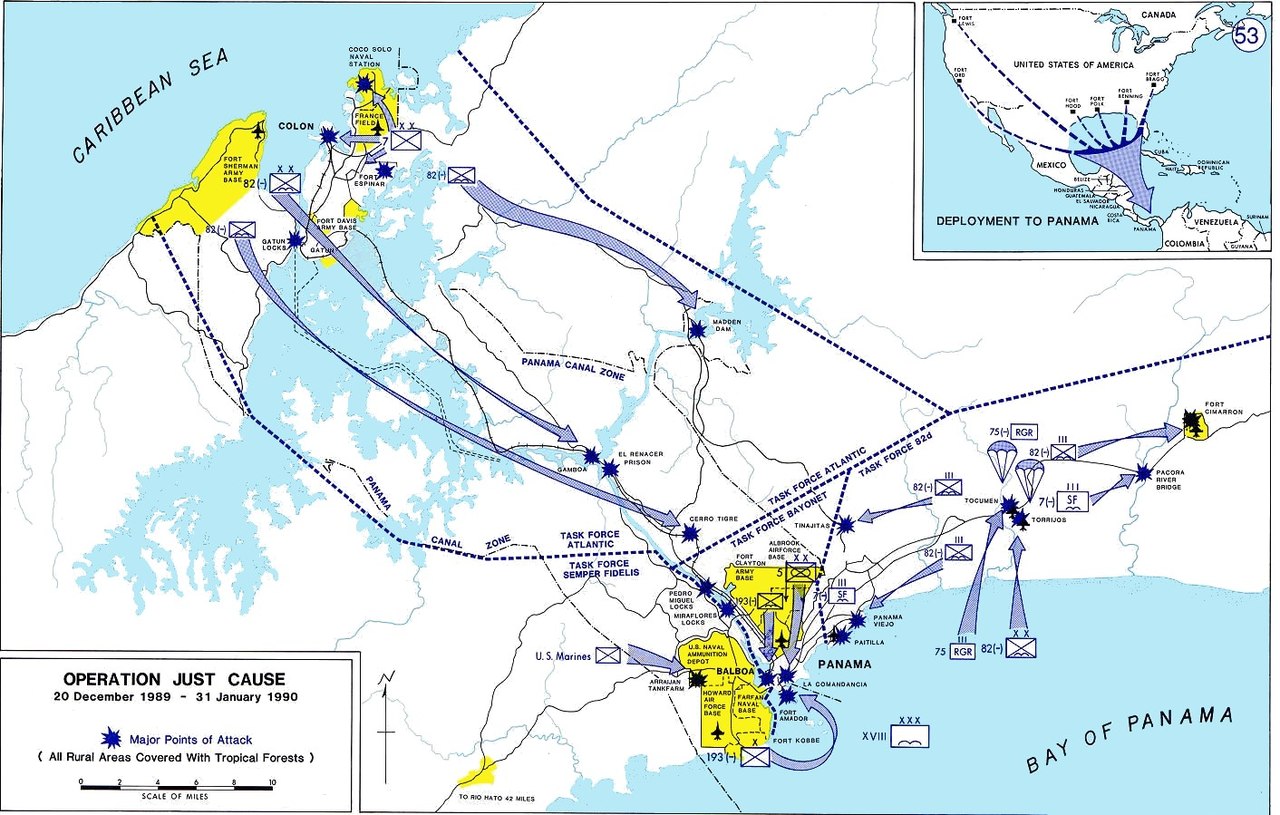
U.S. forces—airborne, mechanized and special operations units—entered Panama beginning in late December 1989. Units were tasked to seize airfields, key command centers, and the Panamanian Defense Force's infrastructure. The campaign lasted into early January 1990; during and after the fighting Noriega was isolated, sought refuge in a diplomatic residence, and ultimately left Panamanian control and was taken into U.S. custody. The U.S. government subsequently recognized Guillermo Endara as president, and the institutional structure of Panama's military was dismantled.
Aftermath and consequences
The invasion brought an immediate change in Panama's leadership and resulted in the formal disbanding of the Panamanian Defense Force. U.S.-Panama relations moved toward civilian-led governance and preparation for the eventual transfer of the canal. The operation also had longer-term effects on Panamanian politics, civil institutions, and public perceptions of sovereignty and foreign intervention. Noriega was transported to the United States to face criminal charges and was later tried and convicted on drug-related offenses.
Legal, humanitarian and international reactions
The intervention provoked wide international debate. Many nations and international bodies criticized the invasion as a breach of sovereignty and international law; supporters argued it was justified by the need to protect lives and combat transnational crime. There were both military and civilian casualties and damage to infrastructure; estimates of the human cost varied and were the subject of controversy. The operation remains a frequently cited case when discussing U.S. use of force, regime change, and limits on intervention.
Sources and further reading
For additional context and primary documentation, consult official statements and historical summaries from the governments involved and independent studies. Useful entry points include historical overviews of Panamanian politics, analyses of the Operation Just Cause planning and execution, assessments of Panama–U.S. relations, and broader treatments of American foreign policy by scholars and international organizations. Related subjects include the treaties governing the Panama Canal, U.S. administration policies under George H. W. Bush, and the role of narcotics trafficking in U.S. interventions. See also legal and human rights evaluations for perspectives on accountability and impact.
Further reading and archival materials can be found through government archives and academic works that analyze the causes, conduct and consequences of the invasion from both Panamanian and international viewpoints. Many summaries and collections reference the operation by name and examine the legacy of United States military interventions in the late 20th century.
Related articles
Author
AlegsaOnline.com United States invasion of Panama (Operation Just Cause) Leandro Alegsa
URL: https://en.alegsaonline.com/art/103067