
Unbipentium (Ubp) — hypothetical element with atomic number 125
Unbipentium (Ubp) is the temporary name for the predicted element with atomic number 125. It is a theoretical superactinide and a candidate g-block member; synthesis attempts have so far failed.
Overview
Unbipentium is the systematic temporary name for the not-yet-discovered chemical element with atomic number 125 and the provisional symbol Ubp. Following IUPAC naming conventions for undiscovered elements, the name is derived from Latin/Greek numerical roots and serves only until an official name is adopted. The element is sometimes called eka-neptunium in older predictive schemes because of its position relative to known actinides on extended periodic table arrangements.
Image gallery
1 Image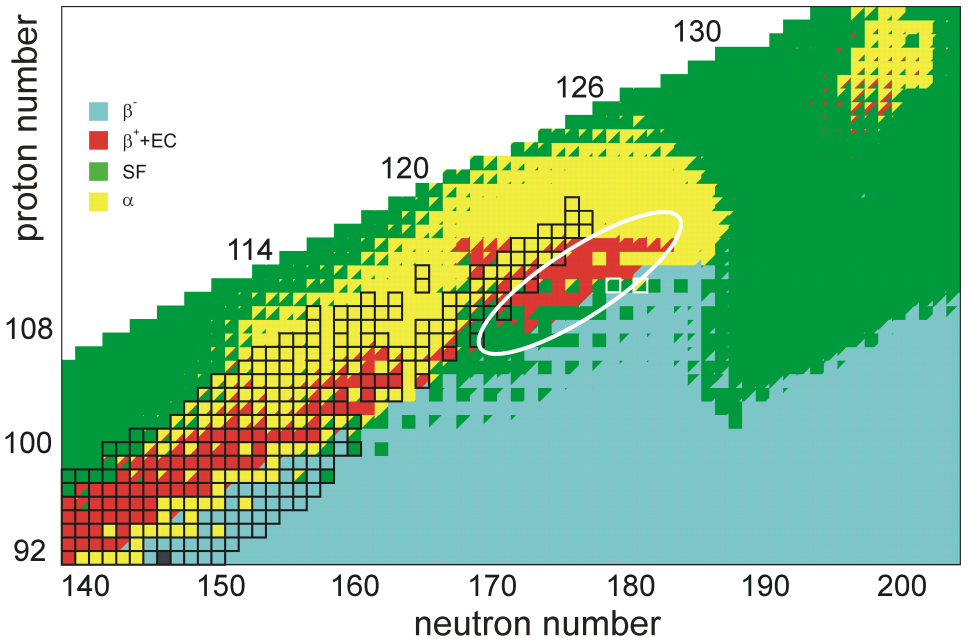
Predicted position and characteristics
In many theoretical extensions of the periodic table, element 125 would occupy a place within the so-called superactinide series and is often placed in a putative g-block where electrons begin to occupy g-orbitals. Exact electronic configuration, chemical behavior, and physical properties remain highly uncertain because effects of extreme nuclear charge and relativistic corrections strongly influence the behavior of superheavy nuclei and their electrons. Any stable isotopes are not expected; instead, isotopes produced in laboratories would likely be extremely short-lived and highly radioactive.
Synthesis attempts and experimental history
Efforts to produce element 125 have been undertaken by heavy-ion fusion experiments. Early work included an attempt at the GSI Helmholtz Centre for Heavy Ion Research in Darmstadt, where targets of Americium-243 were irradiated with accelerated zinc ions. The published reaction studied in that campaign is commonly written in fusion–evaporation notation as:
- 243Am + 66,68Zn → 309,311Ubp*
In that experiment no atoms attributable to element 125 were identified. The absence of observed decay chains consistent with the new element is typical in this region of the nuclear chart: production cross-sections are extremely small, and unambiguous detection requires very high beam intensities, long irradiation times, and careful analysis of decay events.
Why synthesis is difficult
Producing superheavy elements such as Unbipentium poses several technical and scientific challenges. Fusion-evaporation reactions must overcome Coulomb repulsion between heavy nuclei, and even when a compound nucleus forms it may undergo immediate fission instead of surviving long enough to evaporate neutrons and settle into a bound isotope. Additional obstacles include limited availability of suitable target isotopes, the need for intense and stable ion beams, and the interpretation of very sparse decay data. Detection typically relies on identifying characteristic alpha-decay chains or spontaneous fission events that can be traced back to a parent nucleus.
Scientific importance and theoretical context
Interest in element 125 stems from fundamental questions in nuclear physics and chemistry: mapping the limits of nuclear stability, testing models of nuclear structure, and exploring how electron shells behave under extreme relativistic conditions. Some theoretical work considers whether islands of relative stability might exist near certain neutron and proton numbers; however, predictions for Z = 125 vary and are model-dependent. If an isotope of Unbipentium were produced and characterized, it would provide valuable data for refining nuclear theories and for understanding periodic trends beyond the actinides. Research centers that conduct such experiments include facilities like the one in Darmstadt, Germany, which have led many superheavy discovery campaigns using targets such as Americium‑243 and projectile species like zinc.
Distinctions and related elements
Unbipentium should be distinguished from officially named elements: its name and symbol (Ubp) are placeholders under the IUPAC systematic nomenclature. If discovered and confirmed, a permanent name would be proposed and ratified. Related experimental work continues in adjacent regions of the nuclear chart where several superheavy elements have been synthesized and named; progress there informs strategies for attempts at producing heavier nuclei such as Z = 125. Until reproducible experimental evidence appears, Unbipentium remains a theoretical entry in extended periodic tables and an objective for future heavy-ion research.
Related articles
Author
AlegsaOnline.com Unbipentium (Ubp) — hypothetical element with atomic number 125 Leandro Alegsa
URL: https://en.alegsaonline.com/art/102769