
Uranium-235: fissile isotope used in reactors and weapons
Uranium-235 (U-235) is a naturally occurring, fissile isotope of uranium used as nuclear fuel, in early atomic weapons, and in scientific research; it has distinctive nuclear properties and strict controls.
Overview
Uranium-235 (U-235) is a naturally occurring isotope of the chemical element uranium. An atom of U-235 contains 92 protons and 143 neutrons, giving it a mass number of 235. It is radioactive and, unlike the more abundant U-238, is fissile: it can sustain a nuclear chain reaction when struck by appropriate neutrons. In naturally occurring uranium ore U-235 is present only in small proportion (around 0.7–0.8 percent), so the isotope is often separated and concentrated when specific nuclear applications require more than natural abundance.
Image gallery
1 Image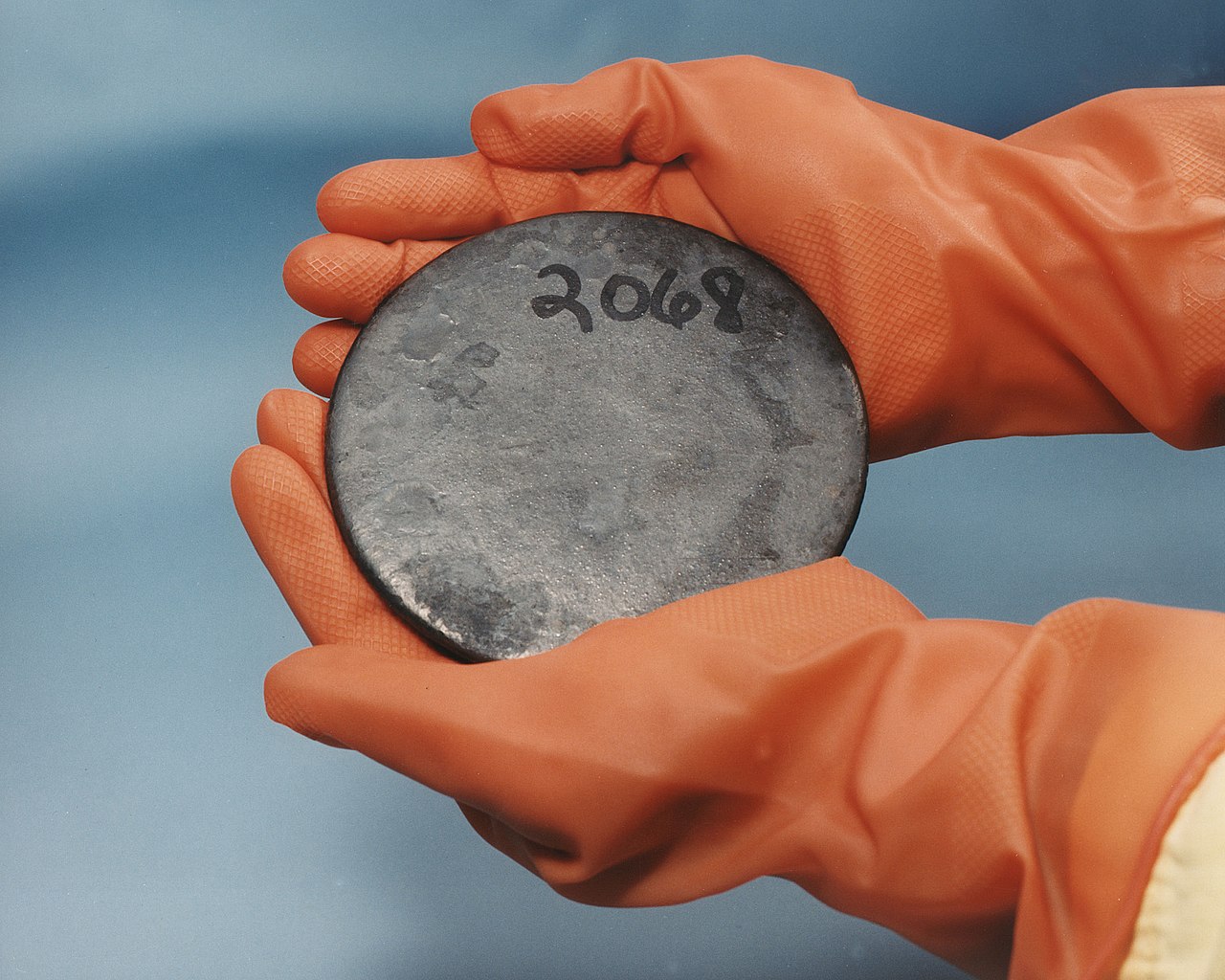
Atomic and nuclear properties
U-235 primarily undergoes alpha decay to thorium-231 and has a long radioactive lifetime; its half-life is commonly given as on the order of 7.0×10^8 years (see half-life). Its nuclear behavior depends strongly on the energy of incident neutrons: thermal (low-energy) neutrons have a high probability of inducing fission in U-235, while the probability is markedly lower for fast neutrons. This energy dependence underpins the design differences between power reactors, research reactors and nuclear weapons. As with other alpha emitters, external exposure to U-235 is less penetrating than gamma radiation, but inhalation or ingestion of uranium particles poses significant internal health risks.
Fission characteristics
When a U-235 nucleus absorbs a neutron it may split (fission) into two lighter nuclei plus additional neutrons and energy. The fission process releases heat and prompt neutrons that can induce further fission events, enabling a chain reaction under suitable conditions. The effective fission cross section for slow thermal neutrons is very large (often cited around several hundred barns), while the cross section for fast neutrons is much smaller (on the order of one barn). Detailed values vary with neutron energy and nuclear data libraries; the qualitative contrast between thermal and fast behavior is the critical practical point. For general background on the fundamental process see nuclear fission.
Enrichment, fuel and applications
Because natural uranium contains only a small fraction of U-235, industrial processes increase its concentration by enrichment. Common methods include gas centrifugation and older gaseous diffusion applied to uranium hexafluoride. Enriched uranium ranges from low-enriched material (LEU, a few percent U-235) used in most commercial power reactors to higher enrichments used in some research reactors and naval propulsion. Material with much of its U-235 removed is called depleted uranium and is used for its density and other properties in industrial and military contexts. Nuclear reactors rely on carefully controlled U-235 fission to generate heat for electricity production; see resources on nuclear reactors for reactor types and fuel cycles.
History and wartime use
U-235 was identified in the 1930s through mass-spectrometric analysis of uranium samples, and experimental demonstrations in the late 1930s and early 1940s established that a rapid chain reaction was possible under certain conditions. During World War II, enriched U-235 was used in an early gun-type nuclear device; that weapon was employed against the city of Hiroshima on August 6, 1945. Contemporary accounts refer to the wartime device as the bomb nicknamed Little Boy. The historical development of fissile material production and weapon design spurred intensive research in nuclear physics and engineering in the mid-20th century.
Measurement, safeguards and regulation
Quantitative analysis of U-235 in samples is performed by mass spectrometry and other isotopic measurement techniques used in geology, safeguards and fuel accounting. Because U-235 is both a valuable fuel and a material of proliferation concern, its production, transport and use are subject to international safeguards, export controls and national regulation. Agencies and treaties work to balance peaceful uses of nuclear energy with measures to prevent diversion to weapons programs.
Health, environmental and disposal issues
Handling uranium-bearing materials requires radiological controls to limit inhalation, ingestion and long-term environmental contamination. Spent nuclear fuel contains most of the original uranium together with fission products and transuranic elements, and it is managed by interim storage, reprocessing in some countries, or long-term disposal strategies. The dual-use nature of U-235—important for power generation yet capable of enabling weapons—continues to shape technical, ethical and policy discussions about its role in energy and security.
Further reading and context
U-235 remains central to discussions of nuclear energy, non-proliferation and nuclear history. For introductory material on isotopes and uranium chemistry see entries on isotope and on uranium. For authoritative technical and policy information consult national nuclear agencies and international bodies responsible for safeguards and reactor safety.
Related articles
Author
AlegsaOnline.com Uranium-235: fissile isotope used in reactors and weapons Leandro Alegsa
URL: https://en.alegsaonline.com/art/103534