
Twente: historical region of eastern Netherlands
Twente is a cultural and historical region in eastern Overijssel, the Netherlands, known for its textile heritage, Low Saxon dialect Tweants, the city of Enschede and modern technology and cross-border ties with Germany.
Twente is a historical and cultural region in the eastern Netherlands, located in the province of Overijssel within the country commonly called the Netherlands. The area is often referred to by its Low Saxon name, Tweante. Its largest and informal capital is the city of Enschede, and the region retains a distinct local identity shaped by language, landscape and industrial history.
Image gallery
9 Images


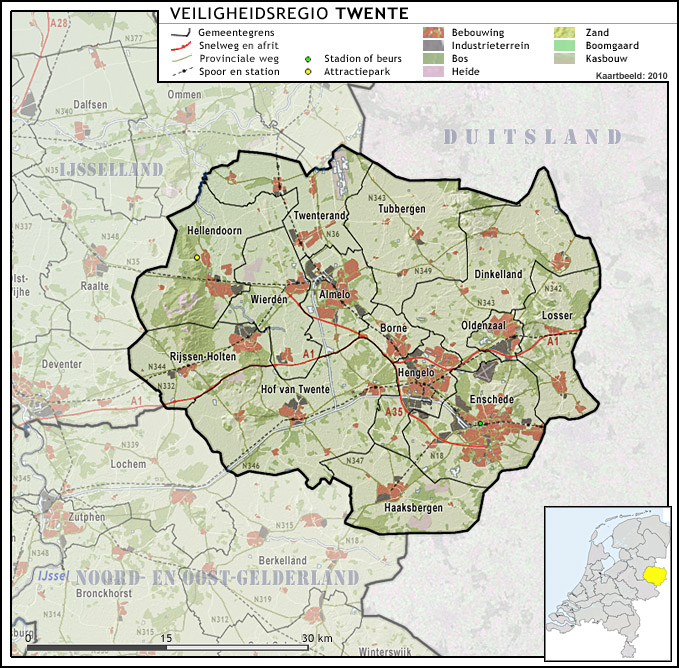


Geography and municipalities
Twente occupies a band of land that borders several neighbouring regions and countries. To the west and north it meets the Salland region; to the south it adjoins the Achterhoek in the province of Gelderland. Across the eastern frontier are German regions: the County of Bentheim in Lower Saxony and the Münsterland area in North Rhine-Westphalia, both parts of Germany. The landscape is a mix of farmland, hedgerow-lined parcels, small forests and meandering streams, with both urban centres and rural villages.
Population, language and identity
About 633,000 people lived in the administrative area commonly called Twente around 2021. Local inhabitants are colloquially known as "Tukkers." Many residents speak a regional Low Saxon dialect called Tweants alongside standard Dutch. This linguistic tradition is an important marker of local culture and is heard in everyday speech, festivals and community life.
Economic development and history
Twente's modern profile was shaped strongly by the textile industry, which dominated the local economy from the 19th century until its decline in the mid-20th century. After a period of industrial contraction in the 1950s and 1960s, the region diversified: the establishment of higher education and research institutions helped stimulate technology, engineering and service sectors. Today Twente mixes light industry, knowledge-driven firms, agriculture and tourism.
Culture, institutions and notable facts
The region supports several medium-sized cities and towns that act as cultural and economic hubs, including Enschede, Hengelo, Almelo and Oldenzaal, as well as smaller municipalities and market towns. Institutions such as universities, research centres and regional museums preserve Twente's industrial past and promote innovation. Sports clubs, cultural events and a lively music and arts scene contribute to local life.
Cross-border ties and modern role
Twente's location along the Dutch–German border encourages cross-border cooperation in commerce, transport and culture. The region is known for local initiatives that link Dutch and German partners on business, education and environmental projects. While its textile era is an important chapter in its history, Twente today is recognised for combining a strong regional identity with contemporary economic and cultural connections across national boundaries.
- Language: Tweants (Low Saxon dialect).
- Informal capital: Enschede.
- Province: Overijssel.
- Border regions: Salland, Achterhoek, County of Bentheim (Lower Saxony), Münsterland.
- Country context: The Netherlands and neighbouring Germany.
Related articles
Author
AlegsaOnline.com Twente: historical region of eastern Netherlands Leandro Alegsa
URL: https://en.alegsaonline.com/art/102227