
Turquoise: properties, history, uses, and varieties
Turquoise is an opaque blue-to-green phosphate mineral prized as a gem and ornamental stone. This article covers its properties, sources, cultural history, treatments, and common imitations.
Turquoise is an opaque, blue-to-green hydrated phosphate mineral valued as a gemstone and ornamental material. Its distinctive color comes mainly from copper (blue) and, in greener specimens, from iron or varying copper:aluminium ratios. The commonly given chemical formula is CuAl6(PO4)4(OH)8·4H2O. Turquoise typically forms as compact masses, nodules, or vein fillings rather than transparent crystals and has a relatively low hardness for a gem, making it sensitive to abrasion and some chemicals.
Image gallery
10 Images


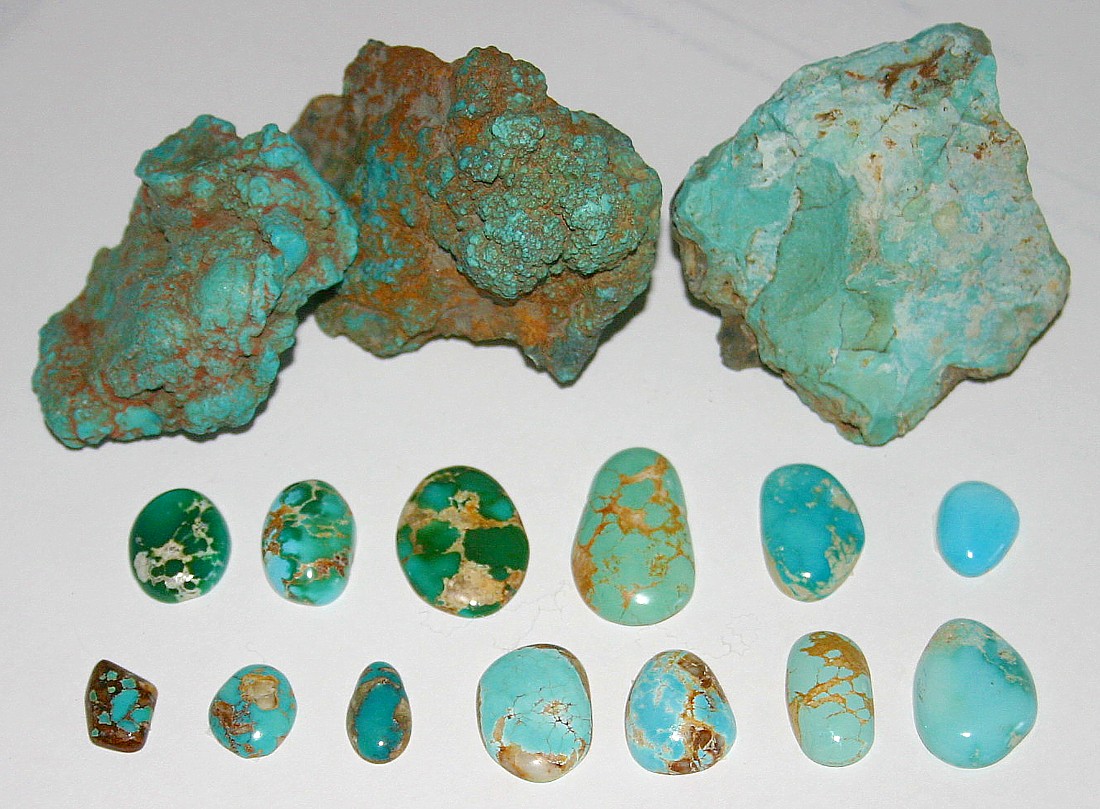
Physical characteristics and identification
Key properties used to identify and evaluate turquoise include color, hardness, porosity, and matrix (veining). Typical features are:
- Color: ranges from sky blue and robin's-egg to blue-green and yellowish green. Pure blue hues without greenish tints are often most prized.
- Hardness: about 5–6 on the Mohs scale, which is softer than many other gem materials and explains why it is commonly cut as a cabochon.
- Texture: usually opaque, with a waxy to subvitreous luster; many specimens show a contrasting brown, black, or gray matrix where the mineral fills cracks in the host rock.
- Treatments: because natural turquoise can be porous or fragile, stabilization (impregnation with resins) and backing are common to improve durability and appearance.
History and cultural significance
Turquoise has been collected and fashioned into jewelry and amulets for thousands of years. It appears in ancient Egyptian, Persian, Mesopotamian, and Central Asian artifacts and has long been important in Native American arts of the American Southwest. The word "turquoise" in European languages derives from a reference to Turkey, the transit route by which the stone reached Europe, though major historic mines were also located in Iran (Persia) and elsewhere.
Sources, varieties, and market value
Important historical and modern sources include Iran (notably Nishapur historically), Egypt, China, Tibet, and deposits in the southwestern United States (Arizona, Nevada, New Mexico). Value depends on hue, saturation, uniformity, and absence of cracks; an even, intense sky-blue without matrix is often termed "Persian" or "robin's-egg" turquoise and is highly valued. Lower-grade material may show greenish tones or heavy veining and is more affordable.
Uses, treatments, and imitations
Turquoise is most commonly cut as cabochons, beads, and inlays for rings, necklaces, and decorative objects. Because of its porosity and softness, common treatments include stabilization with polymers and dyeing; some material is sold as reconstituted turquoise (pressed small fragments with binders). Imitations and look-alikes include dyed howlite, magnesite, glass, plastic, and other copper-bearing minerals such as chrysocolla or variscite. Careful visual inspection, simple tests, and, where needed, gemological analysis can distinguish natural from treated or synthetic material.
For more detailed mineralogical data or trade information, consult a specialized reference or gemological laboratory. Turquoise remains a culturally significant and widely recognized gemstone, prized for its color and long human associations.
Related articles
Author
AlegsaOnline.com Turquoise: properties, history, uses, and varieties Leandro Alegsa
URL: https://en.alegsaonline.com/art/102144