
Tropic of Cancer
One of the Earth's major circles of latitude, located about 23.5° north of the Equator; marking the northernmost latitude where the Sun can be directly overhead at the June solstice.
Overview
The Tropic of Cancer is a major circle of latitude that lies north of the Equator and marks the northernmost position at which the Sun can appear directly overhead. It is commonly defined by a specific latitude measured from the Earth's center and is one of several reference parallels used on maps and in geography. For background on its name, see name origin and for a broader list of reference circles, see circles of latitude.
Image gallery
10 Images




Location and characteristics
The Tropic of Cancer is a fixed line of latitude expressed in degrees north of the Equator; it is routinely shown on atlases and globes and used in coordinate systems for navigation and climate zoning. It is a true parallel: every point along it shares the same latitude. References and examples of its appearance on maps can be found at general mapping resources such as map examples and explanations on parallels at parallel concepts.
Astronomical cause
The position of the Tropic of Cancer is determined by the tilt of the Earth's axis relative to its orbital plane. That tilt causes the Sun's declination to oscillate between northern and southern extremes during the year. At the June solstice the Sun reaches its maximum northerly declination, and observers on the Tropic of Cancer experience the Sun directly overhead at local noon. The relation between latitude and the Equator is addressed in materials about latitude measurements: latitude and specific value.
History and name
The name 'Tropic of Cancer' reflects historical astronomy: in classical antiquity the Sun appeared in the constellation Cancer at the time of the northern solstice, which led to the association. Over long periods the constellations shift relative to the calendar because of precession, so the Sun is no longer in that constellation at the solstice. The seasonal event that defines the line remains the June or northern solstice; see general solstice information at June solstice and context about the Equator at Equator.
Significance, uses and examples
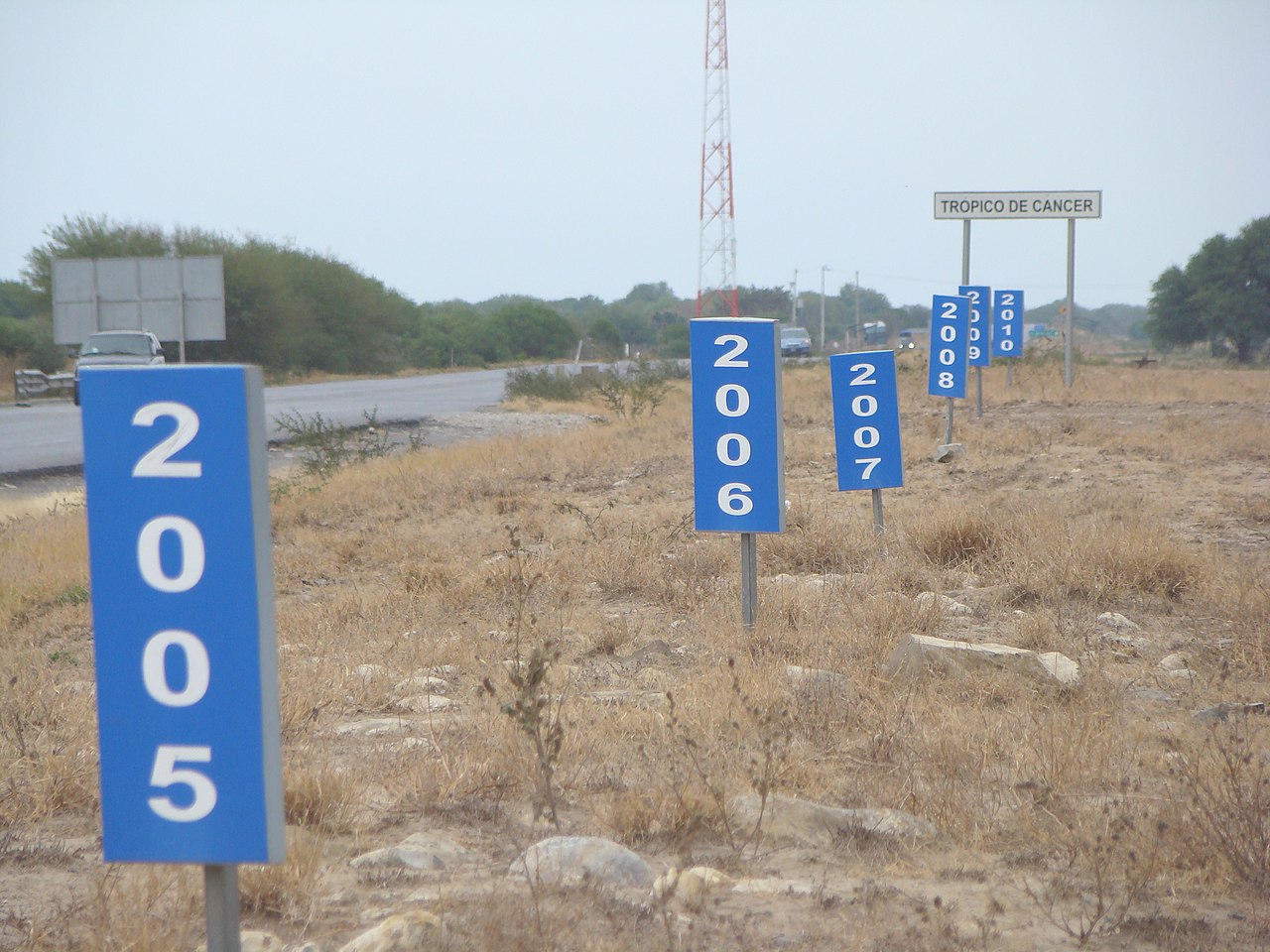
The Tropic of Cancer is useful in climatology, cartography and education. It helps demarcate the northern boundary of the Earth’s tropics, a zone associated with relatively small seasonal variation in daylight and often distinct climate types. It also appears in travel literature and national markers in countries it crosses. Typical practical uses include:
- Defining climatic zones and solar geometry for architecture and agriculture.
- Reference in atlases and GPS-based navigation systems.
- Educational demonstrations of Earth's tilt and seasonal cycles.
Notable distinctions
The Tropic of Cancer is the counterpart to the Tropic of Capricorn in the Southern Hemisphere. Together with the Equator and the polar circles, these parallels form a convenient framework for describing Earth's surface in geographic and climatic terms. For further reading and authoritative summaries see general geographic resources linked above and introductory astronomy sources linked throughout this article.
Related articles
Author
AlegsaOnline.com Tropic of Cancer Leandro Alegsa
URL: https://en.alegsaonline.com/art/101652