
Tropical Storm Cristobal (2008)
Tropical Storm Cristobal formed July 19, 2008, moved northeastward along the U.S. East Coast, peaked July 21 as a strong tropical storm, and dissipated near Nova Scotia on July 23; impacts were mainly rainfall.
Overview
Tropical Storm Cristobal was the third named storm of the 2008 Atlantic hurricane season. It developed from a disturbance off the southeastern United States and was designated a tropical storm on July 19. Cristobal remained over open water for its entire lifespan, tracked generally northeastward parallel to the U.S. East Coast, and lost its tropical characteristics near Nova Scotia on July 23. Because it never made landfall as a tropical cyclone, its most notable effects were precipitation, localized flooding, and elevated surf along portions of the coastline. For broader context see the 2008 Atlantic hurricane season.
Image gallery
10 Images


Meteorological history
The system that became Cristobal began as a region of disturbed weather off the southeastern U.S. coast and later organized into a tropical cyclone on July 19. Over the following days it strengthened to reach its peak as a strong tropical storm on July 21. Steering currents carried Cristobal northeastward, keeping the center offshore but close enough to influence coastal weather. By July 23 the cyclone weakened and its low-level circulation dissipated near the Canadian Maritimes, with remnants absorbed into larger mid-latitude systems.
Impacts and observations
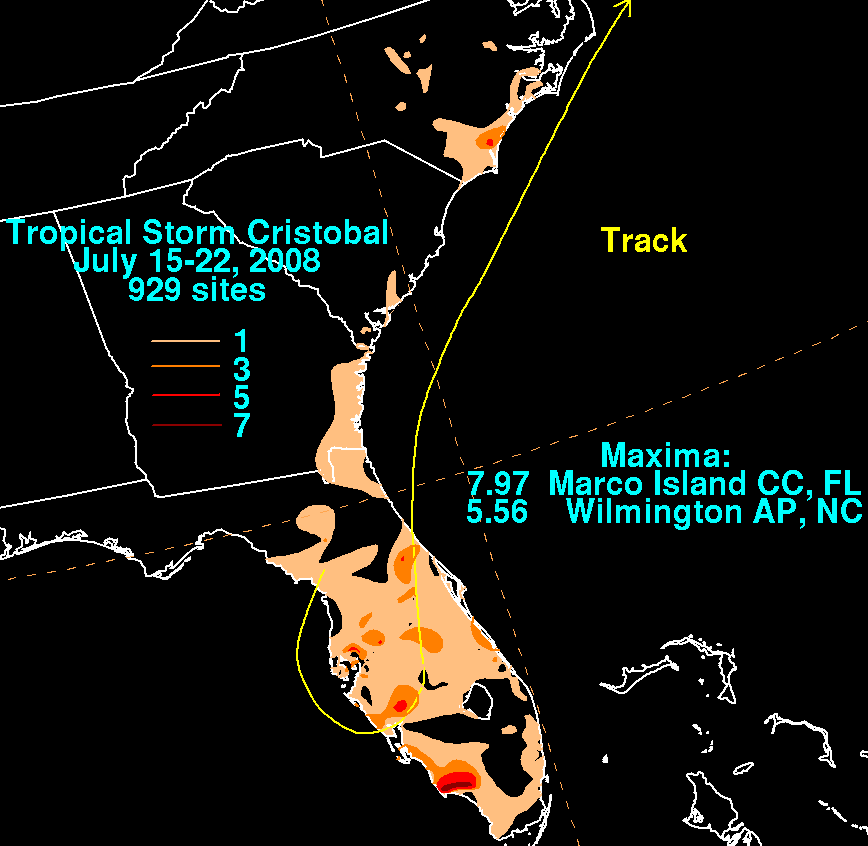
Because Cristobal remained offshore, destructive impacts were limited. The primary effects were rainfall, minor coastal flooding, and higher-than-normal waves and rip currents. Observations reported measurable rainfall in several coastal communities; for example, Wilmington, North Carolina recorded about 3.43 inches (87 mm) of rain, which led to some minor street flooding and ponding in low-lying areas. The storm's remnants also contributed to rainfall in parts of eastern Canada, including Nova Scotia, where localized road and basement flooding was reported. No significant wind damage or widespread power outages were associated with Cristobal.
Timeline and key facts
- Designation as a tropical storm: July 19, 2008.
- Peak intensity reached: July 21, 2008 (strong tropical storm status).
- Track: Generally northeastward, parallel to the U.S. East Coast.
- Dissipation: July 23, 2008, near the Canadian Maritimes.
- Notable measurements: 3.43 in (87 mm) reported at Wilmington, North Carolina.
Significance and aftermath
Cristobal is an example of a short-lived, moderate tropical storm that posed more of a precipitation and coastal hazard than a wind or storm-surge threat. Storms that remain offshore can still produce hazardous surf, rip currents, and localized flooding where rain bands move onshore. Meteorological agencies issued routine advisories while Cristobal was active; coastal communities were reminded to be cautious of rip currents and poor drainage rather than widespread structural damage. The storm's limited footprint means it is often noted in seasonal summaries as a minor but typical Atlantic tropical storm.
Further information
Official post-storm reports and contemporaneous advisories from regional weather services provide detailed analyses of Cristobal's structure, track, and rainfall distribution. Interested readers may consult season summaries and regional rainfall reports for more granular data on the storm's impacts and evolution.
Questions and answers
Q: When did Tropical Storm Cristobal occur?
A: Tropical Storm Cristobal occurred in July 2008.
Q: What was the highest strength of Tropical Storm Cristobal?
A: The highest strength of Tropical Storm Cristobal was as a strong tropical storm.
Q: Did Tropical Storm Cristobal make landfall?
A: No, Tropical Storm Cristobal stayed away from land.
Q: When did Tropical Storm Cristobal die out?
A: Tropical Storm Cristobal died out on July 23 near Nova Scotia.
Q: What was the cause of damages from Tropical Storm Cristobal?
A: Mostly moderate rainfall caused damages from Tropical Storm Cristobal.
Q: Was there any flooding as a result of Tropical Storm Cristobal?
A: Yes, there was minor flooding in Wilmington, North Carolina, and some flooding on roads and in basements in Nova Scotia.
Q: How much rain did Wilmington, North Carolina receive from Tropical Storm Cristobal?
A: Wilmington, North Carolina received 3.43 in (87 mm) of rain from Tropical Storm Cristobal.
Related articles
Author
AlegsaOnline.com Tropical Storm Cristobal (2008) Leandro Alegsa
URL: https://en.alegsaonline.com/art/101695
Sources
- nhc.noaa.gov : "Tropical Depression Three Discussion One"
- nhc.noaa.gov : "Tropical Storm Cristobal Discussion Number 4"
- nhc.noaa.gov : "Tropical Storm Cristobal Discussion Number 5"
- nhc.noaa.gov : "Tropical Storm Cristobal Discussion Number 7"
- nhc.noaa.gov : "Tropical Storm Cristobal Discussion Number 8"
- nhc.noaa.gov : "Tropical Storm Cristobal Discussion Number 11"
- nhc.noaa.gov : "Tropical Storm Cristobal Discussion Number 12"
- nhc.noaa.gov : "Tropical Storm Cristobal Discussion Number 18"
- ap.google.com : "Tropical Storm Cristobal brushes NC coast"
- theledger.com : "System Likely to Deliver More Rain to Polk"
- heraldtribune.com : "Rain is long overdue"
- www4.ncdc.noaa.gov : "Tropical Storm Cristobal Event Report for North Carolina"
- atl.ec.gc.ca : "Tropical Storm Cristobal Information Statement"
- cbc.ca : "Sailor rescued from Cristobal's stormy wrath"