
Triatominae (kissing bugs): biology, distribution, and public health importance
Triatominae are blood-feeding true bugs (subfamily of Reduviidae) known as kissing or conenose bugs. Many species transmit Trypanosoma cruzi, the agent of Chagas disease; control focuses on vector management and improved housing.
Overview
Triatominae are a subfamily of the assassin-bug family Reduviidae. Members of this group are commonly called kissing bugs, conenose bugs or triatomines. More than 130 species are recognized worldwide. Most triatomines are hematophagous, feeding on the blood of vertebrate hosts, although a small number of species take prey or fluids from other invertebrates.
Image gallery
2 Images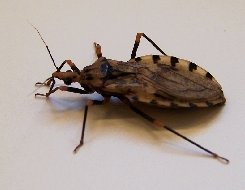
Biology and characteristics
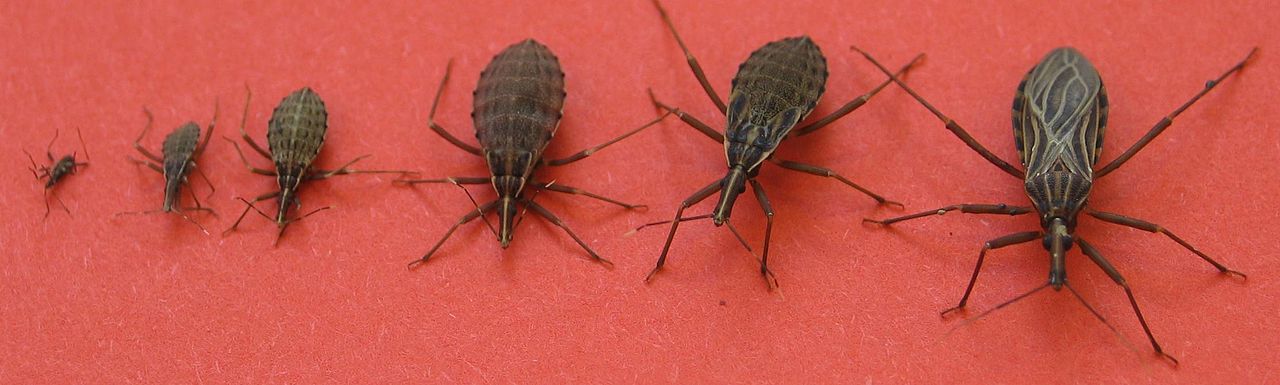
Triatomines are true bugs with a typical hemipteran mouthpart adapted as a piercing-sucking proboscis. Adults are generally elongate and flattened, nocturnally active and attracted to the carbon dioxide and heat emitted by sleeping animals. The life cycle includes eggs, multiple nymphal instars (immature stages), and adults. Feeding behavior and the tendency to defecate close to feeding sites are key factors in pathogen transmission.
Distribution and habitat
Most species occur in the Americas, from the southern United States through Central and South America, where they occupy sylvatic (wild), peridomestic and domestic ecologies. A limited number of species have been recorded in parts of Asia, Australia and Africa, but the highest diversity and the greatest public-health impact are in Latin America.
Medical importance
Some triatomines carry the protozoan parasite Trypanosoma cruzi, the cause of Chagas disease. Transmission most commonly occurs when infective feces deposited by an infected bug contaminate the bite site, mucous membranes or food. While many species may harbor the parasite, only those that are well adapted to living in and around human dwellings—such as Triatoma infestans and Rhodnius prolixus—are considered important disease vectors.
Control, prevention and public health
Managing the public-health risk from triatomines relies on a combination of measures: improving housing to reduce insect refuges, targeted insecticide spraying of infested structures, screening of blood donors, health education and surveillance to detect domiciliary infestation. Domestic and peridomestic control efforts have been highly effective in reducing transmission in many regions, but sylvatic reservoirs and insect movements can complicate elimination.
Notable facts and distinctions
- Triatominae are unusual within Reduviidae because many species feed on blood rather than preying on other arthropods.
- Common names like "kissing bug" refer to their habit of biting near the face of sleeping hosts, though bites may occur elsewhere.
- Species differ in ecology: some are strictly sylvatic while others readily colonize human dwellings—this behavioral variation determines epidemiological importance.
For further reading on classification, behavior and control strategies see resources linked to the family and disease pages: Reduviidae overview, distribution in the Americas, Chagas disease and guidance on vector management (vector control). Additional regional information is available via pages on Asia, Australia and Africa, and on feeding ecology (vertebrate hosts, invertebrate feeding). More on adaptation to human environments: domiciliation and synanthropy.
Related articles
Author
AlegsaOnline.com Triatominae (kissing bugs): biology, distribution, and public health importance Leandro Alegsa
URL: https://en.alegsaonline.com/art/101450
Sources
- bugguide.net : "Triatominae"
- uta.edu : "The Kiss of Death: Chagas Disease"