
Chagas disease (American trypanosomiasis)
Parasitic infection caused by Trypanosoma cruzi, transmitted mainly by triatomine insects in the Americas. Can cause acute symptoms and long-term cardiac or digestive complications; control emphasizes vector reduction.
Overview
Chagas disease, also called American trypanosomiasis, is an infectious illness caused by the protozoan parasite Trypanosoma cruzi. It is endemic to parts of the Americas and affects rural and urban populations. The illness may present as a short-lived acute infection or as a chronic condition that appears years after the initial exposure, sometimes producing severe damage to the heart and digestive tract.
Image gallery
10 Images


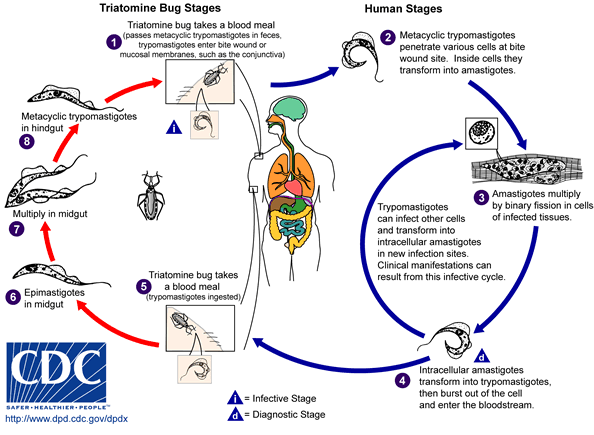


Transmission and life cycle
The parasite is transmitted in several ways. The most classical route involves insects of the subfamily Triatominae, commonly called "kissing bugs," which pass infectious feces after feeding on human blood. Other documented routes include:
- Contamination of food or drink with parasite-contaminated matter (oral transmission).
- Blood transfusion and organ transplantation (blood transfusion is a recognized risk), especially where screening is incomplete.
- Congenital transmission from an infected mother to her fetus during pregnancy.
Geographically the disease is most common in Central American and South American regions, but population movements and transfusion-related cases have extended its presence beyond these areas.
Clinical course and complications
After infection many people experience a mild or unnoticed acute phase with fever, swelling at the bite site or general malaise. If untreated, a proportion of individuals enter a chronic stage that can remain silent for decades. A subset develops progressive complications:
- Cardiac forms: cardiomyopathy, heart rhythm disturbances and heart failure are the most important causes of morbidity and mortality.
- Digestive forms: enlargement of the esophagus (megaesophagus) or colon (megacolon) causing swallowing difficulty, constipation and other symptoms.
Diagnosis and treatment
Diagnosis depends on the stage of infection. Direct detection of parasites in blood is more likely during the acute phase, while serological tests that detect antibodies are the mainstay for identifying chronic infections. Two antiparasitic medications, benznidazole and nifurtimox, are used to treat T. cruzi infection. They are most effective when given early; their benefit in very long-standing chronic disease is more limited and treatment decisions are individualized.
Prevention, control and public health
Reducing transmission relies on a combination of measures. House improvement and targeted insecticide spraying aim to reduce contact with the insect vector (vector), while screening of blood donations and organ donors prevents iatrogenic spread. Public education, surveillance and food-safety practices help limit oral outbreaks. Integrated control programs combine these elements to lower incidence and protect vulnerable communities (control).
History and significance
Chagas disease was first described by the Brazilian physician Carlos Chagas in 1909 after he identified the parasite, the vector and the clinical syndrome. Since then it has remained an important neglected tropical disease because of its chronic impact on health, the difficulty of access to treatment in some regions, and its socioeconomic consequences. Continued efforts in vector control, improved diagnostics and wider access to therapy are central to reducing the burden of this preventable and treatable disease.
For more detailed scientific and public health information see specialized resources: pathogen biology, parasite description, regional data for Central America and South America, vector biology at triatomine studies, transfusion safety guidance, vector management strategies and public health control programs.
Questions and answers
Q: What is Chagas disease?
A: Chagas disease is an illness caused by the protozoan parasite Trypanosoma cruzi.
Q: What are other names for Chagas disease?
A: Chagas disease is also known as American trypanosomiasis.
Q: Where is Chagas disease common?
A: Chagas disease is common in Central and South America.
Q: How is Chagas disease usually contracted by humans?
A: Humans are usually infected by being bitten by a blood-sucking bug of the subfamily Triatominae.
Q: What are other ways Chagas disease can be spread?
A: Chagas disease can also be spread by blood transfusion, organ transplantation, or by eating food contaminated with the parasite. Pregnant women may spread it to the fetus.
Q: What are the stages of Chagas disease?
A: The disease has four stages.
Q: How is Chagas disease treated?
A: Chagas disease can be cured by anti-parasitic drugs.
Related articles
Author
AlegsaOnline.com Chagas disease (American trypanosomiasis) Leandro Alegsa
URL: https://en.alegsaonline.com/art/18315