
Trochophore — marine larval form of many lophotrochozoans
A trochophore is a free-swimming larval stage found in several lophotrochozoan phyla. It is defined by bands of cilia used for locomotion and feeding and is important in dispersal and early development.
Overview
The trochophore is a small, typically planktonic larval stage produced by a number of marine animals, most notably some mollusks and annelid worms. It is often the earliest feeding stage after the egg and serves to disperse young organisms through the water column. For an introduction to the form and function of this stage see trochophore larva.
Image gallery
3 Images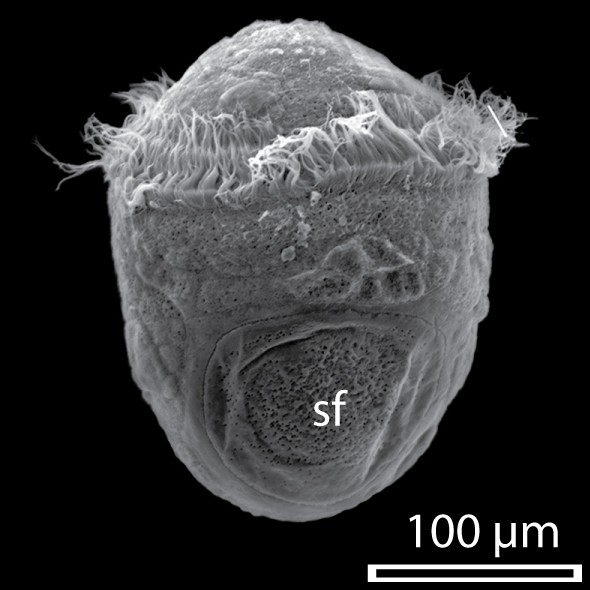


Key characteristics
Trochophores are recognized by their prominent bands of cilia and a roughly spherical or pear-shaped body. The ciliary bands include a prototroch, and in many species one or more additional bands that together produce water flow for swimming and for directing food particles toward the mouth. A sensory apical tuft is commonly present at the anterior end. These features, along with internal organization suited to rapid growth, distinguish the stage from later juvenile forms.
Development and life cycle
After fertilization, embryos that form trochophores undergo cleavage and gastrulation typical of many spiralian groups. The trochophore can be planktotrophic (feeding while in the plankton) or lecithotrophic (relying on yolk), depending on the species. In many mollusks the trochophore is followed by a more specialized veliger stage before settling into a benthic juvenile; in many polychaete annelids the trochophore metamorphoses directly into a segmented juvenile. For context on marine development see marine larval stages.
Ecology: movement and feeding
The bands of cilia generate currents that both propel the larva and bring suspended food particles within reach. By coordinated beating of ciliary rows the larva can change orientation and swim up or down in the water column, which affects dispersal and feeding opportunities. Trochophores are important members of plankton communities, serving as prey for larger planktonic predators and contributing to nutrient cycles.
Evolutionary and taxonomic significance
Trochophore-like larvae occur in several related phyla grouped within the superphylum Lophotrochozoa. Their presence is taken as evidence of shared developmental patterns among these lineages, although not all lophotrochozoans retain a classic trochophore stage — some have lost or modified it during evolution. Comparative study of trochophore morphology and genes has helped clarify relationships among mollusks, annelids, and other groups.
Notable distinctions and research uses
- Trochophore vs. veliger: the veliger is a later, often shelled molluscan stage with a specialized ciliated velum; it is distinct from the earlier trochophore.
- Functional studies of cilia and locomotion in trochophores contribute to broader understanding of fluid dynamics at small scales; see resources on ciliary bands and behavior at ciliary locomotion.
- Laboratory model species with readily observed trochophores are used in developmental biology to study axis formation and cell lineage.
For further summaries and illustrations consult general overviews and taxon-specific sources: trochophore larva, marine larval stages, and reviews of plankton ecology at plankton resources. For evolutionary context see discussions of Lophotrochozoa and specialized literature on ciliary bands.
Related articles
Author
AlegsaOnline.com Trochophore — marine larval form of many lophotrochozoans Leandro Alegsa
URL: https://en.alegsaonline.com/art/101606