
Thymine (5‑methyluracil): the DNA pyrimidine base
Thymine, or 5‑methyluracil, is a pyrimidine nucleobase found in DNA that pairs with adenine and contributes to genetic stability and recognition during replication and repair.
Overview
Thymine, chemically known as 5‑methyluracil, is one of the four standard nucleobases in the genetic polymer that carries hereditary information. It is a pyrimidine base that occurs primarily in the nucleic acid molecule DNA. In sequence notation it is represented by the letter T and is a fundamental component of the DNA alphabet used to encode genes.
Image gallery
2 Images
Structure and base pairing
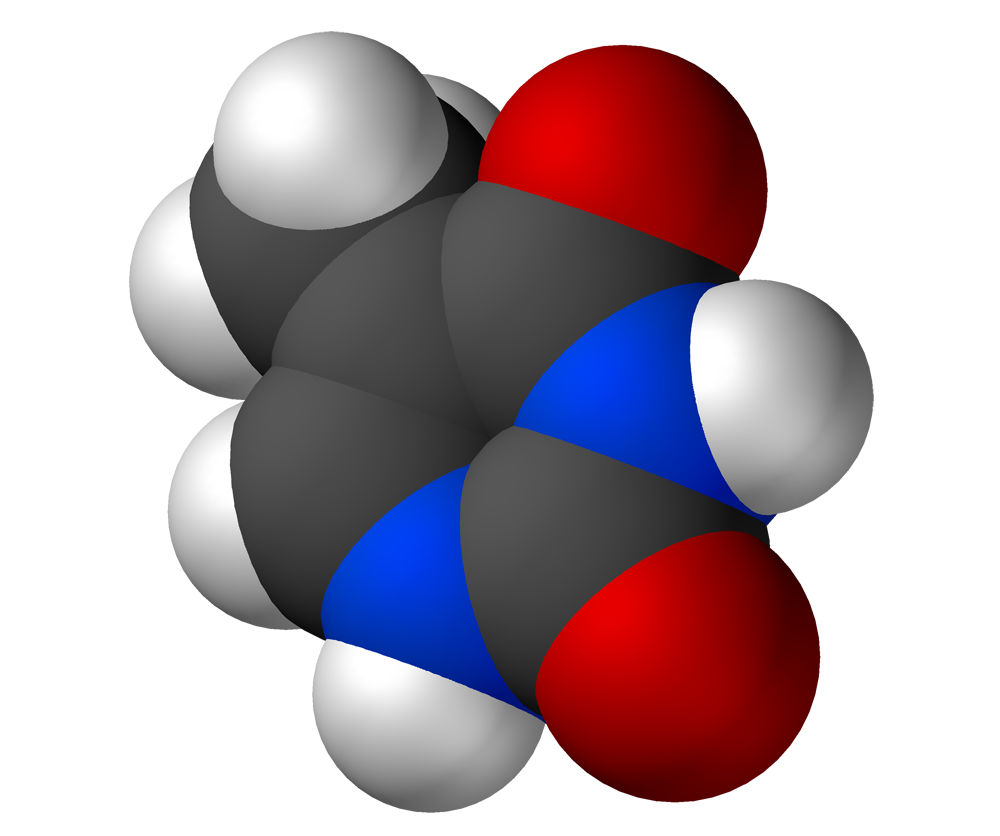
At a molecular level, thymine is uracil with an added methyl group at the 5 position. This small chemical difference distinguishes thymine from uracil and affects how the base interacts with other molecules. In double‑stranded DNA, thymine forms a complementary pair with adenine through two hydrogen bonds, helping to stabilize the regular geometry of the double helix. The methyl group also modestly increases thymine's hydrophobic character compared with uracil.
Biosynthesis and origin
Cells make thymine nucleotides through a biosynthetic pathway in which uracil‑containing precursors are methylated. In most organisms the conversion of deoxyuridine monophosphate (dUMP) to deoxythymidine monophosphate (dTMP) is catalyzed by thymidylate synthase, using a one‑carbon donor. This methylation step is essential for producing the thymidine triphosphates that are incorporated into DNA during replication.
Biological role and importance
Thymine contributes to the chemical stability and integrity of DNA. Because thymine, rather than uracil, is normally present in DNA, the DNA repair machinery can recognize and remove uracil that arises from spontaneous cytosine deamination, helping to prevent mutations. The presence of thymine is also important in processes that read and copy genetic information, such as DNA replication and transcription initiation.
Uses, analogs and examples
Thymine itself is central to molecular biology techniques that analyze DNA sequence and structure. Chemically modified thymine analogs and thymidine derivatives have practical uses: some are incorporated into nucleic acid probes, others serve as antiviral or anticancer drugs by mimicking natural nucleotides and interfering with DNA synthesis. In contrast, in RNA the equivalent base is uracil, which is used in place of thymine for single‑stranded transcripts.
Key characteristics and notable facts
- Canonical pairing: thymine (T) pairs with adenine (A) in DNA.
- Molecular identity: 5‑methyl derivative of uracil.
- Distribution: found primarily in DNA; uracil replaces it in RNA.
- Biological consequence: methylation that forms thymine aids DNA stability and repair recognition.
Thymine's simple modification relative to uracil exemplifies how small chemical changes can be leveraged by biology to encode, protect and process genetic information with high fidelity.
Related articles
Author
AlegsaOnline.com Thymine (5‑methyluracil): the DNA pyrimidine base Leandro Alegsa
URL: https://en.alegsaonline.com/art/99747