
Three-body problem in classical mechanics
The three-body problem asks how three masses move under mutual gravitational attraction. It has no general closed-form solution and is central to celestial mechanics, chaos theory, and spaceflight design.
Overview
The three-body problem asks for the motion of three point masses that interact under Newtonian gravitation. Unlike the two-body case, which admits simple closed-form orbits (conic sections), the general three-body motion can be highly complex and is not solvable by a single general formula. The question arises naturally in physics and astronomy whenever the mutual interaction of three bodies—such as the Sun, Earth, and Moon—is important.
Image gallery
7 Images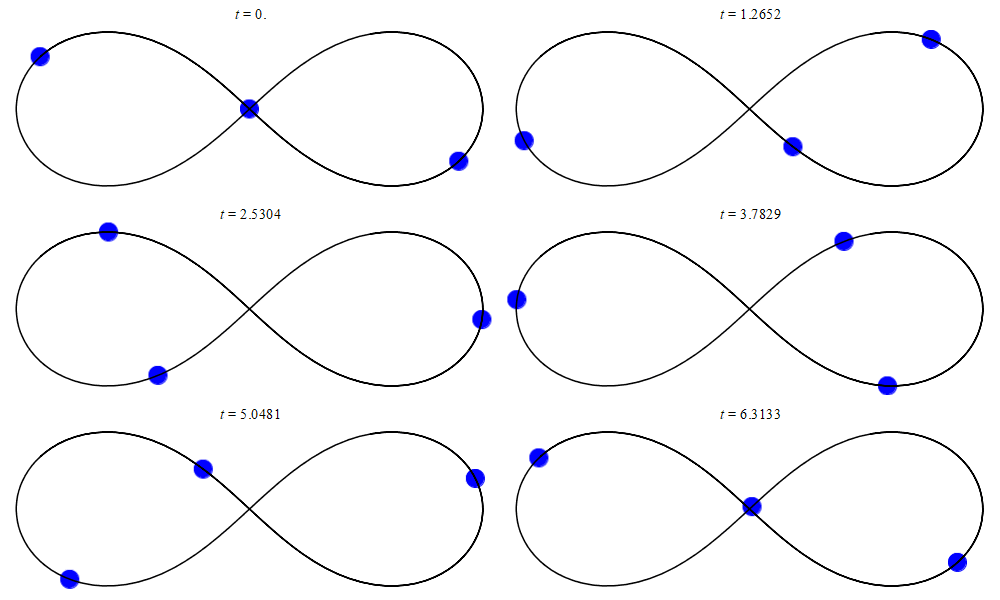



Key characteristics
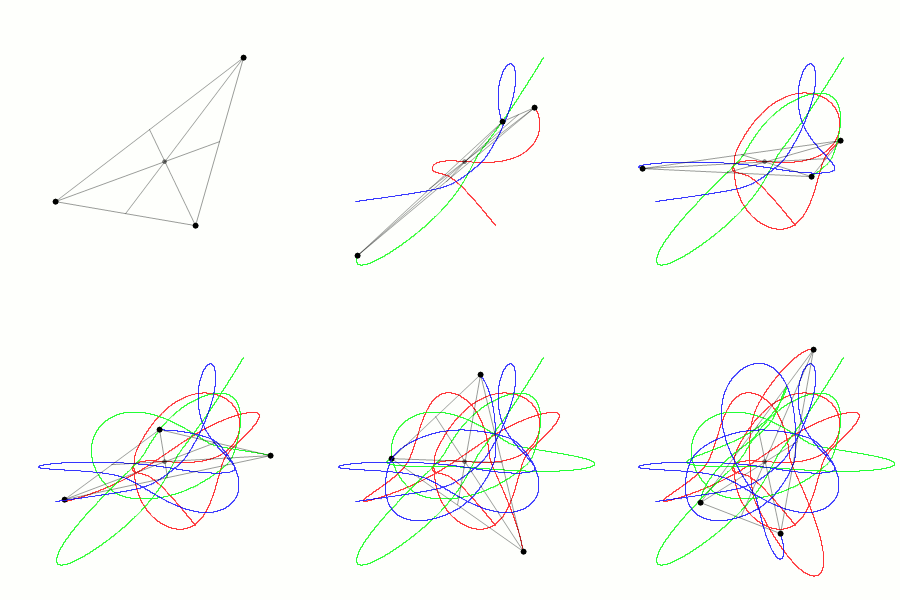
Several properties help describe the problem without producing a universal solution. The system conserves total energy, linear momentum and angular momentum, and the center of mass moves uniformly. Nevertheless, these conserved quantities are not enough to reduce the equations to elementary quadratures. Solutions can show sensitive dependence on initial conditions: tiny changes can lead to very different long-term behavior, a hallmark of deterministic chaos.
Historical development
Interest in the three-body problem dates to Newton’s work on gravitation, but deeper qualitative insights came much later. Pioneering mathematicians and mathematicians in the 19th century showed that the problem admits behavior far richer than simple periodic orbits. Later work produced special analytic series and isolated exact orbits, and modern computer-based searches uncovered many new periodic solutions.
Special cases and notable solutions
Restricting the problem simplifies it in useful ways. The restricted three-body problem treats one mass as negligible (useful for spacecraft and small bodies), and the circular restricted model assumes two primaries move on circular paths, revealing five equilibrium points known as Lagrange points. Some exact configurations are known: collinear and equilateral arrangements, and more exotic periodic paths such as the figure-eight solution discovered by numerical and analytical methods.
Methods and applications
Because no general algebraic solution exists, researchers rely on numerical integration, perturbation theory, regularization of close encounters, and modern symplectic integrators to study motion. The three-body framework underpins many practical tasks: planning gravitational-assist trajectories, studying satellite orbits near Lagrange points, understanding Trojan asteroids, and probing the long-term stability of planetary systems in astrophysics and gravity-dominated dynamics.
Notable facts and distinctions
- The three-body problem illustrates how simple deterministic laws can produce chaotic outcomes.
- There exist infinitely many special or periodic solutions, but they occupy limited regions in the space of all possible motions.
- Analytic series solutions exist under restrictive transformations, but they converge too slowly for most practical computations.
Related articles
Author
AlegsaOnline.com Three-body problem in classical mechanics Leandro Alegsa
URL: https://en.alegsaonline.com/art/99630
Sources
- wolframscience.com : "Historical Notes from Stephen Wolfram's A New Kind of Science"
- worldcat.org : An introduction to mechanics
- sciencemag.org : "Physicists Discover a Whopping 13 New Solutions to Three-Body Problem"
- arxiv.org : "The three-body problem"
- doi.org : 10.1088/0034-4885/77/6/065901
- worldcat.org : 0034-4885