
Time dilation: how motion and gravity alter the passage of time
Time dilation is the relativistic effect by which elapsed time differs for observers in relative motion or at different gravitational potentials, with practical consequences for satellites and clocks.
Overview
Time dilation describes how the amount of proper time that passes between events depends on an observer's state of motion and position in a gravitational field. In modern physics this effect follows from Einstein's theories of relativity: special relativity explains variation due to relative velocity, while general relativity explains variation due to gravity. Time dilation is not an artefact of mechanical clocks; it is a property of spacetime that affects all physical processes, including biological aging and atomic transitions.
Image gallery
7 Images


Two mechanisms
Physicists distinguish two related mechanisms:
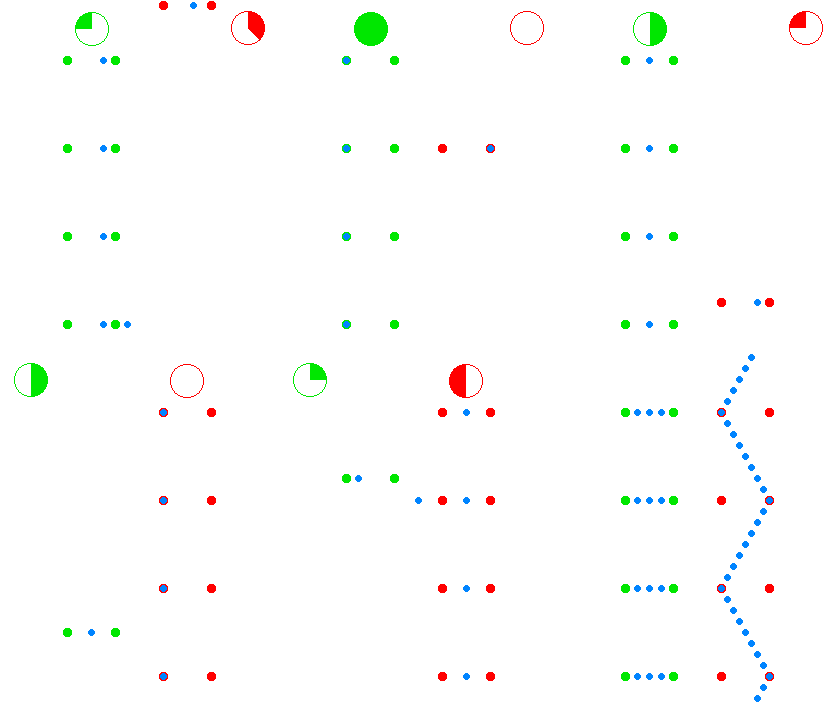
- Velocity-based time dilation — predicted by special relativity. An observer measuring a fast-moving clock finds that it ticks more slowly compared with their own clock. This effect depends on relative speed and is symmetric between inertial observers.
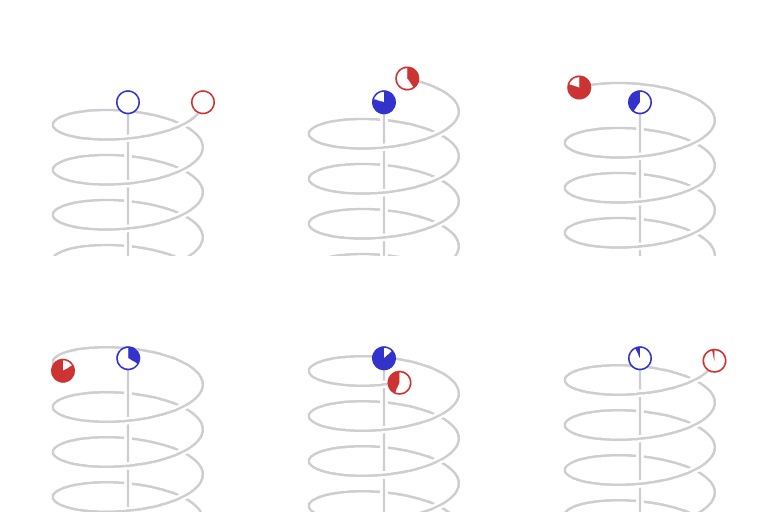
- Gravitational time dilation — predicted by general relativity. Clocks placed deeper in a gravitational field run more slowly than clocks farther away. Massive bodies such as planets and stars warp spacetime, producing this difference in rate; the more intense the gravity, the greater the slowdown.
How it appears in practice
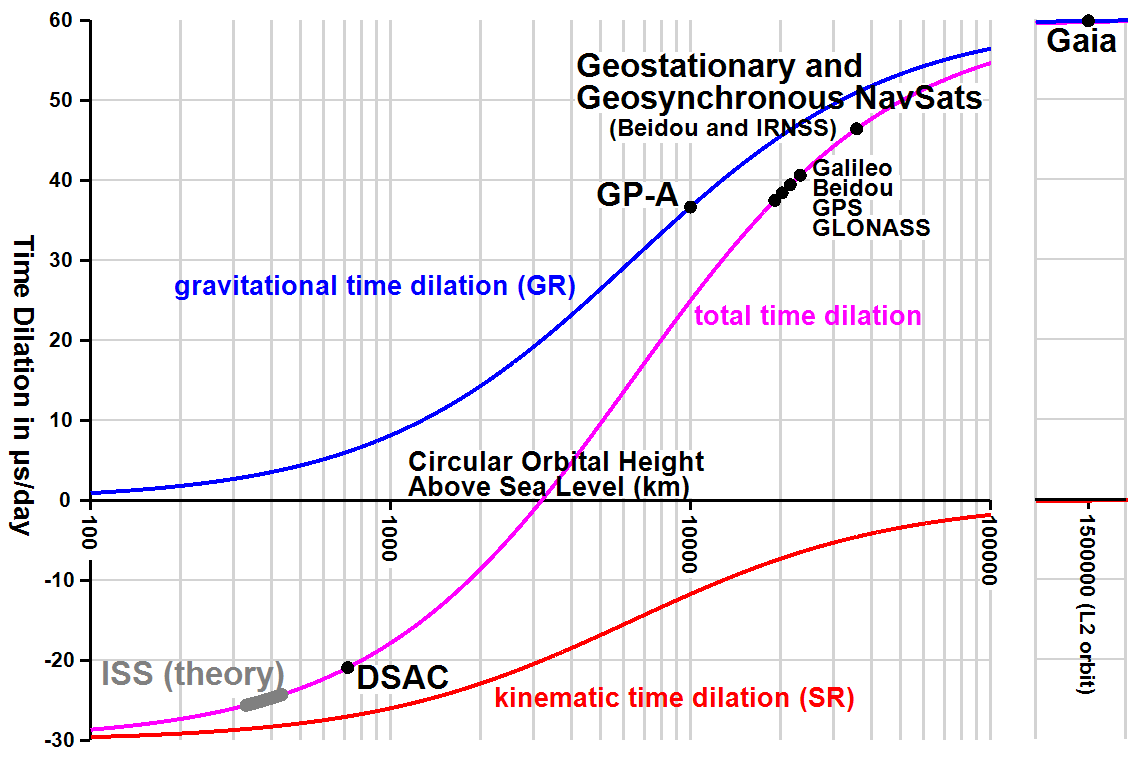
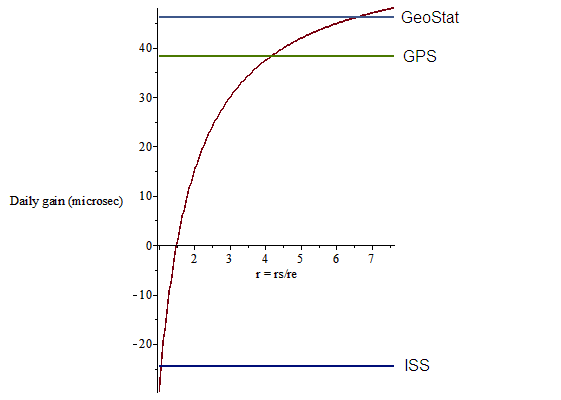
To make the idea concrete: a precision clock located in outer space well away from Earth will record more elapsed time than an identical clock on Earth, because the terrestrial clock sits deeper in Earth's gravitational field. Conversely, a clock on a fast-orbiting platform, such as the International Space Station, experiences velocity-related slowing. In many orbital regimes the two effects partially cancel: low Earth orbit tends to have stronger velocity time dilation, while higher orbits like geostationary orbit experience weaker velocity effects and noticeably less gravity, so clocks there can run faster relative to ground clocks.
Historical development and conceptual points
The twin ideas evolved from early 20th-century work. Special relativity introduced the relativity of simultaneity and a velocity-dependent factor that changes measured time intervals. General relativity then generalized the concept to include gravity by showing that mass-energy curves spacetime and that clocks follow worldlines whose elapsed proper time depends on that curvature. Two important conceptual points: time dilation is coordinate-independent when comparing proper times along worldlines, and the effect is measurable with atomic clocks rather than a mere coordinate convention.
Applications and examples
Engineers must account for both kinds of time dilation. The Global Positioning System corrects satellite clocks for their orbital speed and the weaker gravitational potential at altitude. Satellite operators choose timing hardware appropriate to each orbit, and synchronization procedures use the relativistic predictions as part of routine calibration. Other examples include experiments comparing clocks at different altitudes, tests using particle lifetimes, and thought experiments such as the twin paradox that illustrate asymmetries when acceleration or gravity breaks the symmetry of inertial motion.
Common confusions and notable distinctions
It helps to keep two distinctions clear: special-relativistic time dilation arises from relative velocity and is symmetric for inertial observers; gravitational time dilation arises from differences in gravitational potential and can be experienced even by observers at rest relative to one another. Neither effect implies a single universal ‘‘true’’ rate of time; rather, comparisons depend on which clocks and worldlines are being compared. Both effects have been confirmed repeatedly by experiment.
Further information and curated links
- Gravitational time dilation (overview)
- Passage of time (concept)
- General relativity (formal theory)
- Clock technologies used in tests
- Outer space environments
- Earth reference frames
- Mass and gravity sources
- Planets as gravitating bodies
- Gravitational field (concept)
- Special relativity (fundamentals)
- Satellites and orbital regimes
- International Space Station (example)
- Orbital motion and speed
- Low Earth orbit considerations
- Geostationary orbit characteristics
- Engineering implications for timing
- GPS and relativistic corrections
Questions and answers
Q: What is gravitational time dilation?
A: Gravitational time dilation is a physics concept about changes in the passage of time, caused by general relativity. It occurs when heavy objects like planets create a gravitational field that slows down time nearby.
Q: How does it differ from special relativity?
A: Special relativity states that fast objects move more slowly through time, while gravitational time dilation says that clocks near a strong gravitational field run slower than clocks in a weaker gravitational field.
Q: What happens to clocks on the International Space Station (ISS)?
A: Because the ISS is in low Earth orbit (LEO), its speed causes more slowing down of its clock than speeding up due to gravity. This means that a clock on it is slowed down more than it is sped up.
Q: How does Geostationary orbit affect clocks?
A: An object in Geostationary orbit moves less quickly and is farther away from Earth, so gravitational time dilation is stronger, and clocks move more quickly than in LEO.
Q: What do engineers need to consider when picking different clocks for different orbits?
A: Engineers need to pick different clocks for different orbits depending on how much they are affected by gravity or speed due to their position and distance from Earth's surface.
Q: How does GPS satellites work with regards to both kinds of time dilation?
A: GPS satellites work because they know about both kinds of time dilation - special relativity and general relativity - which allows them to accurately measure distances between locations on Earth's surface despite differences in gravity or speed due to their positions and distances from Earth's surface.
Related articles
Author
AlegsaOnline.com Time dilation: how motion and gravity alter the passage of time Leandro Alegsa
URL: https://en.alegsaonline.com/art/99918
Sources
- relativity.livingreviews.org : "Relativity in the Global Positioning System"
- ui.adsabs.harvard.edu : 2003LRR.....6....1A
- doi.org : 10.12942/lrr-2003-1
- books.google.com : Laser 2006
- ui.adsabs.harvard.edu : 1979ZPhyA.289..151H
- doi.org : 10.1007/BF01435932
- ui.adsabs.harvard.edu : 2010Sci...329.1630C
- doi.org : 10.1126/science.1192720
- pubmed.ncbi.nlm.nih.gov : 20929843
- ui.adsabs.harvard.edu : 1964PhRvL..13..539P
- doi.org : 10.1103/PhysRevLett.13.539