
Thread snake (slender blind snake)
Small, slender fossorial snakes in the family Leptotyphlopidae and related groups. Overview of appearance, behavior, distribution, diet, reproduction, and notable facts.
The term "thread snake" or "slender blind snake" refers to several groups of tiny, burrowing snakes notable for their thin, wormlike bodies, reduced eyes and secretive lifestyles. These snakes belong principally to the family Leptotyphlopidae (and similar blind‑snake families) and are adapted for life below the surface. One well‑publicized member of this general group, Leptotyphlops carlae, is among the smallest known snakes on record; for more on the smallest species see smallest known snake.
Image gallery
10 Images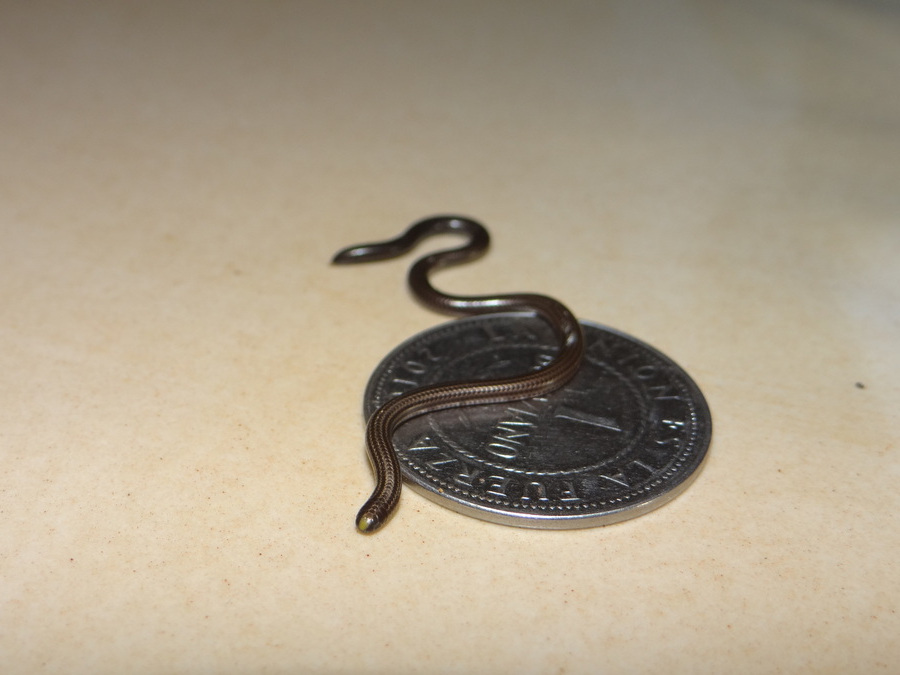


Physical characteristics
Thread snakes are typically very slender, with smooth, glossy scales and a cylindrical shape that helps them move through soil and leaf litter. Eyes are tiny and usually hidden beneath scales, rendering them effectively blind except for light sensitivity. The head is not distinct from the neck, and the tail is short, sometimes ending in a tiny spine. Typical adults range from a few centimetres to a few dozen centimetres depending on species.
Distribution and habitat
Species commonly called thread snakes occur in warm regions around the world. They can be found in parts of North America, South America, Asia and Africa. Habitats vary from humid tropical rainforests to arid scrub and desert margins. Many species are associated with loose soils, fallen logs and the edges of human habitations where they can access insect nests; some are especially common near rainforests or more xeric environments.
Diet and behaviour
Thread snakes feed mainly on small soft-bodied invertebrates. A common preference is for the eggs, larvae and pupae of social insects, which often makes them frequent visitors to ant and termite nests: see research on feeding in relation to ants and termites. They enter galleries and use stealth and small size to exploit concentrated food sources. Most are non‑venomous and subdue prey by suction or simple swallowing.
Reproduction, taxonomy and conservation
Many thread snake species lay eggs (are oviparous), though reproductive modes can vary across taxa. Taxonomically they are distinct from other small, wormlike snakes such as members of the Typhlopidae; identification relies on scale patterns, skull features and molecular data. Because they are secretive and small, population trends are poorly known for many species; habitat loss and introduced predators can threaten local populations. The group is of interest to scientists because of its extreme miniaturization and specialized ecology.
- Notable fact: Some species are so small that they were overlooked until modern surveys documented them.
- Human interaction: Harmless to people and often beneficial because they help control ant and termite brood.
For further reading about specific species and regional checklists consult specialist literature and faunal databases using the links above as starting points.
Related articles
Author
AlegsaOnline.com Thread snake (slender blind snake) Leandro Alegsa
URL: https://en.alegsaonline.com/art/99623