
The Walk (2015 film)
A dramatized, visually driven retelling of Philippe Petit’s 1974 high-wire crossing between the Twin Towers, directed by Robert Zemeckis and released in IMAX 3D in 2015.
The Walk is a 2015 American 3D biographical drama movie that reconstructs the daring high-wire walk performed by Philippe Petit between the Twin Towers of the World Trade Center in 1974. The film was directed by Robert Zemeckis and co-written by Zemeckis and Christopher Browne. It blends narrative drama with immersive visual effects to place viewers on the wire alongside the central performer.
Image gallery
2 Images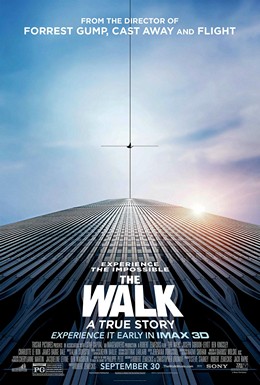

Overview
The story follows Philippe Petit, a French street performer and tightrope walker, as he conceives and executes a clandestine plan to string a cable between the two newly built towers in Lower Manhattan and walk the gap. The plot focuses on his obsession with the walk, the team of friends who help him, and the tension between artistry and illegality. The film stages the act as both a physical feat and a personal statement about risk, beauty, and attention.
Cast and performances
The film stars Joseph Gordon-Levitt as Petit, supported by Ben Kingsley, Charlotte Le Bon, James Badge Dale, Ben Schwartz, and Steve Valentine. Gordon-Levitt performed much of the physical acting for the role and worked to capture Petit’s personality and mannerisms. Critics commonly noted the performances and the film’s visual ambition as its strongest elements.
Production and visual approach
Production combined practical stunt work, on-set wire sequences, and computer-generated imagery to recreate the towers and the vertiginous views between them. The filmmakers used stereoscopic techniques to enhance depth perception, a choice that informed the decision to open in IMAX 3D formats. Robert Zemeckis’s direction emphasizes immersion: long, uninterrupted shots and perspective-driven editing aim to simulate the sensation of walking over a massive urban void while also grounding the film in character-driven scenes.
Release, context and reception
The film was released in late 2015, first in IMAX 3D and subsequently in 2D and standard 3D screenings. Its release carried a conscious memorial tone: the filmmakers dedicated the picture to the victims of the September 11 attacks, and many viewers noted the poignancy of depicting the Twin Towers on screen after their destruction. Reviewers tended to praise the technical achievement and the immersive sequences while offering mixed views on pacing and the dramatization of events.
Historical basis and legacy
Philippe Petit actually achieved the high-wire walk on August 7, 1974, in an act that became legendary as a mixture of artistry, audacity, and illegality. The film takes some liberties typical of dramatizations—compressing timelines, emphasizing certain relationships, and interpreting motivations—while retaining the core fact of the unauthorized walk. It renewed public interest in Petit’s life and the original event, and it serves as an example of how modern filmmaking can reconstruct vanished landmarks for new audiences.
Notable facts
- The production attempted to balance respect for historical memory with cinematic spectacle.
- Technical choices highlighted depth and vertigo, aiming to place viewers in the performer’s point of view.
- The casting combined established actors and younger performers to portray Petit's collaborators and opponents.
For more information about the film’s production, interviews, and technical details, consult dedicated film resources and archived interviews with the cast and crew. The Walk remains frequently cited in discussions about 3D filmmaking and the cinematic recreation of real-world feats.
Production country • 3D technology • Genre • Film • Director • Subject • Setting • Lead actor • Supporting actor • Supporting actress • IMAX release • Dedication
Related articles
Author
AlegsaOnline.com The Walk (2015 film) Leandro Alegsa
URL: https://en.alegsaonline.com/art/99064