
Suru Valley (Ladakh): geography, communities, history and travel
High-altitude valley in Ladakh drained by the Suru River, home to mixed Dardic and Tibetan communities, notable towns Kargil and Rangdum, and routes into Zanskar and the Indus basin.
Overview
The Suru Valley is a high Himalayan valley in the Ladakh region of northern India. It lies at roughly 3,000 metres above sea level and is carved and drained by the Suru River, a tributary of the larger Indus river system. The valley functions as an important natural corridor between the higher Zanskar ranges and the broader Indus basin. Major settlement nodes include the district town of Kargil and the village cluster around Rangdum, which also hosts a historic Buddhist monastery.
Image gallery
5 Images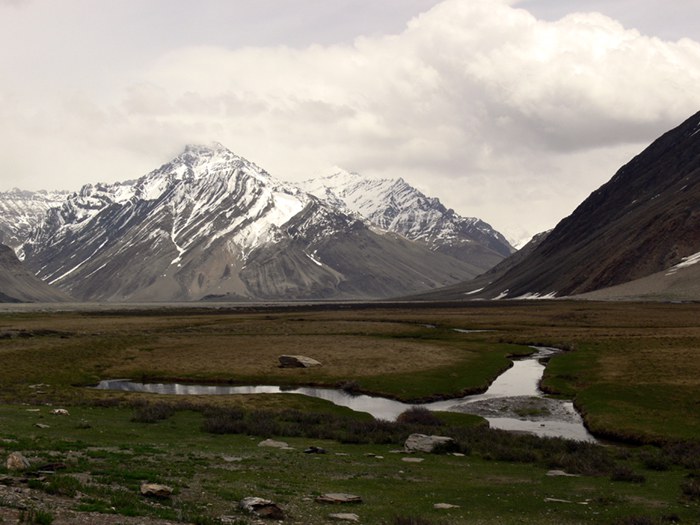


Geography and landscape
The valley presents a contrast between cold, rocky highlands and narrow, vegetated river terraces where winter snowmelt sustains streams and irrigation. Alpine pastures and glaciated ridges bound the valley, while lower slopes support willow and poplar trees planted and tended by local communities. A notable pass near the valley, Penzella Pass at Panikhar, forms one of the routes that connect Suru with the neighbouring Zanskar region and its plateaus.
River and hydrology
The Suru River drains the valley and contributes to the Indus river network. Local hydrology is driven by seasonal snowmelt and glacial runoff; rivers swell in late spring and summer and reduce to thin streams in winter. Because the Suru is part of the broader Indus watershed, changes in its flow affect downstream water availability and seasonal patterns for agriculture and grazing.
People, language and religion
The valley is inhabited by communities of Dardic and Tibetic background. Many residents follow Shia Islam, a religious tradition that shapes communal life in villages and towns, while Buddhist communities persist, particularly in higher-altitude settlements such as Rangdum. Local languages and dialects reflect the region's role as a cultural crossroads between western Himalayan, Central Asian and Tibetan influences.
Economy, land use and culture
Traditional livelihoods in Suru combine agriculture on irrigated terraces, animal husbandry on summer pastures and small-scale forestry. Willow and poplar are common in cultivated stretches and are used for construction, fencing and fuel. Cultural life includes a mix of Islamic and Buddhist festivals, local crafts, and monastic traditions where monasteries remain active as spiritual and community centers.
Travel, routes and tourism
The valley is accessible by road from wider Ladakh and serves as an approach to Zanskar for trekkers and pilgrims. Panikhar, often described as a hill resort at the interface with Zanskar, and the Penzella Pass are landmarks for travelers. Kargil functions as the main administrative and service center for visitors, while Rangdum attracts those interested in high-altitude Buddhist culture and remote mountain vistas. Seasonal access can be limited by snow and weather.
Notable places and resources
- Kargil — principal town and administrative hub.
- Rangdum — high-altitude settlement with a Buddhist monastic presence.
- Panikhar and Penzella Pass — route toward Zanskar plateaus and pastures.
- River corridors — willow and poplar belts along irrigated terraces.
For regional context see Ladakh, details about the valley's main stream at Suru River, the broader basin via the Indus River, and religious background at Shi'a Islam.
The Suru Valley remains important as both a living cultural landscape and a link in the mountainous hydrological network of the western Himalaya. Its combination of rugged scenery, mixed cultural influences and seasonal pastoral and agricultural patterns make it a distinct valley within the broader Ladakh region.
Related articles
Author
AlegsaOnline.com Suru Valley (Ladakh): geography, communities, history and travel Leandro Alegsa
URL: https://en.alegsaonline.com/art/95211