
Sullivan Bay, Victoria — site of Victoria’s first European settlement
Sullivan Bay, near Sorrento at Port Phillip’s entrance, was the location of the first official European settlement in what is now Victoria. The short-lived 1803 outpost is notable for its origins, failings and legacy.
Sullivan Bay is a small inlet on the Mornington Peninsula close to Sorrento, at the entrance to Port Phillip. It occupies a strategic position about 60 km (37 mi) south of Melbourne and has been recognised as the site of the first official European settlement in what later became the state of Victoria, Australia. The bay’s coastal features—open sand flats, exposed headlands and shallow waters—helped determine both the choice of site and the difficulties encountered by early colonists.
Image gallery
3 Images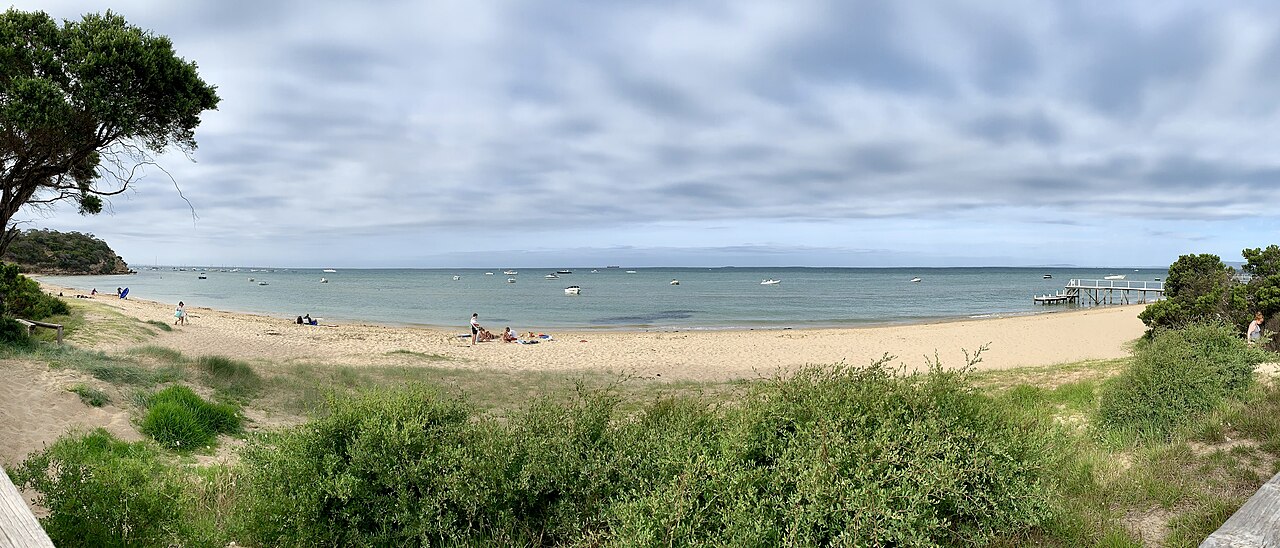


Historical background
The decision to establish a presence at Port Phillip was taken in the context of imperial rivalry and maritime economy. Governor Philip Gidley King in Sydney urged settlement partly to secure fishing and sealing resources and partly to pre-empt other nations, notably the French, from establishing bases in Bass Strait. Earlier exploration by naval officers, including Lieutenant John Murray, identified promising anchorages in the Sorrento area and influenced the selection of Sullivan Bay for a formal outpost. Communications and instructions reached the colonial authorities from London as part of broader plans to consolidate British claims along Australia’s southern coast.
Settlement, conditions and abandonment
The settlement at Sullivan Bay was short-lived. Colonists and a convict contingent faced poor drinking water, sandy soils unsuitable for farming, limited timber and exposure to strong winds and tides. These physical constraints, together with logistical problems and the superior harbour facilities available elsewhere, led officials to relocate the group to the River Derwent in Van Diemen’s Land (now Tasmania) within a relatively brief period. The experience at Sullivan Bay provided administrators with practical lessons about site selection, supply and relations with local Indigenous communities.
Characteristics and notable features
- Geography: shallow bay near the entrance to Port Phillip with sandy beaches and coastal vegetation.
- Strategic aim: intended to secure fisheries and shipping routes in Bass Strait.
- Short occupation: remains important for being the earliest formal European attempt to settle this region, although it did not persist.
- Archaeology and heritage: traces of the early camp and associated artefacts have been of interest to researchers and local heritage groups.
Legacy and visiting today
Although Sullivan Bay did not develop into a permanent town, its historical role is recognised in regional histories and by heritage markers. The site is interpreted as part of the story of colonisation, maritime exploration and the contested use of coastal resources in the early 19th century. Visitors to the area can view coastal scenery and consider the environmental challenges that shaped the settlement’s fate. For background reading and entry points to primary sources and local interpretation, see references and external links associated with studies of early Port Phillip settlement and colonial policy (first official European settlement, Victoria, Australia).
The history of Sullivan Bay connects to broader themes in Australian colonial history—maritime exploration, competition between European powers, interaction with Indigenous peoples, and the practical limits placed on early settlements by environment and logistics. Those interested in visiting or researching the site can consult local museums and heritage organisations for guided material and archaeological reports (37 mi references for distance), or seek governmental heritage listings and conservation plans to learn how this short-lived settlement is preserved in public memory (Melbourne, Sydney, London contexts).
Key historical figures and decisions remain central to accounts of Sullivan Bay: exploratory surveys, the recommendation from Governor King, and the tensions that prompted a rapid transfer of settlers. These elements illustrate how imperial aims, local geography and practical necessity combined to shape one of Victoria’s earliest colonial experiments.
Questions and answers
Q: Where is Sullivan Bay located?
A: Sullivan Bay is located near Sorrento, Victoria, which is 60 km (37 mi) south of Melbourne, at the entrance of Port Phillip Bay.
Q: What is the significance of Sullivan Bay?
A: Sullivan Bay is the site of the first official European settlement in Victoria, Australia.
Q: When did Governor Philip Gidley King propose settling at Port Phillip Bay?
A: Governor Philip Gidley King proposed settling at Port Phillip Bay in 1802.
Q: Why did King propose settling at Port Phillip Bay?
A: King proposed settling at Port Phillip Bay because he believed the area would be good for fishing and sealing, and he was worried that the French might settle there and control Bass Strait.
Q: Who recommended Sorrento as a good spot for settlement?
A: Lieutenant John Murray recommended the Sorrento area as a good spot for settlement.
Q: When did Murray explore Port Phillip Bay?
A: Murray explored Port Phillip Bay in 1802.
Q: Why did Murray recommend Sorrento for settlement?
A: Murray believed that Sorrento would be a good spot for settlement based on his exploration of the area.
Related articles
Author
AlegsaOnline.com Sullivan Bay, Victoria — site of Victoria’s first European settlement Leandro Alegsa
URL: https://en.alegsaonline.com/art/94725
Sources
- slv.vic.gov.au : "Settlement at Sullivan Bay, Ergo, State Library of Victoria"
- virtualsorrento.com.au : "Sullivan Bay Settlement"