
Straightedge and compass construction
Classical geometric constructions made with an unmarked straightedge and a compass: methods, limits, algebraic characterization, classical examples, and key impossibility results.
Straightedge and compass construction is the classical practice of creating geometric figures using only an unmarked straightedge and a compass. In the formal rules this means one may draw straight lines through two known points and circles with a given center and radius, producing new points of intersection that become the basis for further steps. Typical targets are lengths, angles, and shapes, all constructed without measurement instruments beyond those two tools. The straightedge in this context is an ungraduated ruler, and the other essential instrument is the compass.
Image gallery
8 Images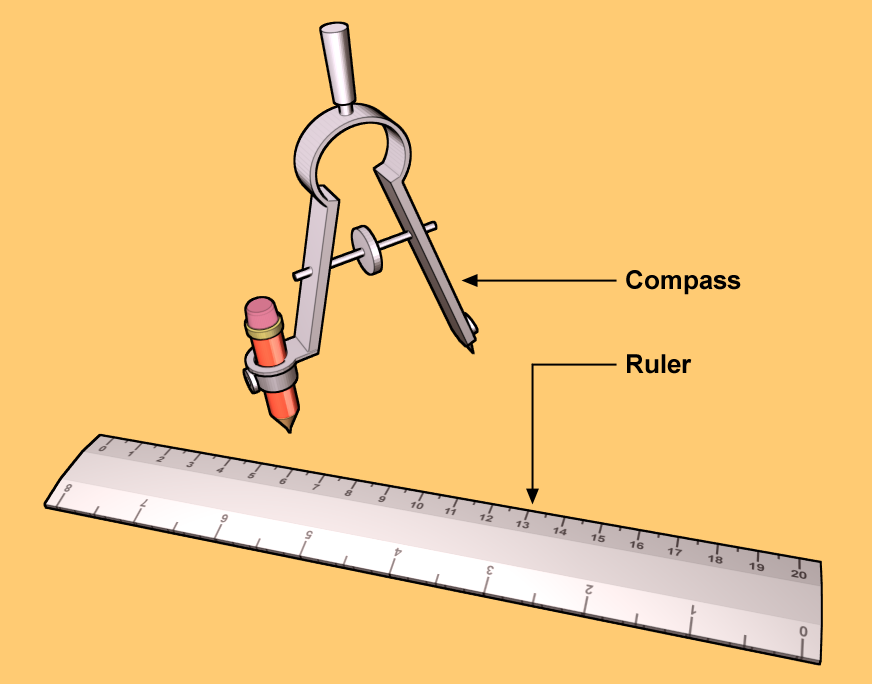




Basic constructions and examples
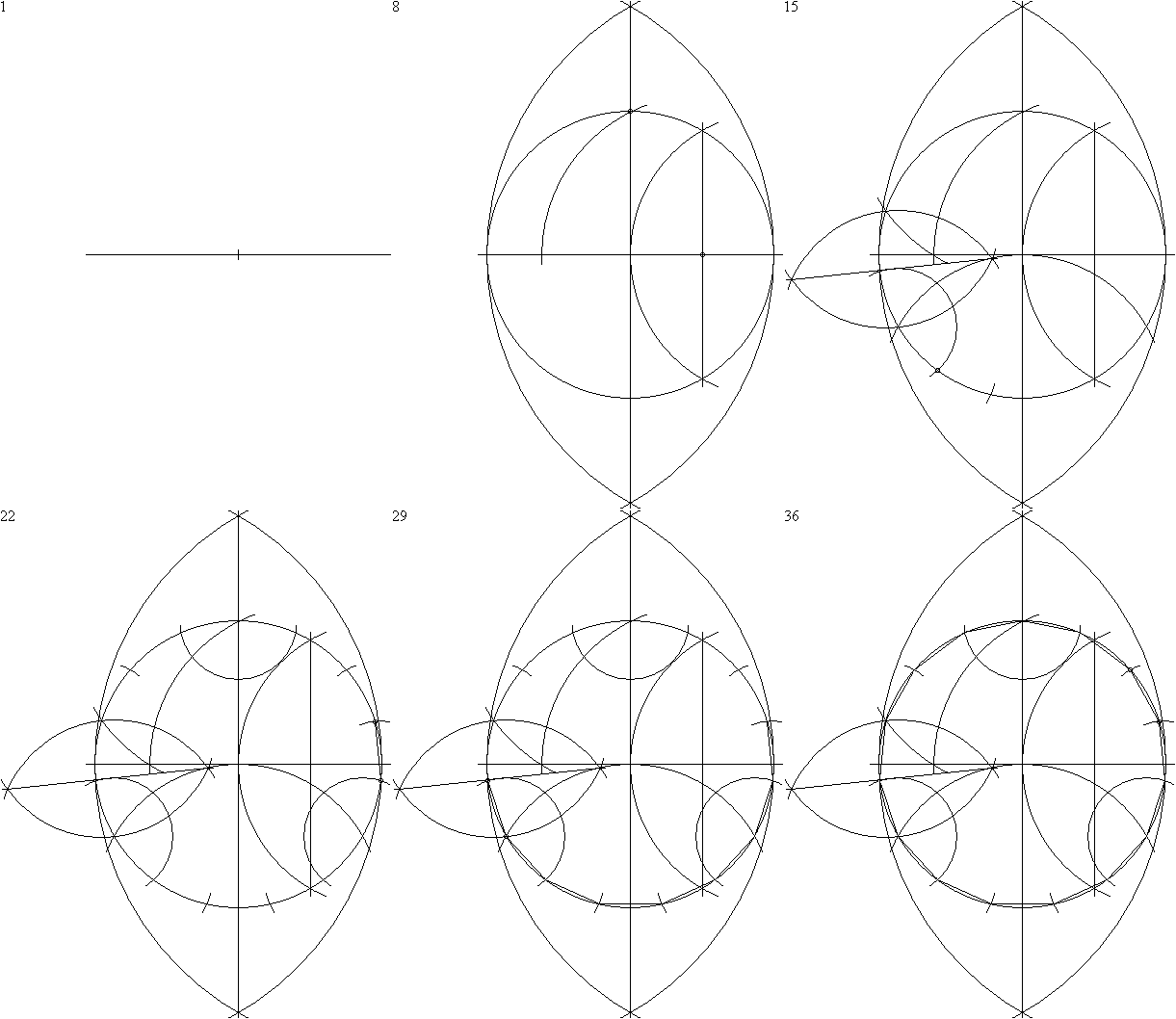
From a few simple operations many standard constructions follow: erecting perpendiculars, bisecting a segment, bisecting an angle, copying a segment, constructing an equilateral triangle on a given side, and inscribing polygons in a circle. Iterating angle bisection yields regular polygons with numbers of sides that are powers of two. Classic exercises in Euclidean geometry demonstrate these procedures with straightedge-and-compass steps.
Algebraic characterization
The class of points and lengths attainable by these constructions can be described algebraically. Constructible lengths correspond to numbers obtainable from the rational numbers by a sequence of square-root extensions; equivalently, the field extensions involved have degree a power of two. This connection lets algebra decide possibility: for a given construction one translates the geometric constraints into polynomial equations and examines whether the required roots lie in a tower of quadratic extensions.
Regular polygons and known limits
Carl Friedrich Gauss identified exactly which regular n-sided polygons are constructible: an n-gon is constructible with straightedge and compass if and only if n equals a power of two times a product of distinct Fermat primes. That criterion explains why only a restricted family of regular polygons can be made; only a handful of Fermat primes are known, so only a limited list of odd-sided regular polygons is currently constructible. Modern treatments link this result to Galois theory and to explicit compass-and-straightedge methods for specific n. See a list of regular polygons and the special role of odd-number factors in the factorization of n with respect to sides.
Impossibility results and deeper theory
Several famous classical problems are impossible under straightedge-and-compass rules. The general angle trisection cannot be performed for arbitrary angles, doubling the cube (constructing a cube with twice the volume of a given cube) is impossible, and the ancient problem of proven impossibility to construct a square of the same area as a given circle ("squaring the circle") follows from modern transcendence results. These impossibilities are consequences of algebraic and analytic theorems: Galois theory explains the limitations coming from degree constraints, while the transcendence of pi rules out the circle-squaring construction.
Historically, straightedge-and-compass construction shaped much of Greek geometry and remained a central topic through the development of algebra. Today it is a standard illustration of the bridge between classical construction techniques and abstract field theory, and its limitations provide clear examples where algebra decides geometric possibility.
Related articles
Author
AlegsaOnline.com Straightedge and compass construction Leandro Alegsa
URL: https://en.alegsaonline.com/art/94153