
Stibnite (antimony sulfide mineral)
Stibnite is a lead-gray to black antimony sulfide mineral (Sb2S3), the primary ore of antimony; known for acicular crystals, softness, and economic uses in metallurgy and flame retardants.
Overview
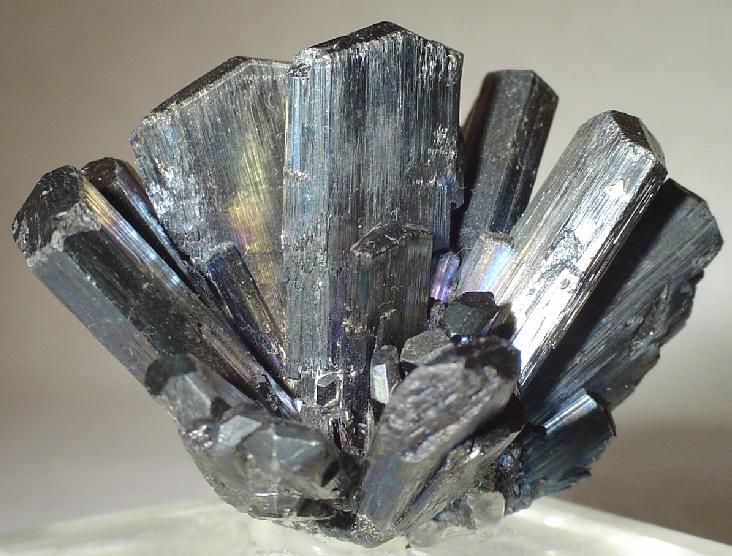
Stibnite is a sulfide mineral whose chemical formula is Sb2S3. It is the chief source and ore of antimony, an element used in alloys, flame retardants and other industrial applications. As a recognizable mineral, stibnite often appears as elongated, needle-like crystals with a metallic luster and a lead-gray to black color. A very large specimen is displayed at the American Museum of Natural History.
Image gallery
6 Images


Physical and chemical characteristics
Stibnite crystallizes in the orthorhombic system and commonly forms acicular (needle-like) or columnar habits that can radiate into bundles. It is soft, about Mohs hardness 2, and has a relatively high density; its specific gravity is typically near 4.63. Stibnite is brittle, has a perfect cleavage in one direction, and yields a dark streak when rubbed on a porcelain plate.
Occurrence and formation
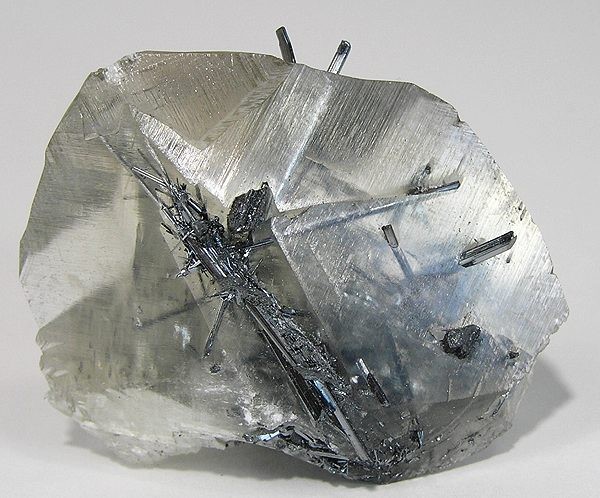
Stibnite typically forms in low- to moderate-temperature hydrothermal veins, often associated with minerals such as quartz, calcite, galena and other sulfides. Major historical deposits have been mined in China, Japan, Mexico and parts of Europe. Geologists and collectors value specimens that display long, intact crystals or radiating sprays.
Uses and economic importance
As the principal ore of antimony, stibnite is mined and processed to extract the element. Antimony is alloyed with lead to harden it (useful in lead-acid batteries and ammunition), and compounds of antimony are used as flame retardants and in some semiconductor applications. Processing methods include mechanical concentration and smelting or roasting to produce antimony trioxide and metallic antimony.
Health, handling and notable facts
Dust from stibnite and soluble antimony compounds can be toxic if inhaled or ingested, so mining and processing require safety controls. Historically, antimony compounds from stibnite were used in small amounts for medicinal and cosmetic purposes (for example as the eye cosmetic kohl), but such uses are now discouraged due to toxicity risks. The mineral has long fascinated collectors for its dramatic needle-like crystals and is often featured in museum collections as an example of sulfide mineralogy; see a general mineral page at stibnite for more context.
Identification at a glance
- Formula: Sb2S3
- Color and luster: lead-gray to black, metallic
- Hardness: about 2 (very soft)
- Specific gravity: ~4.63 (see density notes)
- Principal use: ore of antimony
Related articles
Author
AlegsaOnline.com Stibnite (antimony sulfide mineral) Leandro Alegsa
URL: https://en.alegsaonline.com/art/93907