
Swanscombe Heritage Park: Paleolithic Site and Geological Reserve
A summary of Swanscombe Heritage Park in north-west Kent, its Paleolithic finds, geology, excavations, and significance for understanding early human occupation and interglacial environments in Britain.
Swanscombe Heritage Park lies in north-west Kent and preserves a compact but scientifically rich area of former gravel workings known as Barnfield Pit. Designated a geological Site of Special Scientific Interest and containing two Geological Conservation Review units, the reserve protects exposures that record a sequence of river terraces and interglacial deposits important for Palaeolithic study. The park covers a few hectares and is recognised both for its geology and its archaeological value as a National Nature Reserve official notice and local landmark location.
Archaeologists first became aware of Barnfield Pit because of its abundant stone tools. Large numbers of handaxes and flakes were recovered from the gravel horizons, including implements associated with both Acheulean and Clactonian technological traditions, which illustrate different approaches to tool production in the Lower Palaeolithic technologies. The most spectacular discovery was made in 1935–36 when two fossilised skull fragments emerged from deep gravel deposits. Initially grouped under the informal name "Swanscombe Man," later study concluded the fragments probably came from a young woman and represent an archaic human population dating to the Hoxnian interglacial, roughly 400,000 years ago Hoxnian context. The cranial material has been variably described as early Neanderthal-like or close to populations often placed near Homo heidelbergensis in the Middle Pleistocene spectrum classification comparative site.
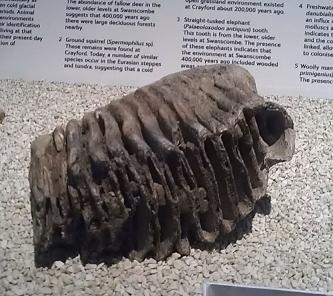
Fieldwork at the pit has taken place in several phases. The original finds came from the lower middle terrace gravels at a depth of nearly eight metres beneath the modern surface. Intensive excavations resumed in the late 1960s and early 1970s, which recovered further stone tools, animal bones and environmental evidence and allowed investigators to map a former shoreline and activity areas preserved in the deposits. The site records both human behaviour and the animals and plants that formed the local ecosystem; faunal remains found there help reconstruct the woodland and riverine habitats of the Hoxnian interglacial fossil record skull finds.
Image gallery
5 Images


Significance and comparisons
Swanscombe is one of the very few places in Britain to yield human fossil material from the Lower Palaeolithic; it is often mentioned alongside Boxgrove, where around 500,000-year-old remains attributed to Homo heidelbergensis have been found Boxgrove comparison. Together these sites provide rare direct evidence of early human presence in northwestern Europe. The combination of stone technology, skeletal fragments and preserved environmental layers makes Swanscombe central to debates about when, how often and under what climatic conditions early humans occupied Britain museum record regional context.
Finds, curation and public access
Most of the bone material discovered during excavations is curated by national collections, while many of the stone tools are held in prominent museum collections. Interested visitors can learn about the discoveries through museum displays and local interpretation, although the in situ gravel exposures are managed for conservation rather than unfettered public excavation. The human remains and artefacts have been studied and are curated in institutions that preserve them for research and display collection.
Notable features and related sites
- Notable artefacts: Acheulean handaxes and Clactonian flakes recovered from terrace gravels.
- Key stratigraphy: lower middle terrace gravels containing shoreline deposits and palaeoenvironmental indicators.
- Excavation history: major finds in 1935–36 and further campaigns in 1968–72 which refined the stratigraphic interpretation.
- Comparative British Palaeolithic sites: Happisburgh, Pakefield, Pontnewydd, Kents Cavern, Paviland and Gough's Cave provide a wider context for early human occupation and coastal and cave sites Happisburgh link.
Further reading and links
- Swanscombe SSSI designation and summary
- Geographic and local information
- Gravel extraction history
- Barnfield Pit quarry background
- Lower Palaeolithic technologies (Acheulean, Clactonian)
- Palaeontological finds from Swanscombe
- Details of the skull fragments
- Taxonomic considerations for the Swanscombe remains
- Hoxnian interglacial context and dating
- Comparison with Boxgrove site
- Material held at the Natural History Museum
- Regional archaeological context
- British Museum stone tool collections
- Other major early Palaeolithic sites in Britain
Questions and answers
Q: What is Swanscombe Heritage Park?
A: Swanscombe Heritage Park or Swanscombe Skull Site is a 3.9 hectares (9.6 acres) geological Site of Special Scientific Interest located in north-west Kent.
Q: What are the two Geological Conservation Review sites at the park?
A: The park has two Geological Conservation Review sites, and a National Nature Reserve.
Q: Where was Barnfield Pit located?
A: Barnfield Pit was located in the former gravel quarry at Swanscombe Heritage Park.
Q: How old were the handaxes found at Barnfield Pit?
A: The handaxes found at Barnfield Pit were mostly Acheulean and Clactonian artifacts, some as much as 400,000 years old.
Q: Who did the skull fragments belong to?
A: The skull fragments belonged to a young woman who was later identified as Swanscombe Man.
Q: How old are the Neanderthal remains from this site? A: The Neanderthal remains from this site date back to around 400,000 years ago during the Hoxnian Interglacial period.
Q: What other key paleolithic sites are there in the UK? A: Other key paleolithic sites in the UK include Happisburgh, Pakefield, Pontnewydd, Kents Cavern, Paviland and Gough's Cave.
Related articles
Author
AlegsaOnline.com Swanscombe Heritage Park: Paleolithic Site and Geological Reserve Leandro Alegsa
URL: https://en.alegsaonline.com/art/95430
Sources
- designatedsites.naturalengland.org.uk : "Designated Sites View: Swanscombe Skull Site"
- magic.defra.gov.uk : "Map of Swanscombe Skull Site"
- jncc.defra.gov.uk : "Swanscombe - Barnfield Pit (Quaternary of the Thames)"
- jncc.defra.gov.uk : "Barnfield Pit (Pleistocene Vertebrata)"
- designatedsites.naturalengland.org.uk : "Designated Sites View: Swanscombe Skull Site"
- designatedsites.naturalengland.org.uk : "Swanscombe Skull Site citation"
- swanscombeheritagepark.co.uk : Interpretation · web.archive.org
- nhm.ac.uk : "Neanderthal woman in pieces"