
Static mixer
A static mixer is an inline device with stationary internal elements that blends fluids or gases by repeatedly dividing and recombining flow; used for continuous mixing in industry and labs.
Overview
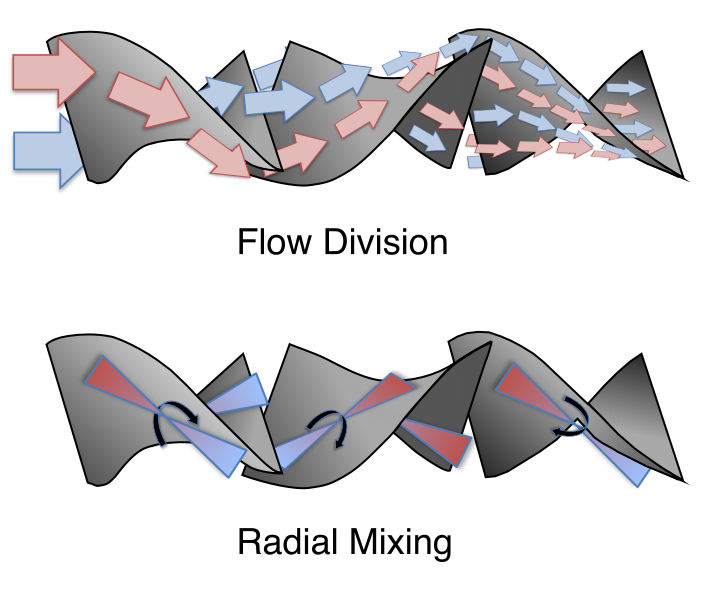
A static mixer is an inline flow device that mixes two or more fluid streams without moving parts. Mixing is achieved by the geometry of internal elements fitted inside a pipe or tube, which continuously split, rotate and recombine the flow. Static mixers are used to blend liquids, disperse gases into liquids, and promote heat or mass transfer in processes ranging from chemical manufacture to water treatment and everyday two‑component adhesives.
Image gallery
4 Images


Design and principle
Typical static mixers contain a sequence of baffles, helical elements, or plate segments that force fluid layers to separate and reorient. At low flow rates mixing is achieved by laminar splitting and recombination; at higher rates turbulent eddies assist the process. Key characteristics include element type, pitch, element count, and bore size; these determine mixing quality and pressure drop.
Common types
- Helical or twisted elements (often used for viscous fluids)
- Plate or corrugated elements (for high throughput)
- Nozzle-type disposable mixers (used for adhesives and epoxies)
- Gas-liquid and static contactors tailored for specific mass transfer tasks
History and development
Static mixing concepts arose from the need for compact, reliable devices that improve process intensification. Over the 20th century the technology evolved from simple baffle inserts to optimized element geometries and materials suitable for corrosive or high-temperature service. Commercial designs were refined to balance mixing efficiency against pressure loss and fouling resistance.
Applications and examples
Static mixers are widely used in industry: chemical dosing and neutralization in water treatment, inline blending of resins and polymers, fuel and lubricant mixing, and reactive mixing for two‑component adhesives where a disposable static mixing nozzle ensures thorough blending at the point of use. They also appear in laboratories for small‑scale continuous experiments and in medical and food processing lines.
Advantages and limitations
Advantages include simplicity (no moving parts), low maintenance, predictable scale‑up by adding length or elements, and suitability for continuous processes. Limitations are pressure drop, potential for fouling with solids or high‑viscosity materials, and reduced effectiveness when long residence times or intense shear are required. Selection balances desired homogeneity, allowable pressure loss and ease of cleaning.
For further technical specifications and application notes consult manufacturers or technical guides; many product pages and datasheets illustrate how element geometry affects performance. Static mixers remain a compact, energy‑efficient option for controlled mixing of liquids and multiphase flows.
Related articles
Author
AlegsaOnline.com Static mixer Leandro Alegsa
URL: https://en.alegsaonline.com/art/93547