
Spring Offensive (1918): the Kaiserschlacht and the Ludendorff Offensive
A concise encyclopedia article on the 1918 German Spring Offensive — its aims, tactics, main operations, course, and consequences for the final year of World War I.
The Spring Offensive of 1918, known in German as the Kaiserschlacht ("Kaiser's Battle") and commonly called the Ludendorff Offensive, was a major series of German attacks on the Western Front during World War I. Launched after Russia left the war, the campaign represented Germany's last large-scale attempt to force a decisive victory before the growing manpower and material advantage of the United States could be fully applied to the Allied cause. The offensive achieved the deepest territorial gains on the Western Front since 1914, but it ultimately failed to secure a strategic victory.
Image gallery
10 Images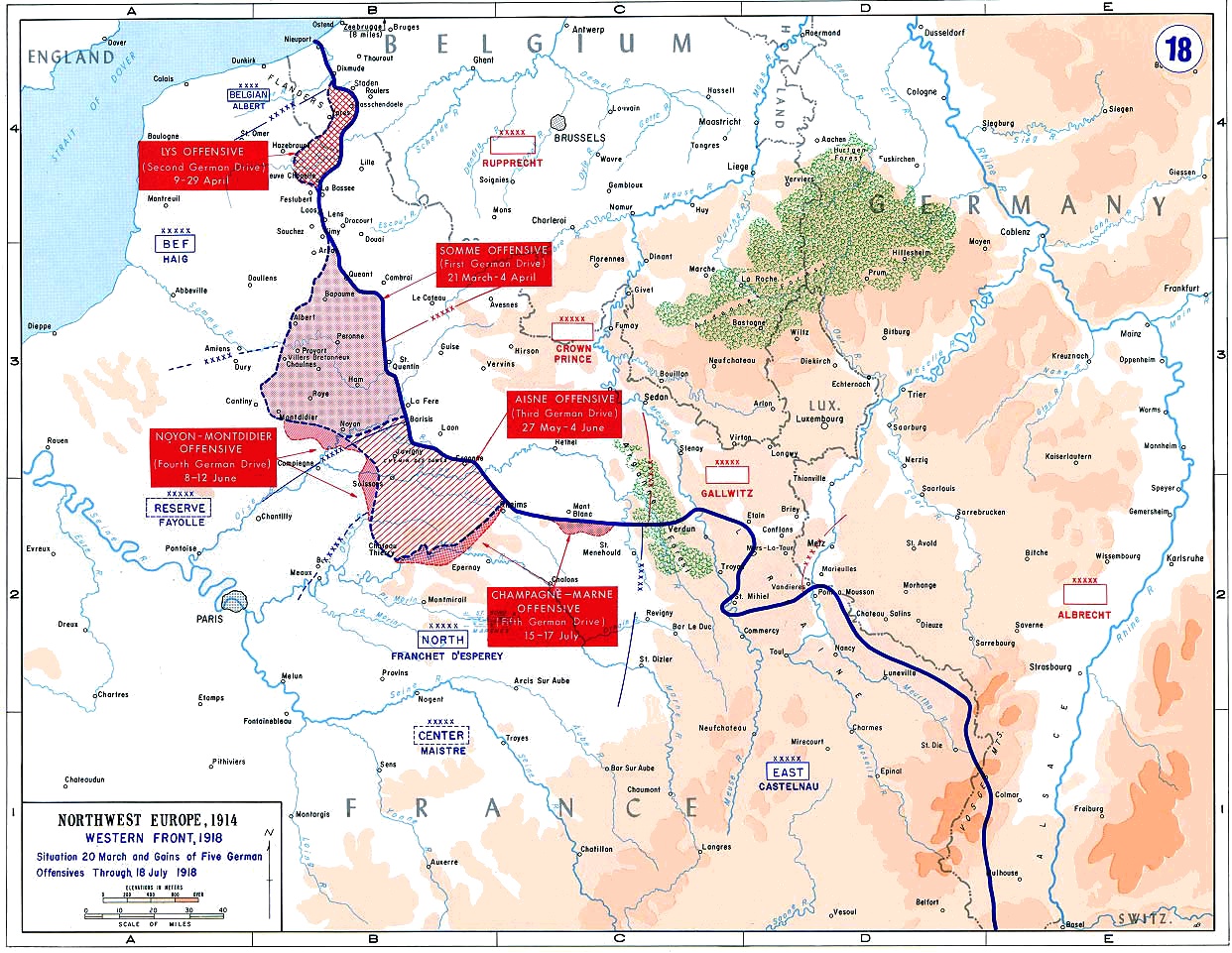






Strategic context and objectives
By early 1918 German leaders recognized that time was running out. The collapse of the Eastern Front following the Treaty of Brest-Litovsk allowed Germany to shift substantial forces westward — nearly fifty divisions by some counts — while Britain and France were receiving increasing numbers of American troops. The German high command, under the operational direction of General Erich Ludendorff, sought to break the stalemate through concentrated, mobile attacks that would split the British and French armies and threaten key logistics centers, compelling an Allied negotiation on terms acceptable to Germany.
Tactics and battlefield methods
Planners employed new small-unit assault techniques developed late in the war. Known broadly as stormtroop or Hutier-style methods, these infiltration tactics emphasized brief intense artillery bombardments, rapid advances by specialized assault groups that bypassed enemy strongpoints, and exploitation of weak points in the defensive line rather than massed frontal attacks. Initial German success depended on surprise, careful preparation, and local superiority in force and artillery.
Course of the offensive
The operation began in March 1918 with a large opening blow often called Operation Michael. German formations punched through at several points and advanced farther than any side had since the opening months of the war. Subsequent attacks struck elsewhere along the front in an attempt to widen the breakthrough and force a collapse of Allied resistance. Early gains, however, outran German supply lines, and casualties, logistical strain, and increasingly effective Allied reorganization blunted the momentum.
Outcome and significance
Although German forces captured substantial ground and inflicted heavy losses, they were unable to capture decisive objectives or destroy the Allied armies. The offensive exhausted German resources and manpower, while Allies—boosted by fresh American units and improved command coordination—prepared counteroffensives. Over the summer and autumn, Allied attacks reversed German gains in a campaign that led to the armistice later that year. The Spring Offensive is therefore widely seen as a last gamble that failed to alter the war's ultimate outcome.
Key features and notable facts
- Often called Kaiserschlacht or Ludendorff Offensive, reflecting German leadership and aims (German perspective).
- Marked by use of specialized infiltration tactics rather than large-scale massed infantry waves (infiltration tactics).
- Redistribution of forces from the Eastern Front after Russia's exit played a crucial role (divisions moved west).
- The offensive demonstrated both the potential and limits of operational mobility in trench warfare and influenced later doctrinal thinking (German and Allied analyses).
For further reading on the operations, units involved, and the tactical innovations of 1918 consult specialist histories and collections of primary documents that examine both the German plans and Allied responses (World War I studies and campaign analyses are useful starting points). Additional resources detail how the campaign set the stage for the Allied Hundred Days counteroffensive and the war's end (United States participation and Allied coordination are central themes).
Researchers can also compare the Spring Offensive with later 20th-century operational ideas to trace the development of combined-arms and maneuver warfare principles (Western Front studies emphasize continuity and change). Contemporary summaries and unit histories remain valuable for understanding how battlefield innovation and industrial limits interacted in 1918 (infiltration tactics offer a direct link between tactical change and strategic outcome).
Related articles
Author
AlegsaOnline.com Spring Offensive (1918): the Kaiserschlacht and the Ludendorff Offensive Leandro Alegsa
URL: https://en.alegsaonline.com/art/92854
Sources
- commons.wikimedia.org : Kaiserschlacht