
South China Sea Islands: geography, claims, resources and significance
Collection of more than 250 maritime features in the South China Sea — islands, reefs and shoals — notable for overlapping territorial claims, fisheries, hydrocarbon prospects and strategic shipping routes.
Overview
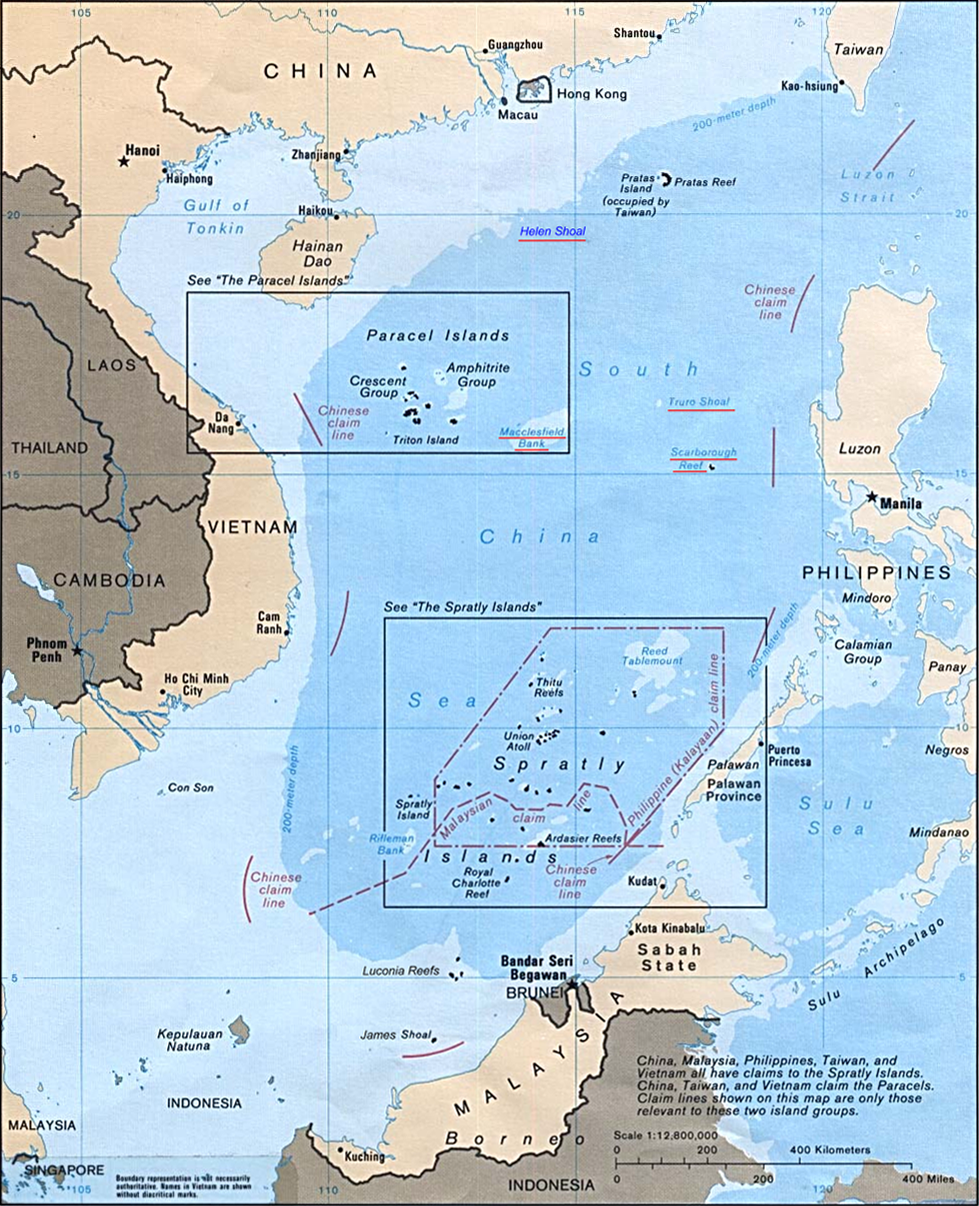
The South China Sea Islands comprise a dispersed group of more than 250 maritime features — including islands, atolls, cays, reefs and sandbars — located in the South China Sea region. Most of these features are small and uninhabited. They are grouped into better known clusters such as the Spratly (Nansha) and Paracel (Xisha) archipelagos and individual features like Scarborough Shoal, many of which are the subject of competing sovereignty claims.
Image gallery
5 Images


Geography and physical characteristics
Features range from permanently emergent islets with vegetation to submerged reefs and exposed sandbanks at low tide. Many are coral in origin; some have been modified by dredging and reclamation. Their physical status — whether they are naturally above water at high tide, are rocks, or are low-tide elevations — matters under international law for maritime entitlements.
History of claims and legal framework
Control and use of these features have been contested for decades. Multiple states assert claims, most prominently the People’s Republic of China (including a historical map dubbed the "nine-dash line"), the Republic of China (Taiwan), Vietnam, the Philippines, Malaysia and Brunei. The United Nations Convention on the Law of the Sea (UNCLOS) establishes concepts such as territorial seas and exclusive economic zones (EEZs) that frame legal disputes. A 2016 arbitral tribunal addressed aspects of competing claims and maritime rights in the area, influencing how parties and observers interpret entitlements.
Resources and economic importance
The region is valued for its abundant fisheries and for potential hydrocarbon resources on and beneath the seabed. Seabed and island areas are known to contain deposits of minerals (minerals), and there are prospects for natural gas (natural gas) and oil (oil) in nearby basins. Together with rich fishing grounds, these resources drive economic interest as well as tensions among claimant states.
Strategic significance and contemporary developments
The South China Sea is crossed by major international sea lanes and is therefore important for global trade and naval strategy. In recent decades several claimants have increased patrols, established outposts, or undertaken land reclamation and construction on reefs and rocks. These activities have raised concerns about regional security, freedom of navigation, and the potential for escalation.
Environmental and ecological considerations
Coral reefs, seabird nesting sites and marine ecosystems in the area are vulnerable to damage from dredging, infrastructure development and overfishing. Conservationists warn that reclamation and artificial construction can have long-term impacts on biodiversity and local fisheries that sustain coastal communities.
Key points and distinctions
- Different feature types (island, rock, low-tide elevation) confer different maritime rights under UNCLOS.
- Several states maintain overlapping claims, and diplomacy, arbitration and bilateral negotiations coexist with on-the-water incidents.
- Economic value derives from fisheries and possible hydrocarbons, while strategic value arises from shipping lanes and military considerations.
For further general information see regional maps and summaries provided by national and international agencies, which document the names, locations and status of individual features.
Questions and answers
Q: What are the South China Sea Islands?
A: The South China Sea Islands are a collection of over 250 small islands, atolls, cays, shoals, and reefs located in the South China Sea.
Q: Are most of the South China Sea Islands inhabited?
A: No, most of the South China Sea Islands are uninhabited.
Q: What valuable resources can be found on the South China Sea Islands?
A: There are minerals, natural gas, and oil deposits on the islands or under the seafloor near the islands.
Q: How many South China Sea Islands are there?
A: There are over 250 South China Sea Islands.
Q: What is the location of the South China Sea Islands?
A: The South China Sea Islands are located in the South China Sea.
Q: Are the South China Sea Islands all the same size?
A: No, the South China Sea Islands vary in size and shape, ranging from tiny shoals to larger atolls.
Q: Are the South China Sea Islands disputed territory?
A: Yes, the ownership of the South China Sea Islands is a source of tension and dispute, with multiple countries laying claim to different parts of the region.
Related articles
Author
AlegsaOnline.com South China Sea Islands: geography, claims, resources and significance Leandro Alegsa
URL: https://en.alegsaonline.com/art/92138
Sources
- globalsecurity.org : "Territorial claims in the Spratly and Paracel Islands"
- cia.gov : "Paracel Islands" at CIA World Factbook
- state.gov : "Limits in the Seas, No. 127, Taiwan's Maritime Claims" at US Department of State,
- globalnation.inquirer.net : "Philippines protests China’s moving in on Macclesfield Bank,"
- community.middlebury.edu : "The Dotted Line on the Chinese Map of the South China Sea: A Note,"