
Atoll: formation, features, ecology, and human significance
An atoll is a ring-shaped coral reef island surrounding a lagoon. This article describes how atolls form, their parts and ecology, where they occur, human uses, threats and conservation responses.
An atoll is a ring-shaped coral reef, often bearing one or more narrow islets, that surrounds a central lagoon. Atolls are living, biologically constructed landforms: they are created and maintained by reef-building corals and other organisms that deposit calcium carbonate. The ring or partial ring of reef and land separates the sheltered lagoon from the open ocean and gives atolls their characteristic doughnut-like appearance.
Image gallery
10 Images


How atolls form
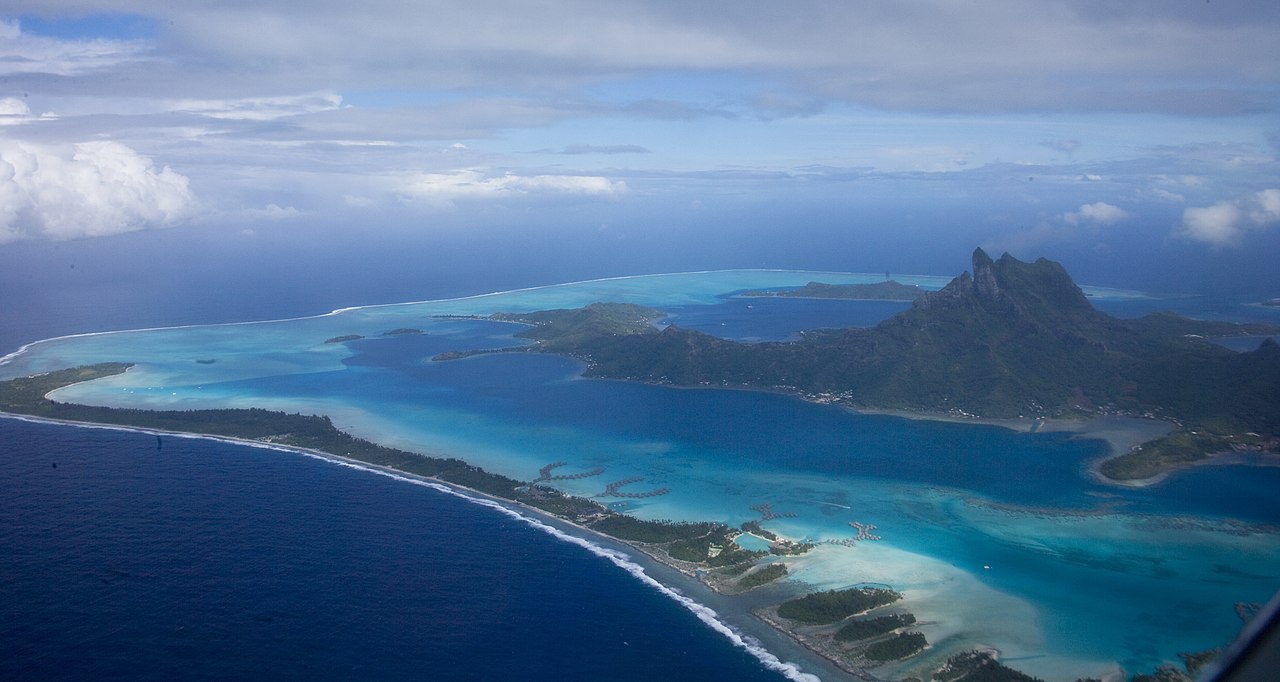
Atoll formation is a long-term process that links volcanic islands and the growth of coral reefs. The usual sequence begins with a volcanic island that rises above sea level and becomes colonized by corals along its margins, forming a fringing reef. If the volcanic island slowly subsides or erodes while corals continue to grow upward and outward, the reef may become detached as a barrier reef with a lagoon between reef and land. If subsidence continues until the original land mass sinks beneath the sea, the reef can remain as a ring around a now open lagoon — an atoll. This conceptual model was clarified in the 19th century by naturalists who recognized the roles of subsidence, reef growth and sea level in shaping reefs; it remains the basic explanation for most atolls.
Key parts and characteristics
- Reef rim: the outer, often continuous coral structure that breaks waves and accumulates sand and rubble.
- Lagoon: the central shallow body of water, which can host seagrasses, patch reefs and juvenile fish.
- Motu or islets: small sandy or vegetated islands formed on the reef rim from coral rubble and wind-blown sand; these may support palms and other coastal plants.
- Reef flat and crest: shallow areas that may be exposed at low tide and that influence how waves and currents move around the atoll.
- Biological framework: stony corals, coralline algae, encrusting organisms and shells of many invertebrates build and cement the reef.
Where atolls occur
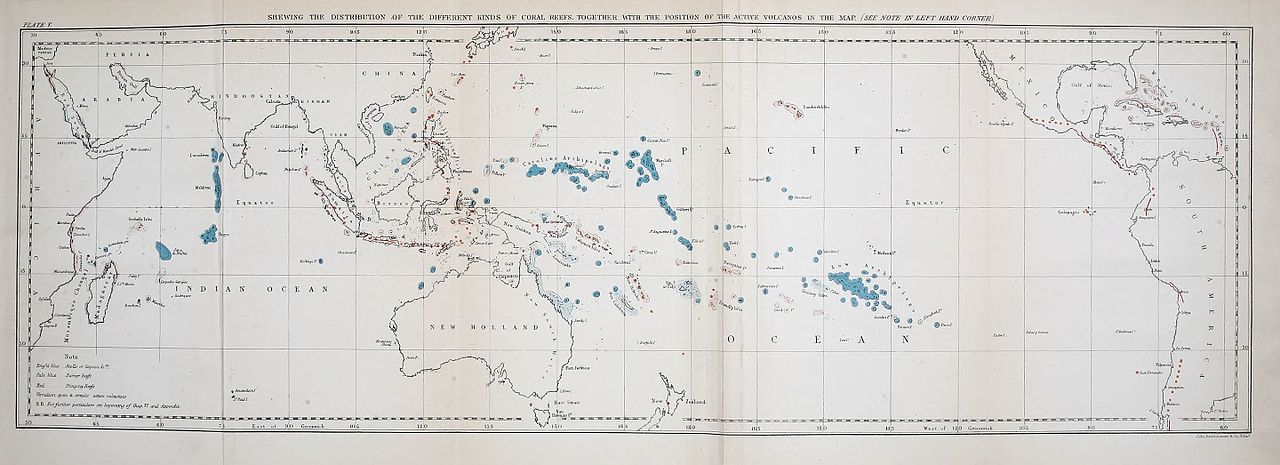
Atolls are characteristic of warm tropical and subtropical waters where reef-building corals thrive, generally between the Tropic of Cancer and the Tropic of Capricorn. They are most common in parts of the central and western Pacific Ocean and in the Indian Ocean, with fewer examples in the Atlantic. Well-known regions with many atolls include the Maldives in the Indian Ocean, the island groups of French Polynesia, the Marshall Islands and many archipelagos across Micronesia and Polynesia. Some countries are composed largely of atolls, such as Kiribati, Tuvalu and the Federated States of Micronesia. The general concept of an island helps place atolls among other island types.
Ecology and natural value
Atoll reefs support high marine biodiversity relative to their area. Coral structures provide habitat for fishes, crustaceans, molluscs and many other organisms, while lagoons and reef flats host seagrass beds and juvenile nursery habitats. Seabirds often nest on the motu, contributing guano that can enrich soils and influence island vegetation. The living reef also acts as a natural breakwater, reducing wave energy and helping to protect low-lying islets from constant wave attack.
Freshwater, soils and vegetation
Small atoll islets rarely have deep soils. Freshwater is commonly present as a thin, lens-shaped layer of fresh groundwater that floats above denser seawater in the porous sediments of the islet; this makes freshwater supplies limited and vulnerable to contamination or overuse. Vegetation on motu typically includes salt-tolerant species such as coconut palm, pandanus and coastal shrubs, which may support small-scale agriculture and traditional uses.
Human use and cultural importance
People have lived on atolls for centuries, adapting to limited land area, scarce freshwater and reliance on marine resources. Traditional livelihoods include reef and lagoon fishing, harvesting of coconut products (copra), and cultivation of tolerant plants. Atolls often have strong cultural connections to place and sea rights, with local knowledge guiding resource use. Modern influences bring tourism, larger-scale fishing and occasional infrastructure development, which can change traditional patterns.
Threats and management
- Climate-related sea-level rise, increased storm intensity and coastal erosion threaten low-lying atoll islets and infrastructure.
- Coral bleaching, disease and ocean acidification reduce reef growth and resilience, undermining the biological foundation of atolls.
- Local pressures such as overfishing, pollution from land-based activities, invasive species (for example rats on islets) and poorly planned construction can degrade habitats and community livelihoods.
Management responses combine local and regional measures: protecting reef areas with marine reserves, restoring corals in key locations, improving land-use to reduce runoff, securing freshwater through rainwater harvesting or careful groundwater use, and planning settlements and infrastructure with hazard and climate risks in mind. Some adaptation options are engineering-based (seawalls, raised platforms) while others emphasize nature-based solutions (mangrove or reef restoration), and many communities blend approaches to suit local conditions.
Conservation, research and related topics
Conservation of atolls includes both protecting the living reef and supporting the human communities that depend on it. Ongoing scientific research addresses coral health, reef-building processes, island stability and the social dimensions of adaptation. Related topics for further study include broader reef ecology (coral reef), the biology of corals (coral), volcanic island origins (volcano), and the historical development of ideas about reefs and subsidence associated with Charles Darwin and evolutionary theory (evolution).
Further reading and resources
- Island (general topic)
- Coral reef (formation and ecology)
- Doughnut-shaped atolls and geomorphology
- Charles Darwin (historical context)
- Evolution (background link)
- Volcano (role in island origin)
- Coral (organisms that build reefs)
- Pacific Ocean (major atoll region)
- Indian Ocean (atoll occurrences)
- Kiribati (example nation of atolls)
- Tuvalu (example nation of atolls)
- Federated States of Micronesia (example nation)
Questions and answers
Q: What is an atoll?
A: An atoll is a type of island formed when a coral reef grows around a sunken island.
Q: How is an atoll formed?
A: An atoll is formed when a coral reef grows around a sunken island over time.
Q: Who was the first person to discover how atolls form?
A: Charles Darwin was the first person to discover how atolls form.
Q: Where are most atolls found?
A: Most atolls are found in the warm areas of the Pacific Ocean and the Indian Ocean.
Q: What do volcanoes have to do with atolls?
A: Volcanoes can wear away or sink deeper, leaving space for coral reefs to grow and form an atoll.
Q: Which countries have atolls as part of their territory?
A: Kiribati, Tuvalu, and the Federated States of Micronesia are examples of nations that have atolls as all or part of their territory.
Q: What happens to the original island where an atoll is formed?
A: Over time, the original island sinks and disappears, leaving only the coral reef structure behind to form the atoll.
Related articles
Author
AlegsaOnline.com Atoll: formation, features, ecology, and human significance Leandro Alegsa
URL: https://en.alegsaonline.com/art/7039