
Barycenter: the center of mass in astronomy and geometry
The barycenter is the common center of mass about which two or more bodies orbit or balance. This article explains its definition, examples (Earth–Moon, solar system), geometry counterpart and uses.
Overview
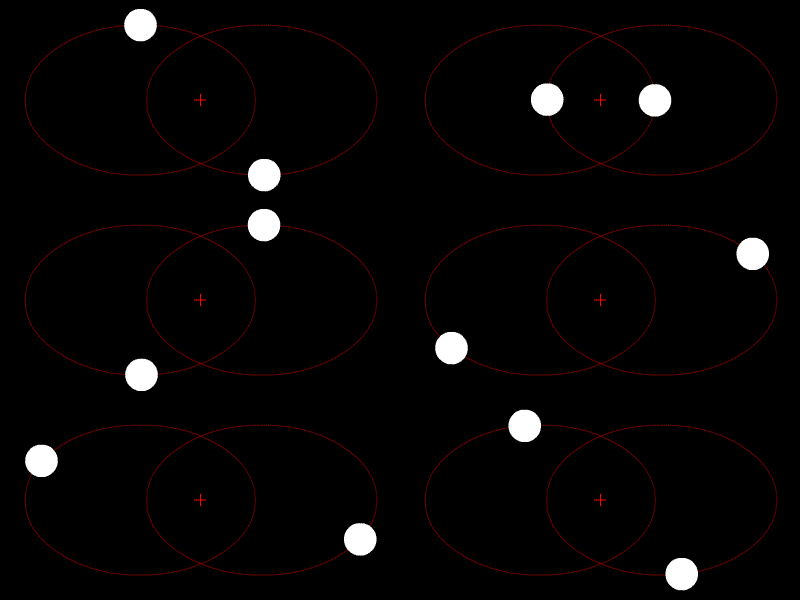
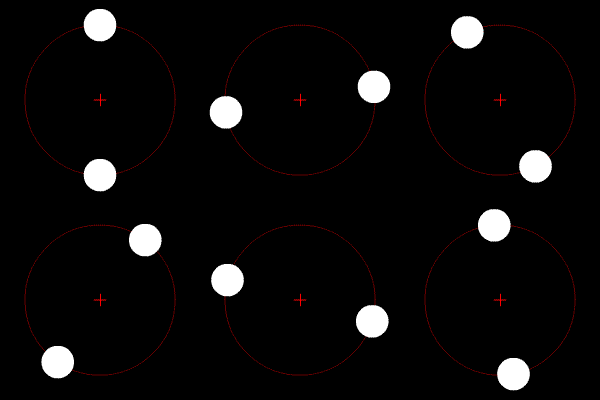
The barycenter (from the Greek term represented by the original word) is the point at which the combined mass of two or more bodies can be considered to act. More simply, it is the balance point that two objects exert on each other: their mutual motions are described as orbiting this common point rather than one body stationary and the other moving around it.
Image gallery
9 Images




Physical definition and simple example
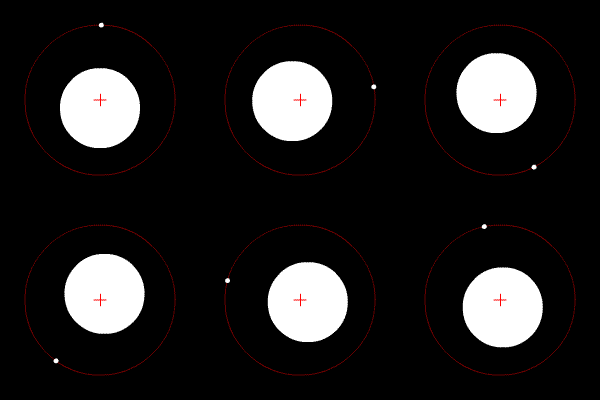
In physics the barycenter coincides with the center of mass of a system. For a two-body pair, the location of the barycenter lies along the line connecting their centers and divides the distance in inverse proportion to their masses. In practical terms, when a moon orbits a planet or a planet orbits a star, both objects move around the barycenter. This is why the Moon does not orbit the exact geometric center of the Earth (Earth) but a point between them, roughly 1,700 km beneath Earth's surface measured from the surface toward the center of the line between the two bodies.
Computation and characteristics
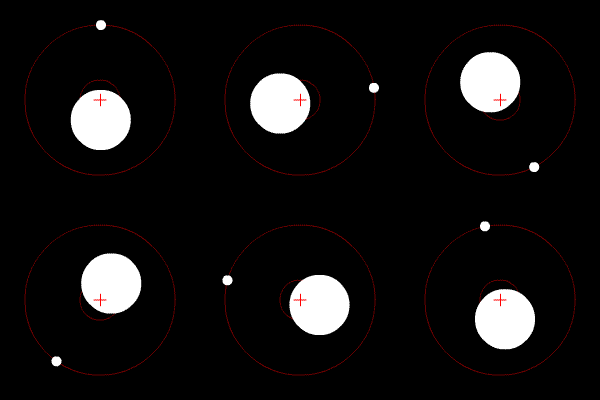
Mathematically, the barycenter is the mass-weighted average of component positions. In an n-body system the same principle applies: each mass contributes to the overall center of mass and the barycenter may lie inside one of the bodies or in empty space. The relative positions of massive members determine whether the barycenter sits within a larger body or outside it; for instance, in some configurations the solar system's barycenter shifts outside the Sun's surface.
Solar system and astronomical importance
Because planets, especially massive ones like Jupiter and Saturn, exert sizeable gravitational influence, the solar system's barycenter moves as the planets orbit the Sun. Depending on the instantaneous alignment of the planets, that common center can fall within the Sun or beyond its surface by significant distances. Tracking barycenters is important in precise spacecraft navigation, long-term orbital studies and in methods used to detect exoplanets by observing a star's reflex motion.
Geometry and related concepts
The term barycenter is also used in geometry to mean a balancing point of a shape. In Euclidean geometry the centroid of a uniform planar figure (often called its geometric barycenter) is the intersection of its medians; for a circle or a regular polygon this point coincides with intuitive notions of the center. The geometric barycenter is distinct from a physical center of mass when density is nonuniform.
Uses, distinctions and notable facts
- Practical uses: predicting tides and the motions of moons, steering interplanetary probes, and refining planetary ephemerides.
- Distinctions: "barycenter" and "center of mass" are often used interchangeably in physics, while in pure geometry the centroid refers to a uniform shape's center.
- Examples in astronomy include the Earth–Moon barycenter and the shifting solar system barycenter influenced by large planets such as Jupiter and Saturn.
For further reading about foundational terms and history, consult sources on the concept's development and its role in orbital mechanics through textbooks and online references. Additional links: balance, center of mass, stars, the Sun.
Notes: the barycenter is a central concept connecting mechanics, astronomy and geometry, and appears whenever multiple masses interact by gravity. Its location informs observational techniques and underpins much of classical orbital theory.
Related articles
Author
AlegsaOnline.com Barycenter: the center of mass in astronomy and geometry Leandro Alegsa
URL: https://en.alegsaonline.com/art/9172