
Center of Mass (Barycenter): Definition, Calculation, and Applications
The center of mass (barycenter) is the average position of mass in a system. This article explains its definition, calculation for discrete and continuous bodies, physical properties, examples, and relation to center of gravity.
The center of mass, also called the barycenter in astronomy and mechanics, is the weighted average position of all the mass in a system. Intuitively, it is the point at which the distribution of mass balances: if all mass were concentrated at that point, the system would have the same translational motion under any external forces. For many practical problems the center of mass provides a convenient single-point description of how a body or collection of bodies moves.
Image gallery
2 Images
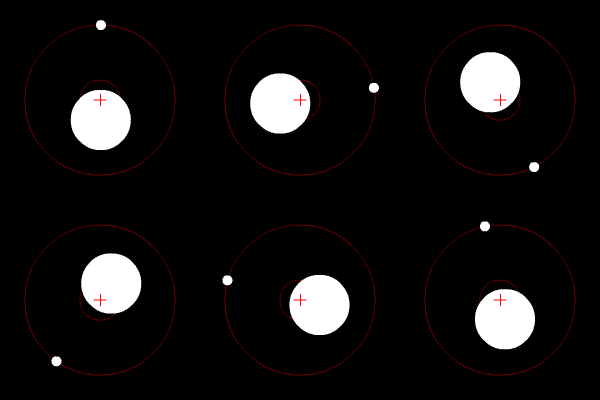
Definition and simple formulas
For a system of discrete point masses m_i at position vectors r_i, the center of mass r_cm is given by r_cm = (sum m_i r_i) / M, where M = sum m_i is the total mass. For a continuous body with mass density rho(r), the center of mass becomes r_cm = (1/M) ∫ r rho(r) dV, integrating over the body's volume. These expressions apply in any chosen coordinate system; the result depends on the positions chosen for the mass elements.
Characteristics and physical properties
The center of mass has several useful properties. For an isolated system with no external net force, the center of mass moves at constant velocity (conservation of linear momentum). External forces acting through the center of mass produce only translation without causing rotation. Conversely, forces not aligned with the center of mass produce torque and can change the system's rotation.
Special cases and examples
- Rigid bodies: the center of mass is fixed relative to the body and moves with it as the body translates.
- Collections of objects: the center of mass can lie in empty space; a familiar example is the Solar System, whose barycenter can fall outside the surface of the Sun as planets orbit (see planetary barycenter).
- Two-body systems: the line joining two masses contains the center of mass at a point dividing the distance in inverse proportion to the masses.
- Everyday mechanics: balancing a plank on a fulcrum or pushing a supermarket trolley demonstrates that pushing through the center of mass yields straight translation, while off-center pushes create rotation.
Relation to center of gravity and practical distinctions
The center of gravity is the point at which the total gravitational torque on the body is zero for a given gravitational field. In a uniform gravitational field the center of gravity coincides with the center of mass. In nonuniform fields, especially over large spatial extents (for example, tall structures in varying gravity), the two points can differ. In everyday engineering and physics problems on Earth, treating them as the same is usually acceptable.
History, terminology, and applications
The term barycenter (from the Greek bary- meaning "heavy" or "weight") is common in astronomy when describing mutual orbits of celestial bodies. Understanding centers of mass underpins orbital mechanics, spacecraft rendezvous, vehicle stability, robotics, biomechanics (human balance and gait), and structural design. Practical calculations range from simple classroom experiments to numerical integration for irregular or composite shapes.
For further background and worked examples, consult introductory mechanics texts and resources: basic mechanics, numerical integration methods for continuous bodies, planetary dynamics and barycenters, orbital perturbations and motion, classroom demonstrations like trolleys and levers (balance examples), and applied engineering guides (design reference).
Related articles
Author
AlegsaOnline.com Center of Mass (Barycenter): Definition, Calculation, and Applications Leandro Alegsa
URL: https://en.alegsaonline.com/art/17975