
Sir Bernard Lovell — pioneering English physicist and radio astronomer
English physicist and radio astronomer; first director of Jodrell Bank Observatory, creator of the large steerable radio telescope there, and a leading figure in early radio astronomy and space tracking.
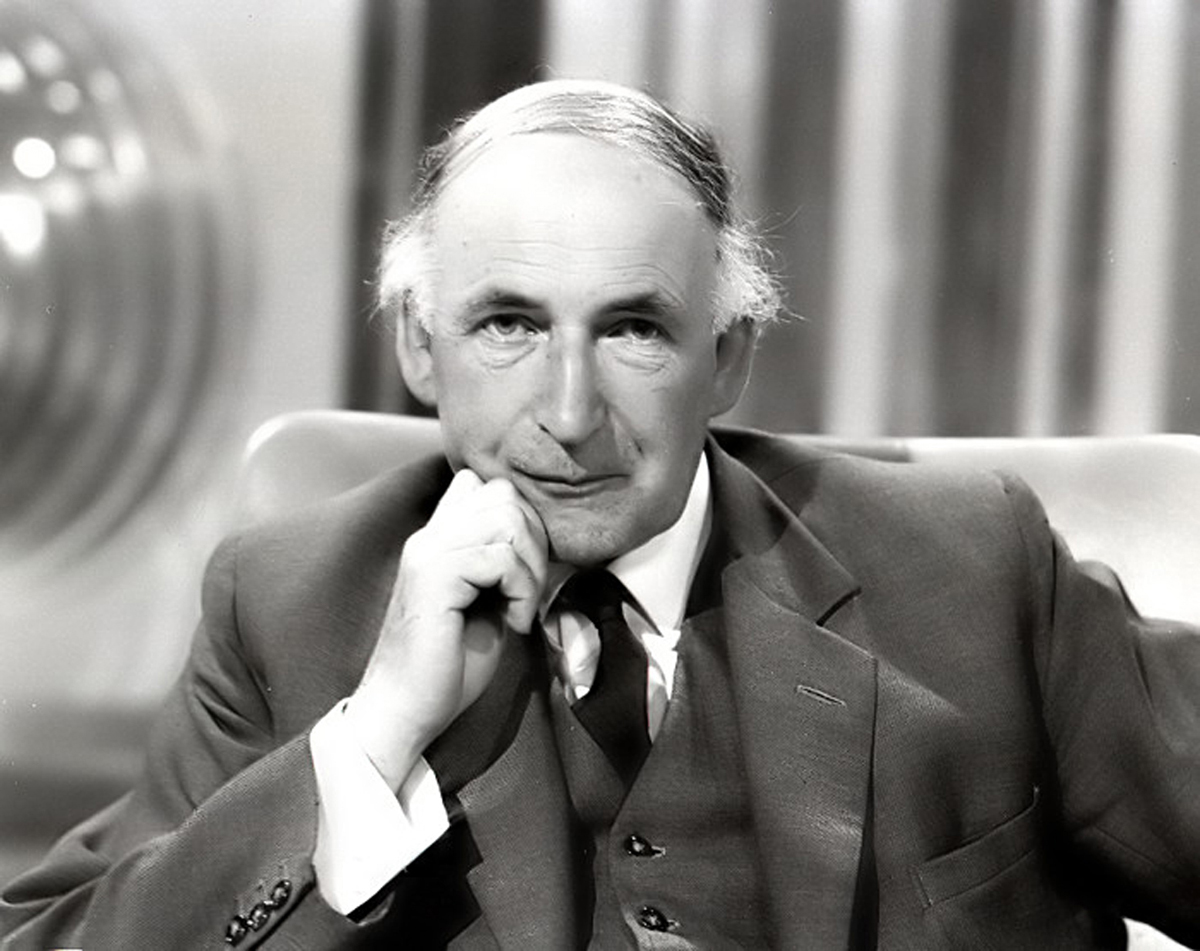
Sir Alfred Charles Bernard Lovell (31 August 1913 – 6 August 2012) was an English physicist and radio astronomer who played a central role in establishing radio astronomy as a major scientific discipline. He served as the first director of the Jodrell Bank Observatory from 1945 until 1980 and is widely associated with the construction of one of the world's largest steerable radio telescopes at that site. Lovell's career bridged wartime radar research and postwar exploration of the radio sky, and he remained a prominent public figure for decades.
Image gallery
3 Images

Scientific contributions and instruments
Lovell is best known for directing the development of large-scale radio astronomy facilities capable of detecting faint signals from the Sun, the Galaxy, and distant cosmic sources. Under his leadership the observatory built a major steerable dish that enabled precision pointing and investigations at radio wavelengths. These instruments allowed studies of meteors, cosmic rays, and compact radio sources, and they provided capabilities that were later applied to tracking artificial satellites and interplanetary spacecraft.
Background and development
Trained as a physicist, Lovell began his career in the era when radar and radio techniques advanced rapidly. During the Second World War many scientists, including Lovell, worked on radar and related instrumentation; after the war he repurposed similar technologies to listen to the sky. He established Jodrell Bank on a site with low radio interference and advocated for the creation of large collecting areas and accurate mounts to improve sensitivity and resolution in radio observations.
Role in the early space age
When the satellite and space probe era began, the capabilities developed under Lovell's direction proved useful for tracking and communicating with early space missions. The observatory's equipment was used for radio tracking and for following objects in orbit, contributing practical support to the emerging space programmes of the mid-20th century. Lovell's public profile grew as the observatory attracted international attention for both scientific and technical achievements.
Honors, legacy and public impact
Lovell received formal recognition for his work: he was appointed OBE, elected a Fellow of the Royal Society, and was knighted in 1961. Beyond awards, his legacy includes the observatory he founded, the large radio telescope that bears his name, and a generation of scientists and engineers inspired by his emphasis on combining experimental ingenuity with bold, large-scale projects. Jodrell Bank continues to be associated with the University of Manchester and remains a focal point in radio astronomy and public outreach.
Further reading
- Biographical surveys and obituaries summarize Lovell's life, career, and influence on radio astronomy.
- Technical histories of Jodrell Bank describe the design and construction of its instruments and their scientific uses.
- For an overview, see resources linked from relevant institutional pages.
Lovell's work exemplifies how wartime technological advances were redirected to peaceful scientific inquiry, transforming observations of the radio sky and enabling new forms of planetary and space research. His name remains attached to one of the landmark observatories of the 20th century and to the broader story of how radio techniques opened a fresh window on the Universe.
Tags
Related articles
Author
AlegsaOnline.com Sir Bernard Lovell — pioneering English physicist and radio astronomer Leandro Alegsa
URL: https://en.alegsaonline.com/art/10801
Sources
- bbc.co.uk : "BBC News - Astronomer Sir Bernard Lovell dies"