
Tycho's Supernova (SN 1572): historical sighting and its modern remnant
SN 1572, known as Tycho's Supernova or B Cassiopeiae, was a naked-eye Type Ia supernova observed in 1572. Its remnant is an important object for studies of explosion physics, shock waves, and historical astronomy.
Overview
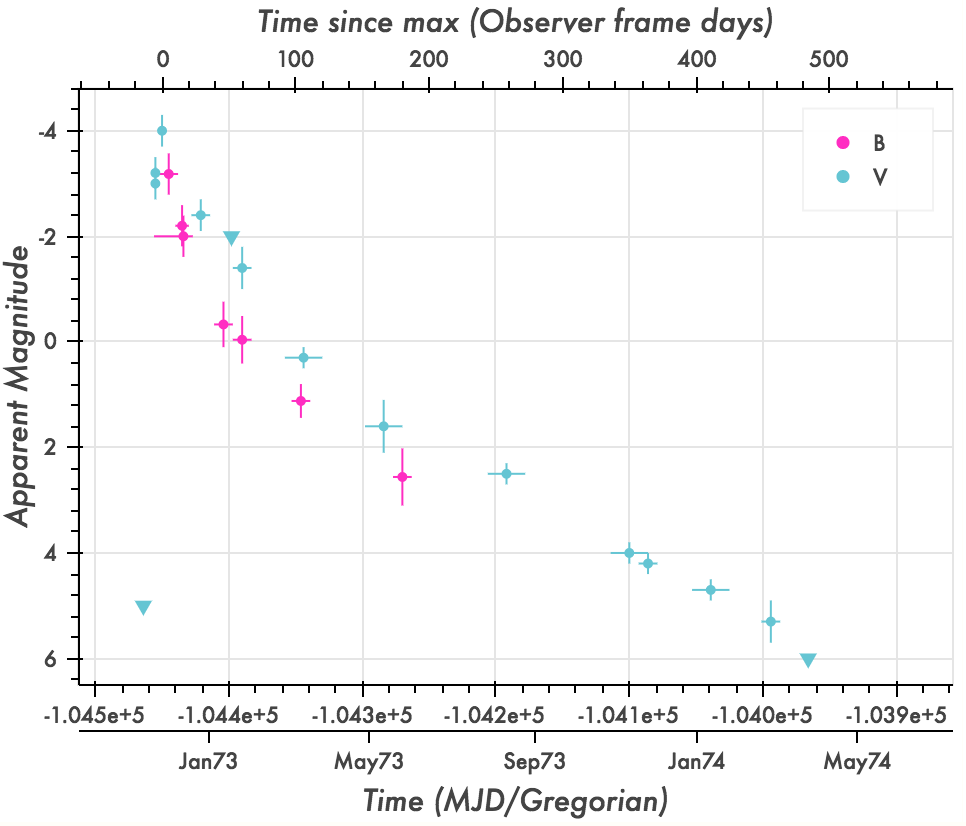
Tycho's Supernova—commonly cited as SN 1572 or B Cassiopeiae—is the bright stellar explosion that appeared in the constellation Cassiopeia in November 1572. Observers across Europe and Asia recorded a new, stationary point of light that rivaled the planets in brightness and was visible without optical aid for many months. It has since been classified as a Type Ia supernova, an explosion that is understood to result from a thermonuclear runaway in a white dwarf star within a binary system. The event is often associated with the Danish astronomer Tycho Brahe, whose systematic observations and published account helped establish its importance in the history of astronomy.
Image gallery
7 Images




Remnant and physical characteristics
The expanding debris left by the 1572 explosion is referred to as Tycho's supernova remnant. At multiple wavelengths it displays a roughly circular shell of shocked gas and high-energy particles. Observations in radio, optical and X-ray bands reveal filamentary structures where the outgoing shock interacts with surrounding interstellar material, producing emission from heated gas and accelerated electrons. The remnant was originally catalogued as the radio source 3C 10 and was among the first historical supernova remnants to be identified in modern surveys.
Historical discovery and impact
The new star was independently noticed by numerous observers shortly after it appeared in early November 1572 in the constellation Cassiopeia. Tycho Brahe published a detailed report the following year documenting position measurements and brightness estimates; his careful work provided strong evidence that the phenomenon lay beyond the Moon and therefore contradicted the Aristotelian idea of an unchanging celestial realm. That challenge to accepted cosmology helped stimulate the transformation of astronomical thought during the Renaissance.
Modern studies and tools
In the 20th and 21st centuries, Tycho's remnant has been the focus of many observational campaigns using radio dishes, optical telescopes and space-based X-ray observatories. Early radio detections identified the source in catalogues such as 3C, while later X-ray imaging and spectroscopy have mapped element distributions and shock temperatures. Modern instruments have also been used to measure the remnant's expansion rate, locate regions of particle acceleration, and search for any surviving companion star from the progenitor system. Light echoes—reflections of the original flash off distant dust—have provided an opportunity to recover spectroscopic information about the explosion centuries after it occurred, confirming its Type Ia character.
Importance and scientific context
Tycho's Supernova remains a key object for several reasons: it is one of the few supernovae recorded by pre-telescopic observers, it provided an early empirical challenge to ancient cosmology, and its remnant offers a nearby laboratory for studying the physics of thermonuclear explosions, shock propagation, and cosmic-ray acceleration. Type Ia supernovae such as SN 1572 are also important in modern cosmology because their consistent luminosities (after calibration) make them useful distance indicators; while SN 1572 itself predates modern calibration methods, it helps astronomers test models of progenitors and explosion mechanisms that underpin those cosmological uses.
Notable facts and open questions
- Alternate names include SN 1572, B Cassiopeiae and the radio designation 3C 10.
- Its visibility to the naked eye and the wide geographic spread of contemporaneous observations make it one of the best-documented pre-telescopic supernovae.
- Modern searches for a surviving companion star have produced debated candidates, and the exact nature of the progenitor system (single-degenerate versus double-degenerate) remains under active investigation.
- Radio telescopes first helped reveal the remnant as a nonstellar radio source; continued multiwavelength study has deepened understanding of high-energy processes in the expanding shell. See work from radio and high-energy observatories for detailed images and analysis (radio and X-ray studies).
For accessible summaries and observational resources about SN 1572 and its remnant, readers can consult historical treatments and modern overviews that gather spectral, imaging and temporal data on this object. To explore primary historical writings and modern technical papers, follow references linked through astronomical archives and specialized review articles (observational timelines, Tycho's accounts).
Tycho's Supernova thus connects a dramatic public spectacle of the Renaissance with current astrophysical research, acting as both a milestone in the history of science and a continuing subject of scientific inquiry.
Related articles
Author
AlegsaOnline.com Tycho's Supernova (SN 1572): historical sighting and its modern remnant Leandro Alegsa
URL: https://en.alegsaonline.com/art/91284