
SN 1987A — Nearby core‑collapse supernova in the Large Magellanic Cloud
SN 1987A, discovered in February 1987 in the Large Magellanic Cloud, is the nearest modern supernova. Its neutrino detections, unusual progenitor, and evolving ring nebula transformed supernova physics and remnant studies.
Overview
SN 1987A is a core‑collapse supernova first observed from Earth on 23 February 1987 in the Large Magellanic Cloud, a satellite galaxy of the Milky Way. At roughly 168,000 light‑years distance it was the closest supernova seen since telescopic records began, bright enough to be noticed without specialized instrumentation and to be studied in detail across the electromagnetic spectrum.
Image gallery
10 Images





Progenitor and classification
The star that exploded was identified from archival images as the blue supergiant known as Sanduleak -69 202. Because its progenitor was a compact, hot blue supergiant rather than a red supergiant, SN 1987A appeared somewhat unusual compared with many previously observed Type II supernovae. Its light curve and spectral evolution prompted revisions to models of how massive stars evolve and explode.
Neutrinos and core‑collapse physics
SN 1987A provided the first direct neutrino signal from a stellar explosion. Underground detectors recorded a burst of neutrinos a few hours before the supernova became bright in visible light, confirming key predictions of the core‑collapse mechanism in which a collapsing stellar core produces an intense neutrino flash. This detection marked a milestone for neutrino astronomy and constrained properties of dense matter and neutrino emission.
Remnant, rings and ongoing observations
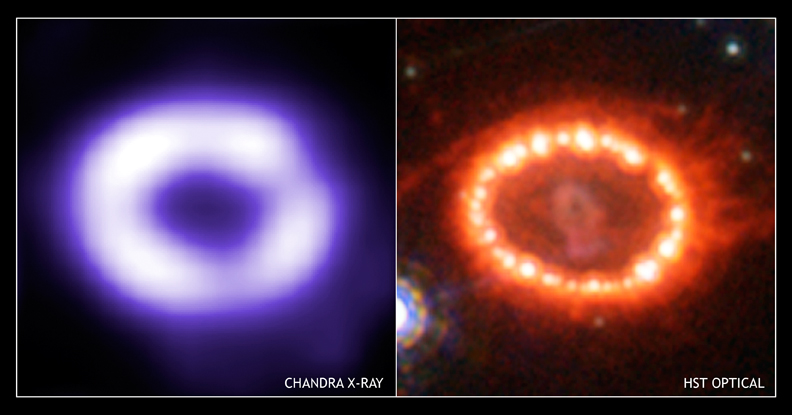
The expanding debris and the circumstellar environment of SN 1987A have been monitored continuously since 1987. High‑resolution images revealed a striking system of rings—an inner bright ring and two larger outer rings—created by earlier mass loss from the progenitor and illuminated by the explosion. Over decades the blast wave has interacted with this material, producing X‑rays, radio emission, and changing optical structure as shocks heat the gas.
Scientific importance and legacy
SN 1987A remains one of the best‑studied supernovae. It provided empirical evidence for nucleosynthesis in explosions (notably production of radioactive isotopes that power the light curve), tested models of stellar evolution, and stimulated advances in multiwavelength and neutrino astronomy. Observatories still track its evolving remnant to learn how supernovae seed galaxies with heavy elements and form compact remnants.
Further reading
- Contemporary observational summaries and archives: observational reports.
- Neutrino detections and theoretical context: neutrino astronomy resources.
Related articles
Author
AlegsaOnline.com SN 1987A — Nearby core‑collapse supernova in the Large Magellanic Cloud Leandro Alegsa
URL: https://en.alegsaonline.com/art/91286
Sources
- spacetelescope.org : "Hubble revisits an old friend" · web.archive.org
- ui.adsabs.harvard.edu : 1989ARA&A..27..629A
- bbc.co.uk : bbc.co.uk/news/science-environment-50473482