
Kepler's Supernova (SN 1604)
SN 1604, called Kepler's Supernova, appeared in 1604 in Ophiuchus. Its remnant is a nearby Type Ia supernova remnant studied across wavelengths to test explosion models and supernova–environment interactions.
SN 1604 is the modern designation for a bright supernova first widely observed in 1604. The event was recorded by many astronomers and observers across Europe and beyond. Because the imperial mathematician and astronomer Johannes Kepler made detailed positional and brightness records and published an extended discussion, the explosion is commonly referred to as Kepler's Supernova, Kepler's Star or Kepler's Nova. Contemporary reports describe a "new star" that rivalled the planets in brightness and remained visible to the unaided eye for many months.
Image gallery
6 Images
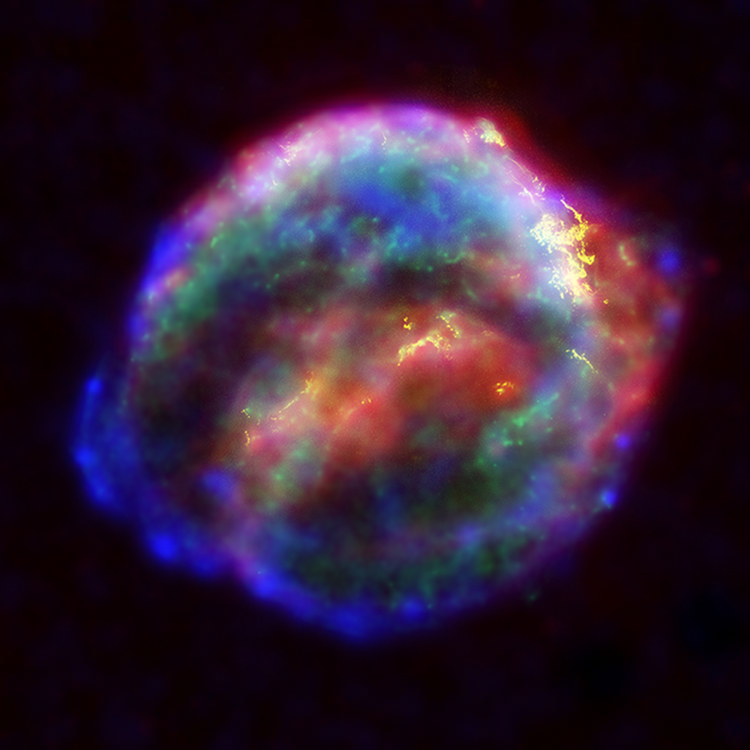




Location and historical record
The transient appeared in the region of the sky associated with the constellation Ophiuchus. Observers of the period tracked its changing brightness and compared its location to nearby fixed stars, producing one of the most complete early datasets for a stellar explosion. Kepler's careful timing and sketches, together with other contemporary accounts, have proved valuable when comparing historical light behavior with modern models. SN 1604 is often cited as the most recent supernova clearly seen within our galaxy with the unaided eye.
Nature and remnant
Modern study has classified the explosion as a Type Ia supernova based on the chemical composition of the expanding debris and comparisons with expected light-curve behavior. The blast left behind a compact supernova remnant, commonly called Kepler's SNR, which is now detected in optical images, radio maps and X-ray observations. Multiwavelength data reveal hot, shocked gas, bright emission from heated ejecta, and dense knots that trace interactions between the expanding material and surrounding circumstellar or interstellar matter.
Scientific importance
Kepler's Supernova serves as a nearby laboratory for understanding Type Ia explosions. Because these events are used as standardizable distance indicators in cosmology, well-documented historical examples with preserved remnants help test theoretical explosion models and nucleosynthesis predictions. Observations of Kepler's remnant inform studies of shock physics, the distribution of synthesized elements, and how the explosion interacts with material lost by the progenitor system before the blast.
Observations and open questions
- Visibility: widely observed in 1604–1606 and recorded in multiple contemporary sources, including Kepler's publications.
- Modern imaging: the remnant has been observed by optical telescopes, radio arrays and X-ray satellites, providing complementary views of its structure and composition.
- Progenitor system: while classified as Type Ia, the exact nature of the progenitor (a white dwarf accreting from a companion star versus a double white-dwarf merger) is still debated and an active research topic.
- Distance and environment: the remnant lies several thousand light-years away; uncertainties in distance and the density of surrounding material affect quantitative interpretations.
Kepler's Supernova represents a link between early telescopic astronomy and modern high-energy astrophysics. Historical brightness records anchored by Kepler's notes combine with 20th- and 21st-century observations to provide a long-term perspective on how a galactic Type Ia supernova evolves. For background and source material see general supernova overviews, historical summaries of the 1604 observations, information on the Ophiuchus location and constellation charts, Kepler's own writings at archival resources via Kepler references, and surveys of historic Galactic explosions such as listings of supernovae in the Milky Way.
Related articles
Author
AlegsaOnline.com Kepler's Supernova (SN 1604) Leandro Alegsa
URL: https://en.alegsaonline.com/art/91285