
Silver bromide (AgBr): properties, structure, and photographic use
Silver bromide (AgBr) is a light-sensitive inorganic salt of silver and bromide. It forms pale crystalline solids, used historically in photography and still studied for photochemistry and materials applications.
Silver bromide is an inorganic chemical compound with the formula AgBr. It consists of silver in the +1 state — silver as Ag+ — paired with a bromide anion. The ionic nature of the material means it is made of oppositely charged ions, a fact central to its crystal packing and reactivity; its oxidation state is commonly described in textbook terms as +1 for silver in this compound.
Image gallery
4 Images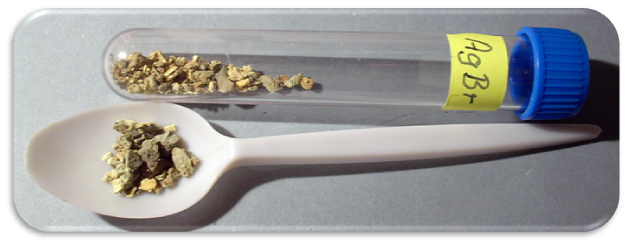


Physical and crystalline characteristics
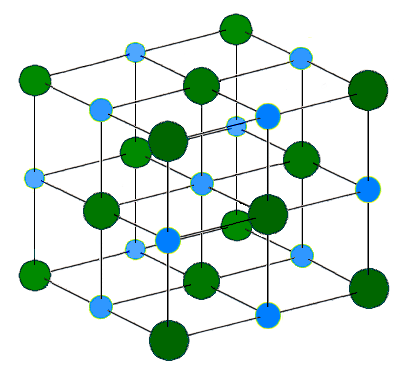
AgBr appears as pale yellow to cream-colored crystals. At ambient conditions it adopts a cubic lattice related to the rock-salt (NaCl) type, in which Ag+ and Br- occupy alternating positions. It is sparingly soluble in water and shows limited solubility trends similar to other silver halides. AgBr also displays pronounced sensitivity to visible light: photons can induce partial reduction of silver ions to metallic silver within the crystal lattice, a property exploited for imaging.
Preparation and chemical behavior
Commonly prepared by mixing a soluble silver salt (for example silver nitrate) with a soluble bromide (such as potassium or sodium bromide), AgBr precipitates as an insoluble solid. It may react with complexing agents or strong reducing conditions; handling and storage are influenced by its light sensitivity. Chemically, it is less soluble and typically less reactive toward simple ligands than silver chloride but more so than silver iodide, giving it distinct behavior among the silver halides.
Uses, history and importance
The most famous application of silver bromide is in traditional photographic emulsions and films, where its photoreduction produces latent images that are developed into visible photographs. During the 19th and 20th centuries AgBr-based emulsions were central to photography and medical radiography. Although digital imaging has largely supplanted film for many uses, AgBr remains significant in certain imaging processes and in research on light-driven processes, photocatalysis, and nanoparticle synthesis.
Practical considerations and distinctions
- Photochemical sensitivity: intermediate among silver halides, influencing grain size and image resolution in film.
- Preparation: typically precipitated by mixing aqueous solutions of silver and bromide salts.
- Comparison: sits between AgCl and AgI in solubility and light response, which determined choices in historic photographic chemistry.
- Environmental and safety: contains silver, a material with antimicrobial activity and environmental persistence; waste is managed to limit release to waterways.
For further technical details, crystallography, or applications, follow general references on inorganic salts and photographic chemistry or consult specialized resources: compound overview, silver element, oxidation states, bromide chemistry, ionic compounds.
Related articles
Author
AlegsaOnline.com Silver bromide (AgBr): properties, structure, and photographic use Leandro Alegsa
URL: https://en.alegsaonline.com/art/90452