
Silver iodate (AgIO3)
Silver iodate, AgIO3, is an ionic inorganic salt made of Ag+ and IO3−. It is a sparingly soluble oxidizing solid used in laboratory chemistry and analytical reactions; handle as an oxidizer and source of iodate.
Silver iodate is an inorganic ionic compound with the formula AgIO3. It is commonly described as a white crystalline solid composed of silver cations and iodate anions. For a general introduction see chemical compound. The constituent ions can be referenced as the silver ion (Ag+) and the iodate ion (IO3−), while information about their formal charges and behavior is discussed under oxidation states and the role of iodine in oxyanions. The silver in AgIO3 is in the +1 oxidation state, often noted as Ag(+1).
Image gallery
1 Image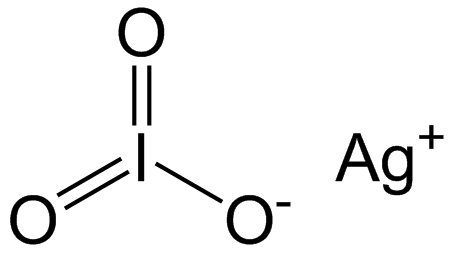
Physical and chemical characteristics
Silver iodate appears as a pale, often white or off-white crystalline powder. It is only slightly soluble in water compared with many alkali metal iodates, and it behaves as an oxidizing agent because the iodate anion contains iodine in a relatively high oxidation state (+5). Structurally, the iodate ion is typically trigonal-pyramidal, while silver is coordinated by oxygen atoms from IO3− in the solid lattice.
Preparation and typical reactions
In the laboratory AgIO3 is most readily prepared by precipitation: mixing a soluble silver salt (for example silver nitrate) with a soluble iodate (such as sodium or potassium iodate) yields insoluble silver iodate and a soluble counter-ion salt. In redox chemistry iodate can be reduced to iodide under strongly reducing conditions, and Ag+ will form other silver salts (e.g., AgI) when reacted with different iodine species.
Uses and significance
Silver iodate has limited but useful roles. It serves as a laboratory reagent and as a convenient solid source of iodate in analytical chemistry and small-scale syntheses. Its oxidizing character and low solubility can be exploited in selective precipitation techniques and qualitative tests that distinguish iodate from other iodine-containing anions.
Safety, handling and related compounds
Like other oxidizers, silver iodate should be stored away from strong reducing agents and combustible materials. Prolonged exposure to soluble silver compounds can lead to accumulation of silver in tissues (argyria) and other toxic effects, so accidental ingestion or prolonged skin contact should be avoided. Related materials include silver iodide (AgI), which has quite different properties and uses (photographic and semiconductor contexts), and alkali metal iodates (e.g., KIO3), which are usually more soluble and used where a soluble iodate is required.
- Common preparation: precipitation from AgNO3 and NaIO3.
- Chemical role: sparingly soluble oxidizing salt.
- Handle as an oxidizer and as a silver-containing hazardous material.
Related articles
Author
AlegsaOnline.com Silver iodate (AgIO3) Leandro Alegsa
URL: https://en.alegsaonline.com/art/90461