
Shanghai Cooperation Organisation (SCO)
Eurasian intergovernmental organisation founded in 2001 to promote security cooperation, political coordination and economic ties across member states; includes founding Central Asian states plus China and Russia.
The Shanghai Cooperation Organisation (SCO) is an intergovernmental regional organisation formed in 2001 to promote security cooperation, political dialogue and practical economic collaboration across large parts of Eurasia. It developed out of earlier confidence‑building talks among neighbouring states and has since become a regular multilateral forum for heads of state, ministers and specialised agencies. The SCO emphasises principles such as state sovereignty, non‑interference and consensus decision‑making, while coordinating on transnational threats and development challenges.
Image gallery
9 Images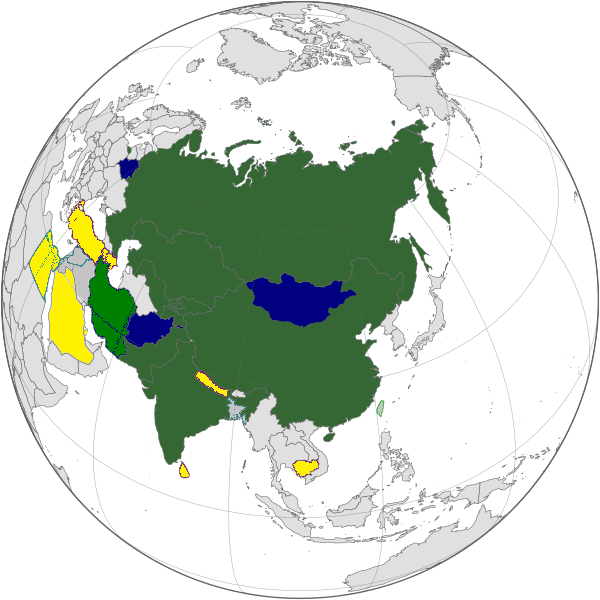


Founding and expansion
The grouping grew out of the so‑called "Shanghai Five" process and was formally established by the leaders of several states in 2001. The original signatories included China, Russia, Kazakhstan, Kyrgyzstan, Tajikistan and Uzbekistan. Since its creation the SCO has expanded its reach by admitting new full members and by developing categories of observers and dialogue partners, reflecting wider regional interest in cooperation on security and economic projects.
Membership and partners
Membership is composed of full members, observer states and dialogue partners. Full membership is intended for states in the region that agree to the organisation's basic aims and rules; observer and partner statuses allow for varying levels of participation in meetings and working groups. Several countries participate in SCO activities without being full members, and the forum routinely invites external partners to summits and working meetings.
Structure and key bodies
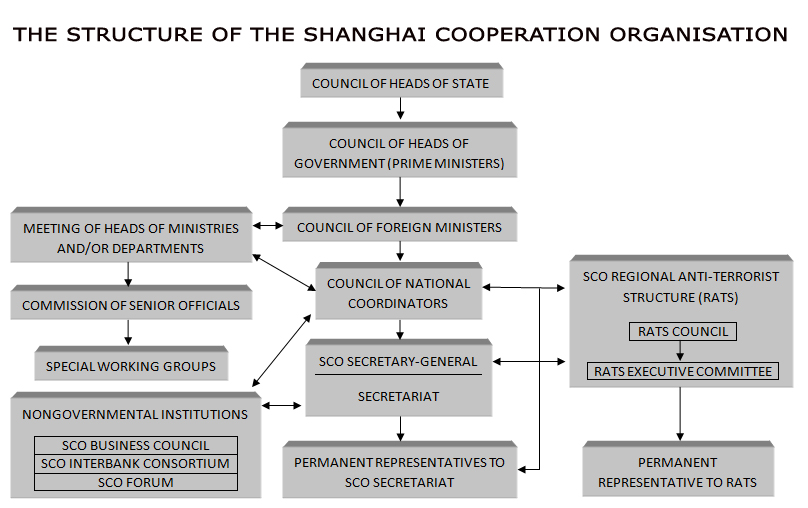
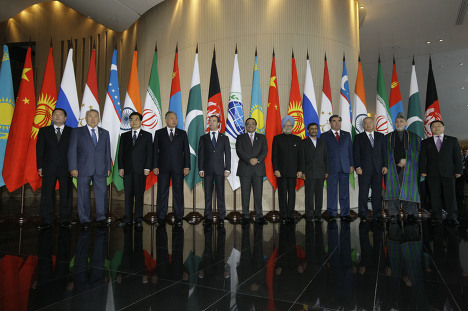
The SCO operates through a set of institutional bodies that meet regularly. The Council of Heads of State is the supreme decision‑making forum and is supported by the Council of Heads of Government. A permanent Secretariat, located in the region, coordinates activities between summits, while the Regional Anti‑Terrorist Structure (RATS) focuses on counterterrorism cooperation and intelligence exchange. Ministerial meetings and specialised working groups cover defence, law enforcement, trade, transport, energy and cultural cooperation.
Objectives and activities
Core aims include cooperation against terrorism, separatism and extremism; strengthening border and law‑enforcement cooperation; promoting trade, connectivity and energy links; and fostering cultural and educational exchanges. Practical activities include multilateral military exercises, counterterrorism training, joint statements on regional security, infrastructure discussions and forums for business and academic contacts.
Significance and challenges
The SCO is significant as a platform where major regional powers and Central Asian states can coordinate policy and signal cooperation on shared concerns. It offers an alternative multilateral space to other international institutions and has been used to advance security collaboration and pragmatic economic initiatives. At the same time, its consensus decision‑making, differing strategic priorities among members, and varying levels of economic integration limit the speed and depth of collective action. The organisation remains principally a consultative forum rather than a supranational body.
Outlook
The SCO continues to evolve in response to changing geopolitical and economic conditions in Eurasia. Its future trajectory depends on how members reconcile divergent priorities, whether they deepen operational cooperation on security and infrastructure projects, and how the organisation balances enlargement with effective coordination. As regional interdependence grows, the SCO is likely to remain an important, if sometimes cautious, actor in Eurasian diplomacy and security arrangements.
Notable facts
The SCO holds annual summits and issues joint declarations; maintains specialised agencies and working groups; and regularly organises joint exercises and technical cooperation. It is best understood as a practical forum for states to manage common threats and opportunities across a broad and diverse region.
Related articles
Author
AlegsaOnline.com Shanghai Cooperation Organisation (SCO) Leandro Alegsa
URL: https://en.alegsaonline.com/art/89452