
Seventeen Provinces: a political entity of the late medieval Low Countries
Historic personal union of duchies, counties and lordships in the Low Countries (15th–16th centuries) that shaped modern Netherlands, Belgium and Luxembourg and sparked the Dutch Revolt.
The Seventeen Provinces was the name given to a large cluster of duchies, counties and lordships in northwestern Europe during the 15th and 16th centuries. They formed a single political framework under a shared ruler rather than a centralized state: a form of personal union within the region commonly called the Low Countries. In contemporary terms these lands corresponded largely to the modern Netherlands, Belgium and Luxembourg, together with border areas in what is now northern France and western Germany.
Geographically the provinces combined coastal territories, river valleys and inland hinterlands. They included important medieval ports and commercial towns that linked the North Sea with the Rhine and inland trade routes. Parts of the territory lay within present-day French departments such as Artois and French Flanders; historically these were integrated into the same political grouping as the other provinces despite linguistic and legal differences. The Seventeen Provinces thus embraced a variety of local laws, languages and customs while operating under a single sovereign.
Politically the grouping grew from Burgundian expansion in the late Middle Ages. Many of the constituent territories were brought together under the dukes of Burgundy of the House of Valois, and later passed by inheritance to the Habsburgs. Under Habsburg rule the provinces formed a principal component of imperial organization in the region and from 1512 were a major part of the Burgundian Circle within the Holy Roman Empire.
The Seventeen Provinces became a theater of deep religious, economic and constitutional conflict in the 16th century. The spread of Protestantism, disputes over taxation and jurisdiction, and imperial policies contributed to unrest. This turmoil culminated in the Dutch Revolt and the long struggle that eventually produced a separation: the northern provinces coalesced into the Dutch Republic, while the southern territories remained under Habsburg (and later Spanish) control for some time.
Image gallery
5 Images
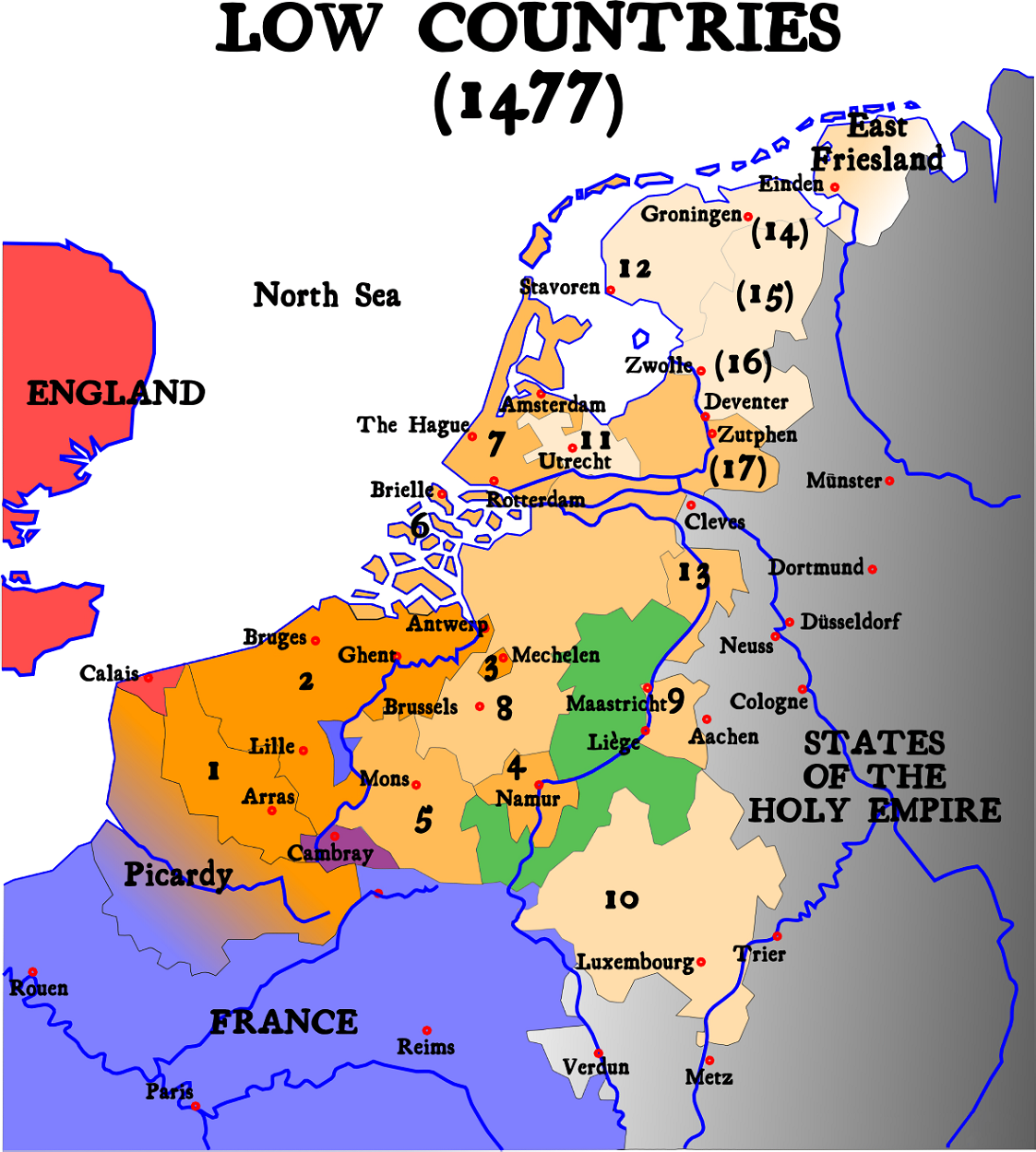



Composition and legacy
- The provinces were not a unitary state but a federation of entities with their own rights and institutions, ranging from counties and duchies to smaller lordships.
- The territory covered important parts of modern Europe, including regions now in the north of France and parts of western Germany, and specific provinces such as Artois played distinctive roles.
- Economically and culturally the region was one of Europe's most dynamic zones: cities such as Antwerp and Bruges (then influential) fostered trade, banking and artistic activity that had lasting effects.
- Historically the Seventeen Provinces are important for understanding the origin of modern national borders and the early modern conflicts that shaped northern Europe.
In later historiography the term "Seventeen Provinces" is used to describe both the political reality of the Burgundian and Habsburg eras and the process by which a fragmented set of territories developed shared institutions. Its story illustrates how dynastic inheritance, economic networks and religious change combined to transform medieval polities into the states that emerged in the early modern period.
Related articles
Author
AlegsaOnline.com Seventeen Provinces: a political entity of the late medieval Low Countries Leandro Alegsa
URL: https://en.alegsaonline.com/art/89215