
Great Seal of Oklahoma
Official emblem used to authenticate Oklahoma state documents, featuring a central territorial seal, a five-point star showing the Five Civilized Tribes, and 45 stars for the Union in 1907.
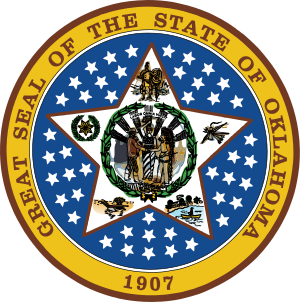
The Great Seal of Oklahoma is the state's principal emblem for authenticating official acts and documents. Its central composition—a five-pointed star within a circle—combines symbols of territorial government, the Five Civilized Tribes historically associated with the region, and the Union of states at the time Oklahoma entered the Union in 1907.
Image gallery
1 Image
Design and symbolism
The seal centers on a five-pointed star. At the very center sits the seal of the Territory of Oklahoma, which represents early territorial government and settlement. Surrounding this central disk are five smaller seals placed at the points of the star; each of these represents one of the Native nations that played a major role in the state’s history.
The five Native nations
- Chickasaw (top point): traditionally depicted with a warrior figure holding a bow and shield, symbolizing defense and the tribe's martial heritage.
- Cherokee (upper left): shown with a star framed by a wreath of oak leaves, evoking unity, sovereignty, and tribal government.
- Choctaw (upper right): represented by a tomahawk, a bow, and three crossed arrows, images tied to both hunting and historical conflict.
- Muscogee (Creek) (lower left): illustrated with agricultural implements such as a sheaf of wheat and a plow, indicating farming and settled life.
- Seminole (lower right): usually shows dwellings and a waterside scene with a hunter in a canoe, reflecting traditional homes and subsistence by waterways.
Stars and the Union
Encircling the central star are forty-five small stars. These represent the forty-five states that formed the United States when Oklahoma was admitted to the Union in 1907. The use of multiple stars to indicate statehood was a common motif in seals and flags from the nineteenth and early twentieth centuries.
History and official use
The composition of the Great Seal grew out of the need to produce a singular, recognizable emblem at and after statehood. The territorial seal that occupies the center predates statehood and relates to the administrative identity of the Oklahoma Territory; more on that historic emblem can be found via the territorial seal reference at Seal of the Territory of Oklahoma. Since adoption, the seal has appeared on proclamations, legal commissions, official records, and as part of the governor’s and other agencies’ insignia.
Variations and notable facts
Artistic renderings of the Great Seal vary in minor details—line thickness, color treatments, and the exact appearance of the small tribal seals—but the overall arrangement (territorial center, five-point star with tribal seals, and the ring of forty-five stars) remains consistent. The seal serves both a ceremonial role and a practical legal function: impressions or reproductions of the seal are used to certify state documents and to signify the authority of state officers.
As with many state emblems, the Great Seal of Oklahoma honors local history while serving as a formal symbol of government authority. Its inclusion of Indigenous nations’ seals acknowledges the distinctive and foundational role those nations have in the region’s story.
Related articles
Author
AlegsaOnline.com Great Seal of Oklahoma Leandro Alegsa
URL: https://en.alegsaonline.com/art/88313
Sources
- statesymbolsusa.org : statesymbolsusa.org/symbol-official-item/oklahoma/state-seal/seal-oklahoma