
Oklahoma Territory (1890–1907)
Organized U.S. territory formed in 1890 covering western present-day Oklahoma; created by federal law, settled by land runs and migration, and combined with Indian Territory to form the state of Oklahoma in 1907.
Overview
Oklahoma Territory was an organized territory of the United States, established by federal legislation in the late 19th century. It comprised the western portion of what is today the state of Oklahoma. The territory was formally created on May 2 (1890) and existed until November 16 (1907), when it was combined with adjacent Indian Territory and admitted to the Union as the 46th state.
Image gallery
10 Images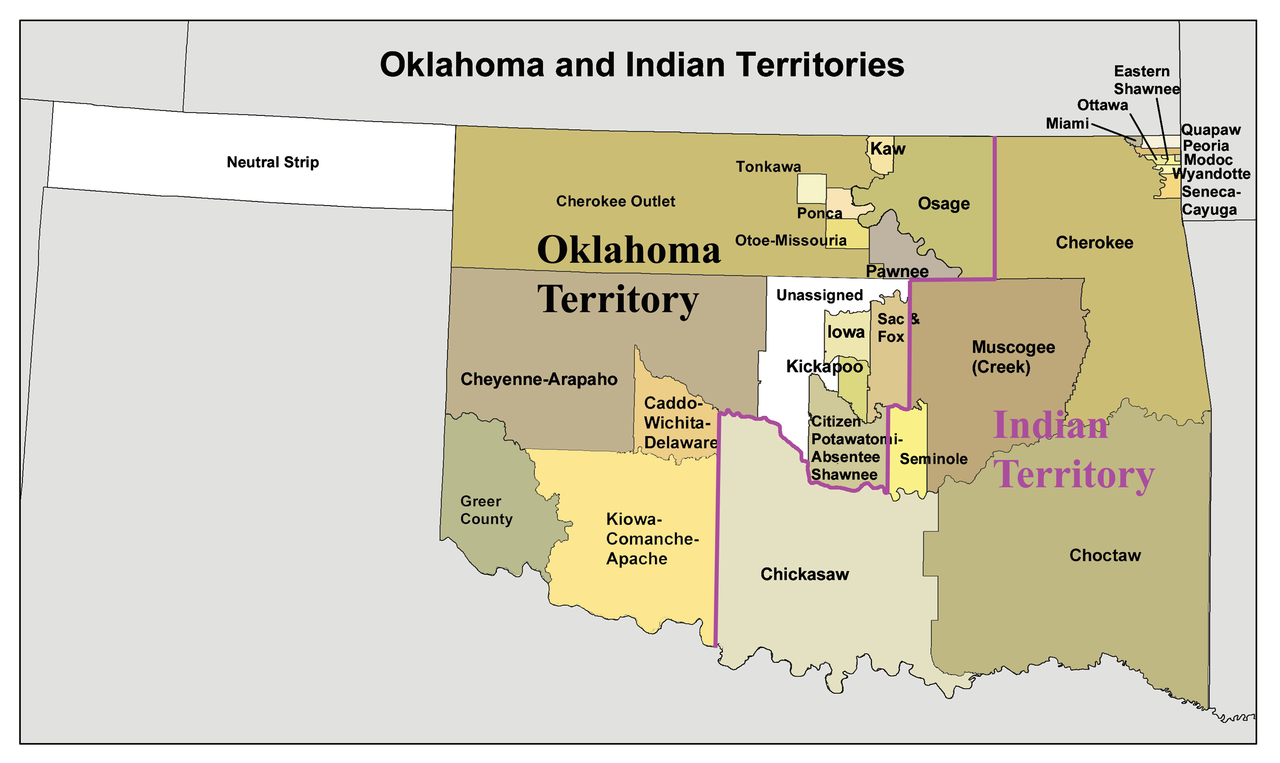


Formation and legal framework
The territory was organized under an Organic Act passed by Congress. Its creation followed decades of treaties, cessions and purchases that reshaped control of lands in the southern Great Plains. Federal policy in the period sought to open large tracts to settlement while balancing legal obligations to Native American nations long resident in the region.
Settlement patterns and land runs
Settlement was characterized by rapid migration and a series of land openings commonly known as "land runs" and lotteries. Tens of thousands of settlers, often arriving by rail or wagon, claimed plots of land, founded towns and established farms and ranches. The nickname "Sooners" became associated with those who entered land prior to official openings. Towns rose quickly along transportation routes and at railroad junctions, serving as commercial and administrative centers.
Government, capital and institutions
As an organized territory, it had a federally supervised government including a governor, territorial legislature and courts, but many local matters were handled by elected territorial officials. Guthrie served as the territorial capital and was an important political and economic hub. Territorial institutions addressed public order, land claims, infrastructure and the creation of schools and courts.
Economy, society and relations with Indian Territory
The territory's economy was based on agriculture, cattle ranching and the expansion of railroads that connected producers to markets. Populations included European-American settlers, African American freedmen and people relocating from other states. Relations with neighboring Indian Territory were complex: legal questions, jurisdictional disputes and differing federal policies affected everyday life, land tenure and political organization in the region.
Statehood and legacy
When the two territories were joined and admitted as a single state in 1907, the political map of the region was permanently altered. The territorial experience left lasting marks on settlement patterns, place names, institutions and transportation networks. For contemporary research, consult federal records, territorial archives and state histories for primary documents and further interpretation (federal records, statehood studies, admission documents).
- Key dates: May 2 (1890) and November 16 (1907).
- Related jurisdictions and resources: Indian Territory, later the state of Oklahoma, and national archives (federal, state).
- Further reading and collections are available through historical societies and regional libraries (founding dates, contemporary accounts).
Related articles
Author
AlegsaOnline.com Oklahoma Territory (1890–1907) Leandro Alegsa
URL: https://en.alegsaonline.com/art/72228