
Sentinel (Spitfire sculpture, Birmingham)
Sentinel is a 16 m public sculpture by Tim Tolkien on Spitfire Island, Birmingham. It depicts three half‑scale Spitfires with vapor‑trail supports and commemorates the Castle Bromwich wartime factory.
Overview
Sentinel is a large outdoor sculpture by British artist Tim Tolkien located on Spitfire Island, a busy roundabout at the entrance to the Castle Vale estate in Birmingham. Rising to about 16 metres, the work portrays three Spitfire aircraft peeling away from each other in ascent. It functions as both a public artwork and a local memorial to the region's aircraft‑building heritage. For more images and basic site information see artist or project listing.
Image gallery
2 Images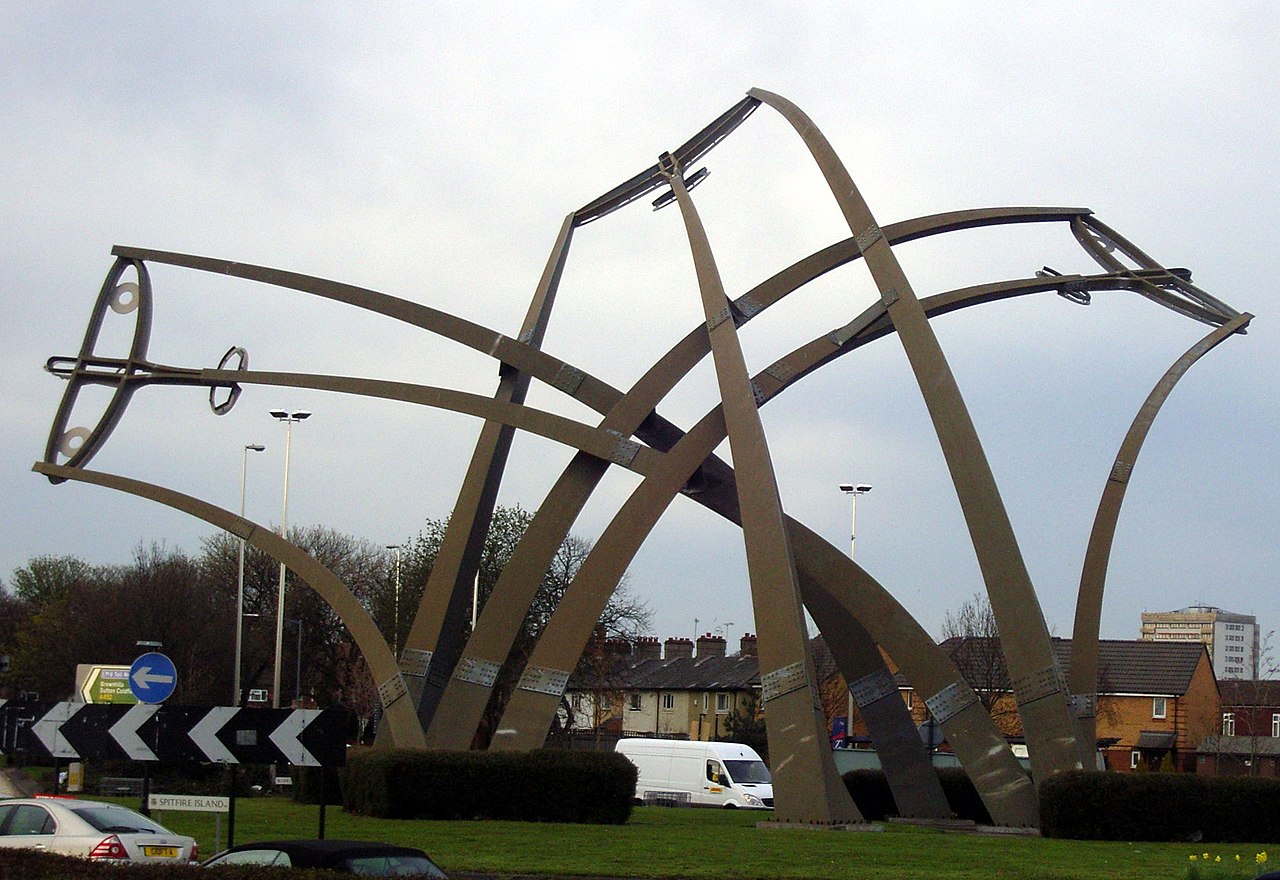

Design and materials
The composition shows three half‑scale Spitfire fuselages mounted on sweeping curving beams that evoke vapour trails. The aircraft forms are fashioned from aluminium panels to suggest the original aircraft skin, while the supporting structures are formed from weathering or painted steel to give the impression of movement and lift. The arrangement of the three aircraft at slightly different angles creates a dynamic, three‑dimensional skyline feature visible to drivers and pedestrians. Technical descriptions and construction notes are available from project summaries and archival pages: project details.
Location and context
Sentinel sits at the junction of the Chester Road and the A47 Fort Parkway, near Junction 5 of the M6 motorway and adjacent to the Jaguar car plant that occupies part of the former Castle Bromwich Aircraft Factory site. The sculpture is positioned to act as a gateway marker for Castle Vale and to acknowledge the area's role in aircraft production during the Second World War. Visitor and transport information may be found via local council or visitor guides: local authority page.
Historical significance
The work commemorates the Castle Bromwich factory where large numbers of Supermarine Spitfire fighters were produced during the war. While Sentinel is a contemporary public artwork rather than a literal monument, its imagery deliberately references the Spitfire's importance to British wartime aviation and the local industrial contribution. For background on the aircraft and factory history, consult heritage resources and museum pages: heritage information.
Public role, reception and maintenance
As a prominent roadside sculpture, Sentinel functions as an emblem of local identity and a frequent subject for photography. It marks a transit hub and is intended to be seen at speed as well as up close. Public responses have noted its evocative sense of motion and its role in connecting contemporary community life with industrial memory. Information on conservation, any restoration efforts, and local events referencing the sculpture can be sought from municipal arts programmes and news archives: news and updates.
Key features and visiting notes
- Three half‑scale Spitfire forms mounted on curving steel supports.
- Materials: aluminium for aircraft shells, steel for structural trails.
- Located on Spitfire Island, visible from major roads and motorway approaches.
- Acts as a commemorative gateway to Castle Vale and a reminder of the Castle Bromwich factory legacy.
Further reading, image galleries and artist statements are available from cultural directories and local heritage organisations: gallery or archive, artist profile and interviews.
Questions and answers
Q: Who created the Sentinel sculpture?
A: The Sentinel sculpture was created by Tim Tolkien.
Q: Where is the Sentinel sculpture located?
A: The Sentinel sculpture is located on Spitfire Island, a roundabout at the intersection of the Chester Road and the A47 Fort Parkway at the entrance to the Castle Vale estate in Birmingham.
Q: What is the height of the Sentinel sculpture?
A: The Sentinel sculpture is 16m high.
Q: What is the significance of the Spitfires in the Sentinel sculpture?
A: The Sentinel sculpture shows three Spitfires peeling off up into the air in different directions and commemorates the nearby Castle Bromwich factory where most of Britain's wartime Spitfires were built.
Q: What materials were used to create the Spitfires in the Sentinel sculpture?
A: The half-scale Spitfires in the Sentinel sculpture are made of aluminium.
Q: What is the purpose of the curving steel supporting beams in the Sentinel sculpture?
A: The curving steel supporting beams in the Sentinel sculpture act as vapour trails for the Spitfires.
Q: What landmarks are near the Sentinel sculpture?
A: The Sentinel sculpture is near Junction 5 of the M6 motorway and the Jaguar car factory, both of which are located near the former Castle Bromwich aircraft factory.
Related articles
Author
AlegsaOnline.com Sentinel (Spitfire sculpture, Birmingham) Leandro Alegsa
URL: https://en.alegsaonline.com/art/88878
Sources
- news.bbc.co.uk : "Spitfire remembered on Anniversary"