
Adams County, Illinois — overview, geography, history and local life
Adams County is the westernmost county of Illinois, anchored by the city of Quincy. Founded in 1825 and named for John Quincy Adams, it has a river-influenced economy and a mix of small cities and rural townships.
Overview
Adams County sits on the far western edge of Illinois, where the landscape meets the Mississippi River and the region forms part of the state’s riverfront corridor. The county’s largest city and administrative center is Quincy, long a regional hub for commerce, healthcare and cultural institutions. According to the 2010 census, the county had a population of about 67,103; contemporary totals can differ with later counts and estimates.
Image gallery
5 Images



Geography and communities
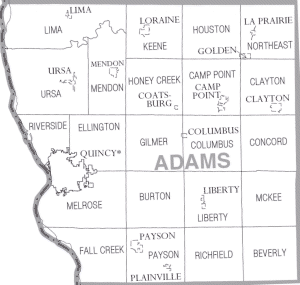
Adams County combines a small urban core with extensive agricultural lands and a network of rural townships. Its riverside location has influenced settlement patterns, transportation links and the local economy. In addition to Quincy, the county contains several smaller towns and unincorporated communities that provide local services and farming support.
History
The county was established in 1825 and was named in honor of John Quincy Adams, the sixth President of the United States. The choice of name reflects a common early-19th-century practice of honoring national leaders when new counties and towns were organized. The area’s growth was shaped by river trade, westward migration and the development of agriculture on rich Midwestern soils.
Economy, culture and significance
Adams County’s economy rests on several pillars: row-crop agriculture in surrounding townships, river and rail access for freight and regional distribution, and a service and cultural base centered in Quincy. Historic downtown neighborhoods, local museums and annual community events contribute to the county’s cultural identity. Healthcare, education and light manufacturing also provide employment and services for the county and nearby counties in the Illinois–Missouri border region.
Government, transport and community life
The county government is based in the county seat, where county offices, courts and civic institutions are located. Transportation corridors that link local producers to broader markets include river facilities, regional highways and rail lines; these have long been important to the county’s role as a regional supply and service center. Local schools, parks and civic organizations play a central part in community life.
Notable facts and resources
- Founded in 1825, Adams County commemorates early national leadership through its name and institutions; see references to the sixth President for historical context.
- The county’s location along the Mississippi has influenced its economy and settlement patterns; it is a key part of western state geography and cross-river connections.
- For official information, community services and local planning documents consult county and municipal resources linked from regional portals and the county’s public websites.
Further reading and external links are maintained by local historical societies and government pages; for general demographic data consult federal census releases and state summaries available through official channels.
Tags
Related articles
Author
AlegsaOnline.com Adams County, Illinois — overview, geography, history and local life Leandro Alegsa
URL: https://en.alegsaonline.com/art/877
Sources
- quickfacts.census.gov : "State & County QuickFacts"
- naco.org : "Find a County" · web.archive.org