
John Quincy Adams
Sixth U.S. president, diplomat, and prominent anti‑slavery congressman; son of John Adams and a major figure in early American diplomacy and politics.
John Quincy Adams (1767–1848) was an American statesman who served as the sixth President of the United States and whose long public career included roles as diplomat, secretary of state, and congressman. He is remembered for shaping early U.S. foreign policy, for his persistence in opposing slavery later in life, and for several notable firsts: he was the first president who was the son of a president and the first to be photographed rather than portrayed in a painted portrait. For a concise overview of his presidency see the sixth president.
Image gallery
10 Images


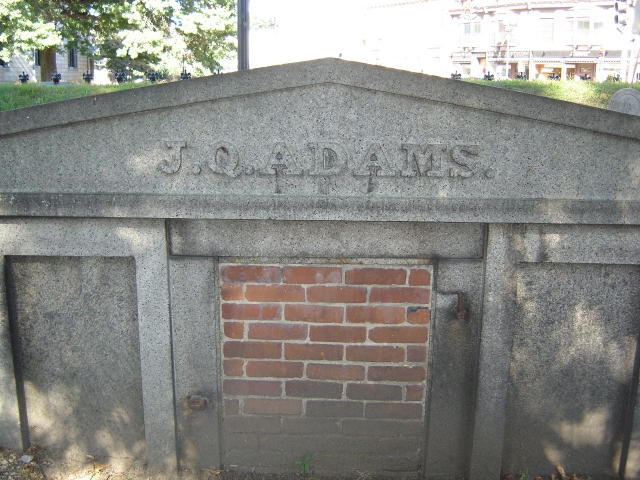


Early life and diplomatic apprenticeship
Born into a politically prominent New England family, Adams received a classical education and spent much of his youth abroad while his father served in diplomatic posts. He entered public service at a young age and aligned with the Federalist tradition in his early career, reflecting the political currents of the 1790s and early 1800s; more on his party affiliation is available at Federalist references. His first important foreign appointment came in 1794, when he became minister to the Netherlands; his diplomatic training continued through missions in Prussia, Russia, and Great Britain, and is further documented in material about his posts, including the Dutch assignment at the Netherlands.
Secretary of State and presidency
Adams served as Secretary of State under President James Monroe, where he played a central role in formulating the Monroe Doctrine and negotiating treaties that defined U.S. boundaries and influence. His tenure at the State Department is often considered the high point of his diplomatic career; sources on the office discuss his contributions in more detail at Secretary of State. In 1824 he was elected president in a contested election and served one term. As president he promoted internal improvements, scientific advancement, and a cautious approach to expansion and patronage, positions that made him politically isolated in some quarters.
Later career and fight against slavery
After leaving the White House, Adams returned to public life as a member of the House of Representatives, where he became a vocal opponent of slavery and an advocate for constitutional principles. He argued before the Supreme Court in the Amistad case, a high-profile 1839 legal battle over captured Africans seeking freedom; his involvement is frequently cited in summaries of the Amistad case. In Congress he waged a prolonged effort against the so-called Gag Rule, which had suppressed anti‑slavery petitions; his persistence contributed to its repeal in the 1840s and highlighted his commitment to free debate.
Legacy and notable facts
- Diplomatic architect: his work as Secretary of State shaped early American foreign policy and boundary settlements.
- Anti-slavery advocate: late-career moral and legal opposition to slavery influenced abolitionist discourse.
- Historical firsts: first presidential son to become president; first U.S. president photographed.
- Long public service: roles ranged from minister and senator to cabinet officer and representative, reflecting a multi-decade commitment to the republic.
Adams remains a complex figure: a proponent of national development and law, often at odds with the rising democratic and sectional politics of his era. For further study on his presidency, diplomatic career, and legal work consult the linked topics above and specialized biographies that place his life in the context of the early American republic. Additional reading may be found through general resources at presidential summaries, detailed party histories at Federalist accounts, diplomatic records via State Department, biographies of James Monroe, European missions such as to the Netherlands, and legal treatments of the Amistad case.
Questions and answers
Q: Who was John Quincy Adams?
A: John Quincy Adams was the sixth president of the United States.
Q: What was significant about John Quincy Adams’ presidency?
A: Adams was the first president who was a son of a president and the first president to be photographed instead of painted.
Q: What kind of politics did John Quincy Adams uphold?
A: Adams was a Federalist.
Q: What was John Quincy Adams’ position under President James Monroe?
A: Adams was Secretary of State under James Monroe.
Q: When did John Quincy Adams start his career in politics?
A: Adams began his service when he was just 27 in 1794 when he was named United States Minister to the Netherlands by President Washington.
Q: What did John Quincy Adams fight against in Congress?
A: Adams led the fight against slavery in Congress.
Q: What was John Quincy Adams’ involvement in the Amistad case?
A: In 1838, at age 71, John Quincy Adams spoke for the African slaves of the slave ship Amistad and won the case.
Related articles
Author
AlegsaOnline.com John Quincy Adams Leandro Alegsa
URL: https://en.alegsaonline.com/art/122628
Sources
- whitehouse.gov : John Quincy Adams Whitehouse biography
- theatlantic.com : "Happy Birthday, John Quincy Adams"
- worldatlas.com : "List of Multilingual Presidents"
- wikidata.orgQ11816.html : wikidata.orgq11816.html
- catalogo.bne.es : XX1572157
- catalogue.bnf.fr : cb12284310j
- data.bnf.fr : (data)
- cantic.bnc.cat : a11177378
- d-nb.info : 118643789
- isni.org : 0000 0001 2128 2017
- id.loc.gov : n79140988
- catalog.archives.gov : 10583041
- aleph.nkp.cz : jn20011211222
- nla.gov.au : 36311662
- uli.nli.org.il : 000602218